
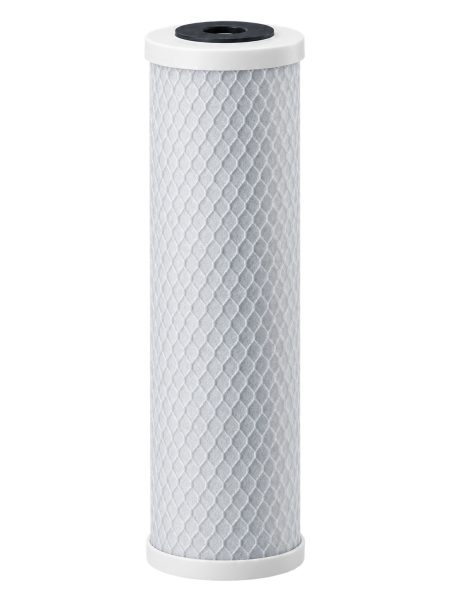
Carbon Block Cartridge 10" 0,5 Micron Coconut - Aquapro
Part number ART081751 · Filter cartridges
Net prices excl. VAT and ordering are reserved for signed-in professional accounts.
Carbon block cartridge 10" - 0,5 micron
Polishing cartridge in 10" format, made of coconut shell activated carbon compacted into a block, 0,5 micron rating. Aquapro reference PR-APC-10C-05.
Carbon block or loose carbon: not the same thing
The difference is structural and it governs performance.
In a GAC cartridge (granular carbon), the carbon sits loose inside a shell. Water flows freely through it and naturally finds the easiest path. Over time it carves preferential channels: part of the flow then crosses the bed with no real contact with the media. The granules can also settle and migrate.
In a carbon block cartridge, carbon powder is compacted and bonded into a solid block crossed by microchannels. No loose granules, no settling, no path of least resistance.
Water is forced through the material. Contact is uniform across the whole surface, from the first litre to the last.
The 0,5 micron rating
This is the block's second function, and it is absent from a GAC cartridge.
The compacted structure acts as a fine mechanical filter at 0,5 micron, a rating a granular bed cannot reach. The cartridge therefore captures ultra-fine particles on top of treating taste and odour.
A single body thus performs two functions: fine filtration and adsorption. That simplifies the chain and frees up a stage on a compact installation.
Coconut shell carbon
The raw material is not neutral. Carbon made from coconut shell develops a particularly dense microporous structure, a very large number of small-diameter pores.
That geometry is precisely what suits the molecules responsible for tastes and odours, and free chlorine. It is the reference carbon for drinking water polishing, ahead of coal- or wood-based carbons, whose porosity is coarser.
What the cartridge handles
The free chlorine in mains water, with everything that implies upstream of an RO membrane: chlorine attacks polyamide TFC chemically and the damage is irreversible.
The tastes and odours, chlorine, earth, must, that make water unpleasant to drink despite being perfectly safe.
Fine particles down to 0,5 µm, by mechanical filtration.
Where to use it
As carbon prefiltration ahead of an RO membrane. As final polishing on a drinking water point. Protecting coffee and ice machines, where chlorine taste carries straight into the finished product. And as general filtration on mains water, when both taste and mechanical fineness are wanted.
On sediment-loaded water, fit a 5 or 10 µm prefilter upstream: at 0,5 µm the block blinds quickly if it absorbs the whole particulate load on its own.
Replacement
Every 6 to 12 months depending on usage and water quality.
Activated carbon saturates: its adsorption surface fills up, and once full it captures nothing. A badly overdue cartridge can even release part of what it had captured.
On a carbon block, mechanical blinding often occurs before chemical saturation: a drop in flow is therefore a replacement signal just as much as a returning taste.
Fitting
Shut off the water and depressurise before opening the housing. Follow the flow direction.
After repressurising, flush for several minutes before use: any new carbon releases black fines at start-up. This is normal and harmless, provided it is flushed out.
Filter cartridges
- Cartouche Charbon Bloc 20'' - 0.5 Micron Charbon Noix de Coco Aquapro, ref. PR-APC-20C-05 ref. ART081752
- Cartouche Charbon Bloc 20'' - 1 Micron Charbon Noix de Coco Aquapro, ref. PR-APC-20C-1 ref. ART081753
- Cartouche Charbon Bloc 20'' - 5 Microns Charbon Noix de Coco Aquapro, ref. PR-APC-20C-5 ref. ART081754
- Ecosoft wound cartridge 2.5" x 10" 20 microns Ecosoft, ref. ECO-CPN251020ECO ref. ART081864
- Cartouche Charbon Bloc 10'' Anti-bacterie Agreee Nsf - 5 Microns Aquapro, ref. PR-APC-10CN-5 ref. ART081123
- Ensemble de Filtres de Remplacement 4-5 D'ecosoft Ecosoft, ref. ECO-CSVRO50ECOST ref. ART087712
- Ecosoft Carbon Post-Filter CHV2010ECO - RO Systems ref. ART087713
- Filtre de Mineralisation Ecosoft pour Osmoseurs Ecosoft, ref. ECO-PD2010ECO ref. ART087714
- Granular Activated Carbon Cartridge 10" Ecosoft CHV2510 ref. ART087718
- Cartouche Filtration Charbon Actif Granulaire Big Blue 10'' Ecosoft, ref. ECO-CHV4510ECO ref. ART087719
- Cartouche Filtration Charbon Actif Granulaire Big Blue 20'' Ecosoft, ref. ECO-CHV4520ECO ref. ART087720
- Ecosoft coconut shell activated carbon block cartridge 10", ref. ECO-CHVCB2510ECO ref. ART087721
- Cartouche Filtration Charbon Actif Bloc Big Blue 10'' Ecosoft, ref. ECO-CHVCB4510ECO ref. ART087722
- Cartouche Filtration Charbon Actif Bloc Big Blue 20'' Ecosoft, ref. ECO-CHVCB4520ECO ref. ART087723
- Cartouche pour la Reduction du Tartre Ecosoft, ref. ECO-CMV2510ECO ref. ART087724
- Filter cartridge Ecosoft, ref. ECO-CRV2510ECO ref. ART087725
- Filter cartridge Ecosoft, ref. ECO-CRVF4520ECO ref. ART087727
- Filter cartridge Ecosoft, ref. ECO-CRVS4520ECO ref. ART087729
- Cartouche Bobinee 10'' Sediments et Divers 1 Micron Ecosoft, ref. ECO-CPN25101ECO ref. ART087730
- Cartouche Ecosoft, ref. ECO-CPN25105ECO ref. ART087731
- Cartouche Bobinee 10'' Sediments et Divers 10 Microns Ecosoft, ref. ECO-CPN251010ECO ref. ART087732
- Cartouche Sédiments en Polypropylène Dimm, ref. Filtre ref. ART087733
- Ecosoft melt-blown cartridge 2.5" x 10" 1 micron, ref. ECO-CPV25101ECO ref. ART087735
- Ecosoft PP melt blown filter cartridge 10" 5 microns - ref. ECO-CPV25105ECO ref. ART087736
- Ecosoft melt-blown cartridge 2.5" x 10" 10 microns, ref. ECO-CPV251010ECO ref. ART087737
- Ecosoft PP melt blown filter cartridge 10" 20 microns - ref. ECO-CPV251020ECO ref. ART087738
- Cartouche Spun Pp 20'' X 4 1/2'' pour Sédiments - 5 Microns Ecosoft, ref. ECO-CPV25205 ref. ART087739
- Cartouche Spun Pp 30'' pour Sédiments - 5 Microns Ecosoft, ref. ECO-CPV253 ref. ART087740
- Cartouche Spun Pp 40'' X 4 1/2'' pour Sédiments - 5 Microns Ecosoft, ref. ECO-CPV25405 ref. ART087741
- Filter cartridge Ecosoft, ref. ECO-CPV45105ECO ref. ART087742