

Two designs for the same job
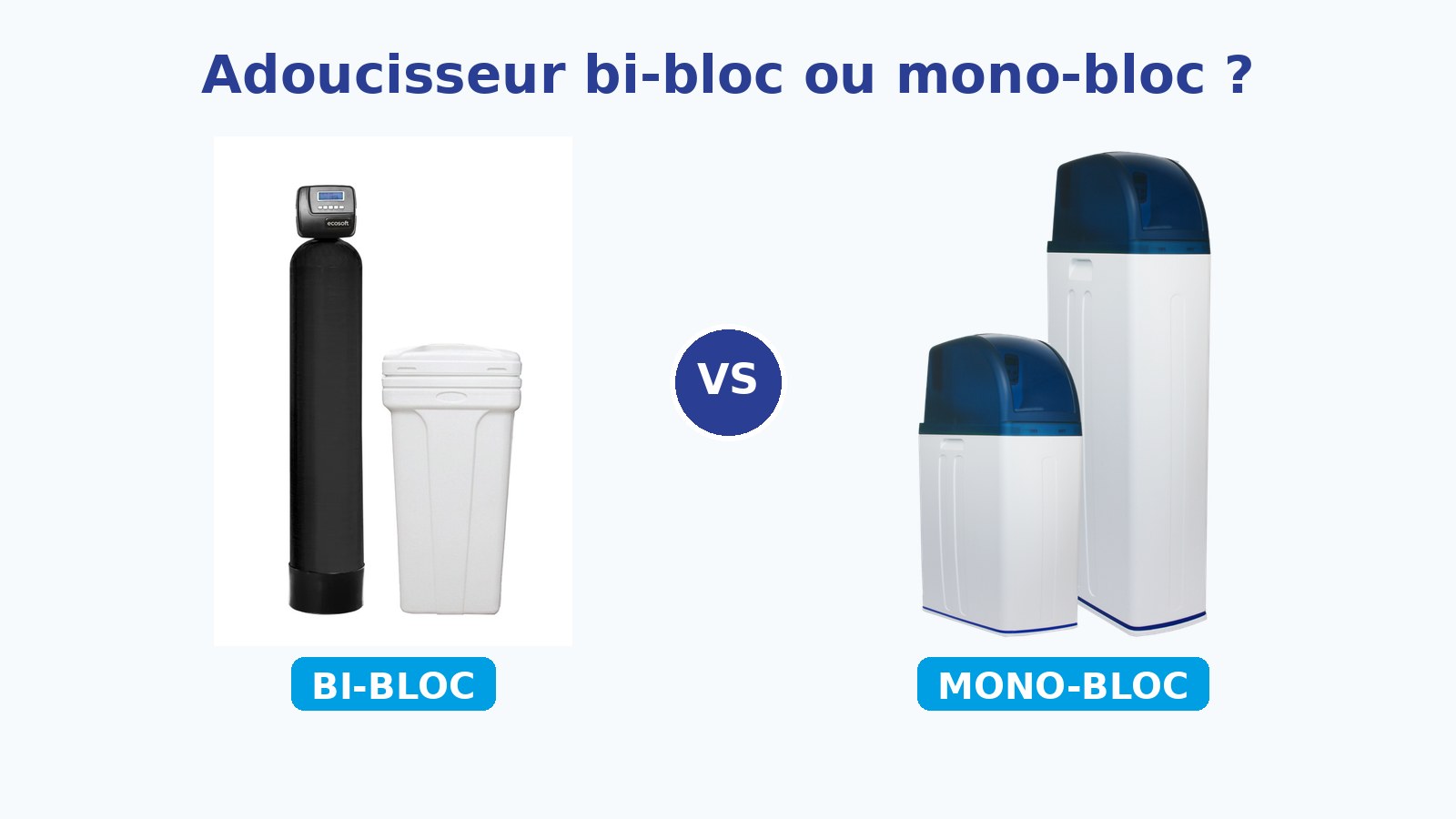
Twin-tank or all-in-one, a water softener does the same thing: it swaps calcium and magnesium ions (limescale) for sodium using a resin regenerated with salt. The difference is purely physical: how the resin bottle and the brine tank are arranged. That design choice drives footprint, installation, maintenance and cost · all selling points you can put forward to your customers.
All-in-one (cabinet): compact, everything in one unit
On an all-in-one (also called “cabinet” or “compact”) softener, the resin bottle sits inside the brine tank. The whole thing is a single cabinet with the valve on top.
- Minimal footprint: a single unit, ideal for flats, utility cupboards or small plant rooms.
- Fast installation: one position, one connection.
- Clean design: closed cover, tidy for visible spaces.
- Limit: the salt reserve shares the tank volume with the bottle · slightly lower salt autonomy, and the resin sits within the brine tank.
Twin-tank: two separate elements
On a twin-tank softener, the resin bottle and the brine tank are two distinct parts linked by a hose. It is the traditional design of commercial and industrial settings, now also offered for residential use.
- High salt autonomy: the independent brine tank can be generously sized · fewer refills.
- Layout flexibility: both parts are positioned separately, fitting where an all-in-one would not.
- Higher capacities: suited to large volumes, very hard water and intensive use.
- TWIN (duplex) version: two alternating bottles for continuously softened water, 24/7, with no interruption during regeneration.
- Limit: bulkier, two elements to connect.
At-a-glance comparison
| Criterion | All-in-one | Twin-tank |
|---|---|---|
| Footprint | Very compact (1 unit) | Bulkier (2 elements) |
| Layout flexibility | Low (fixed block) | High (separate elements) |
| Salt autonomy | Medium | High (dedicated tank) |
| Capacities / flow | Residential to commercial | Residential to industrial |
| Continuously softened water | No (simplex) | Yes in TWIN version |
| Aesthetics | Tidy (cover) | More technical |
| Installation | Fastest | 2 connections |
| Indicative budget | Generally more affordable | Varies by volume / TWIN |
Simple rule · Tight space and looks first → all-in-one. Large volumes, very hard water, salt autonomy or continuous soft water → twin-tank (TWIN for zero interruption).
How to guide your customer
The right choice depends on three parameters: incoming water hardness, consumption (number of people / draw-off points) and space constraints. In every case, sizing matters more than design: a well-sized unit regenerates less often, uses less salt and lasts longer. Our detailed method: How to size a professional water softener.
The DIMM softener range
Compact all-in-one: Core, Triton, Austin, Ideal, ARCA, AURORA, Titanium, ORUS 2.
Twin-tank & TWIN: Twin-tank softener (separate bottle and tank, wide choice of valves, TWIN version for continuously softened water).
All our designs accept a wide range of volumetric valves; for control-head details, see Clack CE vs CI valve.
Why work with DIMM
- Expertise since 1991 · Belgian water-treatment specialist, in Belgium and France.
- Stock and spare parts · valves, resin, tanks, hoses, accessories.
- Technical support · sizing, design choice, installation, after-sales.
For any sizing or information, contact the DIMM team.