


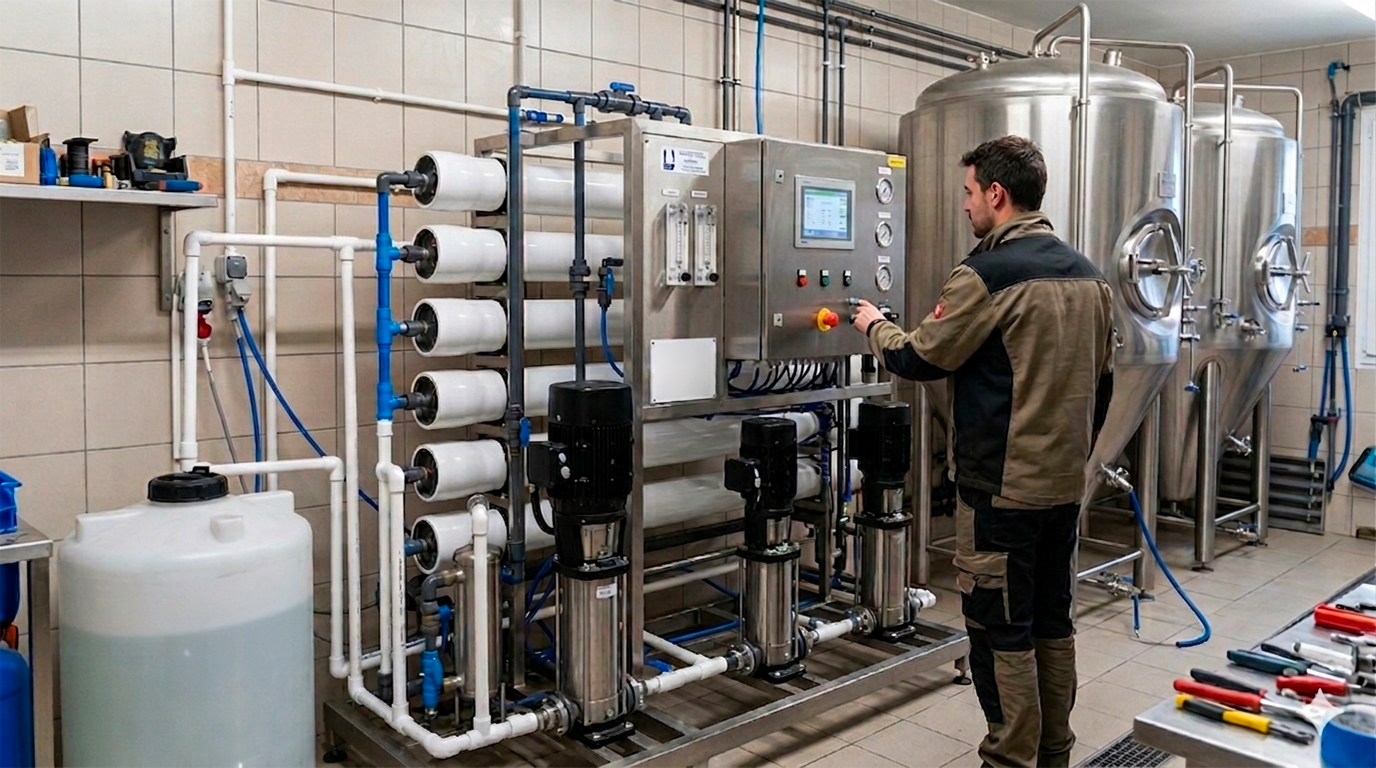
A client calls in a panic: "My softener is using salt every week and the water goes hard at the weekend." Diagnosis after inspection: a 25-litre vessel for a 60-room hotel in a 38 °F zone. The softener, installed by a colleague three months earlier, is literally three times too small.
The reverse scenario is equally common. A nursing home is offered a 150-litre resin vessel for a real consumption that would justify 60 — result: the resin only regenerates every 12 days, bacteria colonise the resin bed between cycles, and the client ends up with softened but microbiologically questionable water.
Sizing a professional water softener is not a matter of intuition or catalogue browsing. It involves five precise calculations in a fixed sequence. This article details the method used by design offices and the DIMM technical team — with formulas, reference values and four worked examples (hotel, nursing home, restaurant, residential) that you can replicate immediately on your next projects.
1. Why sizing is the #1 field error
In over 60% of professional installations audited, sizing shows a deviation of more than 25% from the optimum. The reason is almost always the same: starting from the number of people or rooms, reading a line in a supplier catalogue, and ordering. This method ignores three fundamental variables: actual inlet hardness, peak flow rate, and desired regeneration frequency.
| Sizing | Field symptoms | Typical annual cost | Risk |
|---|---|---|---|
| Undersized | Hard water at weekends, salt every 2-3 weeks, capacity loss | €3,000 to €7,000 | Scale in pipework, client complaints, DHW failure |
| Correctly sized | Regeneration every 2-7 days, monthly salt, stable hardness | €0 | None |
| Oversized | Regeneration > 10 days, stagnant resin, excess water use | €2,000 to €5,000 | Microbial contamination, pressure drop, salt/water waste |
⚠️ Why a softener must NEVER go more than 10 days without regenerating
The cation resin stays permanently moist. At 20-25 °C in the resin vessel and without a brine cycle, heterotrophic bacteria (Pseudomonas, Aeromonas, sometimes Legionella) can colonise the bed in 7 to 14 days. Regular brine passage (12-26% NaCl) during regeneration has a partial biocidal effect — this is one reason we target regeneration every 2 to 7 days in continuous use.
2. Step 1 — Calculate water consumption (daily + peak)
Everything starts here. Total water consumption determines the volume to be softened between regenerations, and peak hourly consumption determines the flow rate the valve and vessel must handle without interruption.
Sector reference ratios
These ratios are used in design offices (sources: French Water Information Centre, ADEME, FEHAP, DIMM field data 2024-2026):
| Sector | Average consumption | Peak coefficient | Softened share |
|---|---|---|---|
| Residential — detached house | 120-180 L/person/day | ×2 over 1h morning (showers) | 100% (except drinking if client prefers) |
| Residential — apartment block | 130-200 L/person/day | ×2.5 over 2h morning | 100% POE (point of entry) |
| 3-4★ Hotel | 220-350 L/room/day | ×3 over 2h morning | 100% (except kitchen on request) |
| Nursing home / hospital | 250-450 L/resident/day | ×2.5 over 2h morning | 100% (DHW production + laundry) |
| Restaurant | 5-15 L/cover | ×4 over lunch service | 50-80% (drinking water excluded) |
| Offices | 20-50 L/workstation/day | ×2 over lunch break | 50-100% depending on use |
| Campsite | 120-200 L/person/day | ×3 over 1h evening | 100% sanitary blocks |
| Industrial / laundry | variable — process metering | process-dependent | process-dependent |
📏 Formula — Daily softened water consumption
Daily consumption (m³/d) = No. of units × Ratio (L/unit/day) × Softened share (%) ÷ 1000
Example: Hotel 80 rooms × 280 L × 100% = 22.4 m³/d of softened water
Peak flow: typically 3-5 m³/h for residential, 5-15 m³/h for commercial, 15-60 m³/h for industrial. Peak flow is used in step 5 to validate pressure drop.
Common mistake
Many installers start from the client's water meter. This is a good basis, but beware: the meter includes garden irrigation, pool filling, and flush water — none of which need softening. Always subtract these to obtain the actual consumption requiring softening.
3. Step 2 — Measure inlet hardness and set the target hardness
Measure inlet hardness (TH)
The Titre Hydrotimétrique (TH), expressed in French degrees (°f) in France and Belgium, indicates the concentration of calcium (Ca²⁺) and magnesium (Mg²⁺) ions. Three measurement methods:
- Test strip (€5): indicative, sufficient for initial assessment
- EDTA drop kit (€25): ± 1 °f accuracy, recommended method
- Water utility report: official annual value, watch for seasonal variations (up to ±5 °f between borehole and mains)
In intensive commercial settings (hotel, nursing home, laundry), always measure on site: utility analyses may differ from reality at the softener injection point, especially if the building has a private borehole or mixed supply.
Set the target hardness (residual TH)
| Residual TH target | Recommended use | Reason |
|---|---|---|
| 0-2 °f | Laundry, dry cleaning, steam boiler | Process requiring zero scale |
| 3-5 °f | Hotel, nursing home, restaurant, collective residential | Comfort / non-corrosivity balance |
| 6-10 °f | Offices, shops, individual housing | Comfort + residual minerals |
| Absolute 0 °f | NEVER for sanitary water | Corrosion risk + mineral imbalance |

4. Step 3 — Calculate the required exchange capacity
This is the core calculation. Exchange capacity expresses the amount of hardness a softener can remove between two regenerations. It is expressed in French degrees × cubic metres (°f·m³).
📏 Exchange capacity formula — the core formula
Capacity (°f·m³) = Consumption between 2 regen. (m³) × (Inlet TH − Target residual TH) in °f
Example: Hotel 80 rooms, daily consumption 22.4 m³/d, inlet hardness 38 °f, target 5 °f, regeneration every 3 days:
22.4 × 3 × (38 − 5) = 67.2 × 33 = 2,218 °f·m³
Convert to resin volume
Standard strong acid cation resin (e.g. Purolite C100E) has a typical useful capacity of 5-7 °f·m³ per litre of resin, depending on salt dosing at regeneration.
| Salt dose | Resin capacity | Resin efficiency | Recommended use |
|---|---|---|---|
| 80 g/L (economy) | 4.5-5 °f·m³/L | Excellent (4 g salt/°f removed) | Commercial with moderately hard water (< 30 °f) |
| 120 g/L (standard) | 5.5-6 °f·m³/L | Good (5 g/°f) | General commercial use |
| 160 g/L (high) | 6.5-7 °f·m³/L | Medium (6 g/°f) | Very hard water (> 35 °f), peak flows |
| 200 g/L (max) | 7.5 °f·m³/L max | Poor (7 g/°f) | Avoid — salt waste |
5. Step 4 — Choose the configuration: single, twin or parallel?
With the target resin volume, choose the installation architecture. Three configurations dominate in the commercial sector:
Single vessel
One resin vessel, night-time regeneration (2-4 am slot). Drawback: during regeneration (45-90 min), water bypasses and becomes hard again. OK for: seasonal hotels closed at night, offices, sites with daytime-only consumption.
Alternating twin
Two vessels alternating: while one regenerates, the other produces softened water. Advantage: 24/7 softened water, constant flow. Ideal for: nursing homes, hospitals, 24h hotels, laundries. Pentair offers 9100SXT and NXT2 in twin configuration.
Parallel (multiplexed)
2-4 vessels in parallel managed by a single controller: simultaneous production + sequential regeneration. Ideal for: very high industrial flows, multi-tenant sites, redundancy requirements. Pentair Supertank range with industrial valves.
6. Step 5 — Verify hydraulic parameters (flow, velocity, pressure drop)
A correct exchange capacity is not enough: the water must flow. Three hydraulic parameters to validate:
Linear velocity in the resin (BV/h)
| Application | Service velocity (BV/h) | Max peak velocity |
|---|---|---|
| Residential | 15-25 | 40 |
| Continuous commercial | 20-35 | 50 |
| Industrial | 30-40 | 60 |
Pressure drop
On a correctly sized vessel, pressure drop is 0.3-0.8 bar at nominal flow. Above 1 bar, the system is hydraulically undersized.
7. Four complete worked examples
Example A — 4★ Hotel, 80 rooms, Île-de-France (TH 38 °f)
Consumption: 80 × 280 L = 22.4 m³/d. Peak flow: 8 m³/h. Regeneration target: every 3 days.
- Required capacity: 22.4 × 3 × (38 − 5) = 2,218 °f·m³
- Resin volume (120 g/L dose): 2,218 ÷ 6 = 370 L → 400 L vessel (16" × 65")
- Architecture: alternating twin (24/7 hotel) with Pentair NXT2 valve
- Velocity: 8,000 ÷ 400 = 20 BV/h ✓
- Salt consumption: 400 × 120 = 48 kg/regen × 122 regens/year = 5.9 t/year
Example B — Nursing home, 90 residents, Flanders (TH 32 °f)
- Capacity: 31.5 × 2 × (32 − 5) = 1,701 °f·m³ per vessel
- Resin: 1,701 ÷ 5.5 = 310 L per vessel → 2 × 300 L
- Architecture: alternating twin Pentair NXT2 + downstream UV sterilisation
Example C — Restaurant, 150 covers/service, Wallonia (TH 28 °f)
- Capacity (regen 4 d): 2.1 × 4 × (28 − 5) = 193 °f·m³
- Resin: 193 ÷ 5.5 = 35 L → 50 L vessel
- Architecture: single Pentair 5800XTRi volumetric, night regeneration
Example D — Detached house, 4 persons, West Flanders (TH 32 °f)
- Capacity: 0.6 × 5 × (32 − 5) = 81 °f·m³
- Resin: 81 ÷ 5 = 16 L → 20 L standard vessel
- Architecture: compact single with Pentair 5800XTRi volumetric valve
- Salt: 20 × 100 = 2 kg/regen × 73 regens/year = 146 kg/year (≈ €80/year)
8. The 7 common sizing errors
- Starting from occupant count alone without measuring inlet hardness.
- Forgetting the peak coefficient — 80 hotel rooms means 80 showers in 90 minutes each morning.
- Choosing a "round" vessel from the catalogue rather than calculating precisely.
- Confusing nominal and useful capacity — catalogues often show the theoretical peak (200 g/L salt).
- Using time-based mode in seasonal commercial sites. Always volumetric in commercial.
- Not installing a blending bypass — impossible to adjust residual hardness.
- Skipping the hydraulic check — excellent resin volume at 80 BV/h will not soften at peak.
Conclusion: 5 minutes of calculation, 10 years of peace
Precise professional softener sizing is not rocket science: it is five simple calculations taking less than 10 minutes. The difference is installation lifespan, client satisfaction and after-sales call-back rate.
DIMM supports installers, distributors and reseller partners in pre-sizing, architecture selection (single / twin / parallel) and commissioning of Pentair softeners in France and Belgium. On request: sizing spreadsheet, sector project sheets, sizing training.
Need to validate a sizing? We'll help.
DIMM has supported water treatment professionals since 1991 in Belgium and France. Pentair softener pre-sizing, single/twin/parallel architecture, design office training — contact DIMM.