
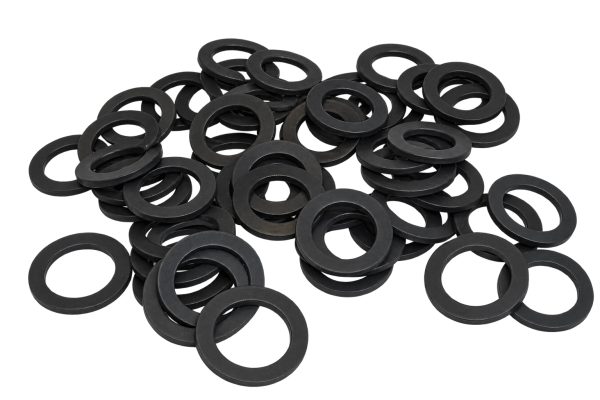
Rubber washer 3/4" for DIMFLEX hose, ref. DIMFLEX-CAOUTCHOUC-34
Part number ART040828 · Flexible hoses
Net prices excl. VAT and ordering are reserved for signed-in professional accounts.
Rubber washer 3/4"
Sealing washer in rubber in 3/4" format (20×27), designed for swivel nuts on hoses and threaded fittings. Reference DIMFLEX-CAOUTCHOUC-34.
Where the seal actually forms
This is the point many installations miss, and which explains most leaks at threaded connections.
On a 3/4" swivel nut connection, the thread is parallel. Its threads serve only to tighten the two parts against each other. They cannot seal, regardless of force applied.
The seal forms entirely on the washer, compressed between the flat bearing surface of the nut and that of the nipple opposite.
Direct consequence: no washer, no seal. And a worn washer cannot be compensated by tightening. Forcing the nut crushes the washer without improving anything, and eventually deforms the bearing surface.
Rubber or fibre: what changes
Both exist in 3/4" and are not equivalent depending on use.
The fibre washer is rigid. It compresses little, withstands high temperatures, and suits connections that are rarely dismantled.
The rubber washer is flexible. It deforms more to conform to the bearing surface, which allows it to compensate for minor surface defects: slightly marked bearing surface, limescale trace, imperfect flatness. This is what makes it the standard choice on sanitary hoses, whose nuts are handled at each intervention.
In return, it takes permanent deformation after compression. A rubber washer that has been removed does not return to its original shape.
The replacement rule
A removed washer is a washer to be replaced. This is the rule, and it has no cost-effective exception.
A rubber washer that has worked under pressure has taken the imprint of its bearing surface and lost some of its elasticity. Reinstalled, it may hold for a few days, a few weeks, then weep. And a slow leak behind a softener or under a sink is not immediately visible.
The calculation is simple: a washer costs a few cents, a return visit costs a service call. Having a box of washers in the van is the only tenable position.
Where to use it
On sanitary hoses with 3/4" swivel nut, connecting softeners, filter housings, safety groups, bypass and any treatment unit with 3/4" fittings.
More broadly, on any 20×27 flat bearing surface connection in the sanitary network.
Installation
Check that the bearing surface is clean on both sides: a grain of limescale or sand is enough to create a leak path that the washer cannot compensate for.
Verify that the new washer is intact, without nicks or protruding mould marks, and place it flat at the bottom of the nut. A washer placed at an angle or stacked on a forgotten old washer is a guaranteed leak.
Tighten by hand, then finish with a quarter turn with a wrench. No more: beyond that, you crush the washer without gaining seal, and risk marking the bearing surface.
Never twist the hose during tightening: hold the hose body while turning the nut.
Restore water slowly and check for weeping for a few minutes.
Flexible hoses
- Hose stainless ACS DIMM, ref. DIMFLEX-CAOUTCHOUC-12 ref. ART040827
- Hose stainless ACS DIMM, ref. DIMFLEX-CAOUTCHOUC-1 ref. ART040829
- Hose stainless ACS 112 mm DIMM, ref. DIMFLEX-FIBRE-112 ref. ART040825
- Hose stainless ACS 114 mm DIMM, ref. DIMFLEX-CAOUTCHOUC-114 ref. ART040830
- Hose stainless ACS 114 mm DIMM, ref. DIMFLEX-FIBRE-114 ref. ART040824
- Hose stainless ACS 112 mm DIMM, ref. DIMFLEX-CAOUTCHOUC-112 ref. ART040831
- Hose stainless ACS DIMM, ref. DIMFLEX-FIBRE-1 ref. ART040823
- Hose stainless ACS DIMM, ref. DIMFLEX-FIBRE-12 ref. ART040821
- Hose stainless ACS DIMM, ref. DIMFLEX-FIBRE-38 ref. ART040820
- Hose stainless ACS 3/4" male-female 500 mm DIMM, ref. DIMFLEX-34MF-500-INOX-ACS ref. ART078686
- Hose stainless ACS 3/4" male-female 600 mm DIMM, ref. DIMFLEX-34MF-600-INOX-ACS ref. ART078687
- Hose stainless ACS 3/4" male-female 800 mm DIMM, ref. DIMFLEX-34MF-800-INOX-ACS ref. ART078688
- Hose stainless ACS 3/4" male-female 1000 mm DIMM, ref. DIMFLEX-34MF-1000-INOX-ACS ref. ART078689
- Hose stainless ACS 1" / 3/4" male 500 mm DIMM, ref. DIMFLEX-44M-34F-500-INOX-ACS ref. ART078690
- Hose stainless ACS 1" / 3/4" male 600 mm DIMM, ref. DIMFLEX-44M-34F-600-INOX-ACS ref. ART078691
- Hose stainless ACS 1" / 3/4" male 800 mm DIMM, ref. DIMFLEX-44M-34F-800-INOX-ACS ref. ART078692
- Hose stainless ACS 1" / 3/4" male 1000 mm DIMM, ref. DIMFLEX-44M-34F-1000-INOX-ACS ref. ART078693
- Connection hose, Flexible epdm-acs dn20 3/4f - 3/4f inox acs, Dimm DIMFLEX-DN20-2516-34FF-500-INOX-ACS ref. ART078694
- Connection hose, Flexible epdm-acs dn20 3/4f - 3/4f inox acs, Dimm DIMFLEX-DN20-2516-34FF-800-INOX-ACS ref. ART078695
- Stainless Braided Hose ACS 3/4"F x 3/4"F - 1000 mm ref. ART078696
- Hose stainless ACS 3/4" female-female 1300 mm DIMM, ref. DIMFLEX-34FF-1300-INOX-ACS ref. ART078697
- Connection hose, Flexible epdm-acs dn20 3/4f - 3/4fc inox acs, Dimm DIMFLEX-DN20-2576-34F-34FC-500-INOX-ACS ref. ART078698
- Hose stainless ACS 3/4" female-female elbow 600 mm DIMM, ref. DIMFLEX-34FFC-600-INOX-ACS ref. ART078699
- EPDM ACS Flexible Hose DN20 3/4"F × 3/4"FC Inox 800 mm ref. ART078700
- EPDM ACS Flexible Hose DN20 3/4"F × 3/4"FC Inox 1000 mm ref. ART078701
- Hose stainless ACS 3/4" female-female elbow 1500 mm DIMM, ref. DIMFLEX-34FFC-1500-INOX-ACS ref. ART078702
- Hose stainless ACS 3/4" male-female elbow 500 mm DIMM, ref. DIMFLEX-34MFC-500-INOX-ACS ref. ART078703
- Hose stainless ACS 3/4" male-female elbow 600 mm DIMM, ref. DIMFLEX-34MFC-600-INOX-ACS ref. ART078704
- Hose stainless ACS 3/4" male-female elbow 800 mm DIMM, ref. DIMFLEX-34MFC-800-INOX-ACS ref. ART078705
- Hose stainless ACS 3/4" male-female elbow 1000 mm DIMM, ref. DIMFLEX-34MFC-1000-INOX-ACS ref. ART078706