
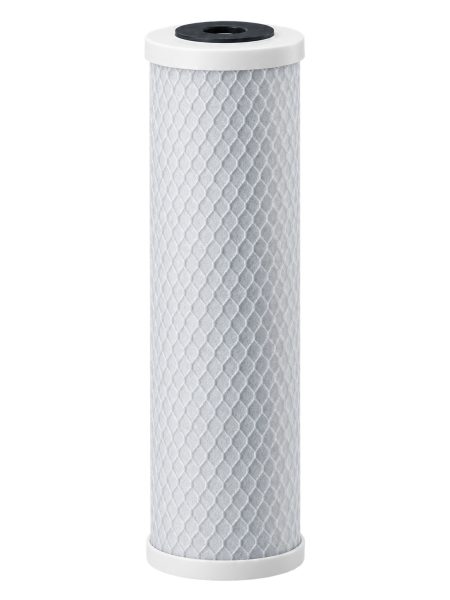
Pentek CBC-10BB Activated Carbon Block Cartridge - 0.5 Micron - 9 3/4'', ref. PENTEK-155170-43
Part number ART070282 · Filter cartridges
Net prices excl. VAT and ordering are reserved for signed-in professional accounts.
Pentek CBC-10BB Cartridge
Activated carbon block cartridge in Big Blue 10" format, filtration rating 0.5 micron. Media: agglomerated PAC (powdered activated carbon bonded into a solid block). Manufacturer reference 155170-43.
Actual dimensions 118 × 248 mm, or 4.625" × 9.75". Service flow rate 2 gpm (7.6 L/min), pressure drop 20 psi at 2 gpm. Rated capacity over 50,000 gallons (approximately 189,000 litres) for chlorine reduction. Temperature range 4.4 to 88.2 °C.
"10BB" but 9"3/4: this is not an error
This is a common point of confusion at the counter, so let's clear it up straight away.
Big Blue 10" is a format name, not a measurement. The actual cartridge length is 9"3/4, exactly as on standard European filter housings. The "10" designates the family, not the size.
What truly distinguishes the Big Blue is the diameter: 4.625" versus 2.5" on a standard cartridge. This larger diameter provides the media volume, hence the flow rate and service life.
A Big Blue cartridge will not fit in a standard filter housing, and vice versa. Check the bowl diameter, not the length.
Activated carbon block in agglomerated PAC
The media is powdered activated carbon bonded into a solid block, traversed by microchannels.
The difference from granular carbon is structural. In a GAC cartridge, the carbon is in loose grains; water circulates between the grains and eventually creates preferential pathways: part of the flow passes through with minimal contact with the media.
In a block, water is forced to pass through the material. Contact is uniform across the entire surface, from the first to the last litre. The powder also offers a greater exchange surface than granular carbon.
The block additionally provides mechanical filtration at 0.5 micron, which a bed of grains cannot achieve.
Pressure drop: the critical factor to review before purchasing
20 psi at 2 gpm, or approximately 1.4 bar pressure drop. This is a high value, and it is intentional: it is the price of a dense 0.5 micron block.
This figure must be factored into the system design, not discovered after installation.
On a network at 4 bar, losing 1.4 bar across a single stage leaves little margin, especially if a sediment prefilter and a water softener are on the same line. On a network at 2.5 or 3 bar, this cartridge is not the right choice for whole-house treatment: the customer will notice insufficient pressure as soon as two draw points operate together.
It is therefore intended for installations where available pressure is adequate, or for point-of-use applications where the required flow rate remains moderate.
If pressure is the limiting factor, the FloPlus-20BB from the same manufacturer delivers the same 0.5 micron rating with only 4 psi pressure drop at 4 gpm, thanks to different media. This is the true selection criterion between the two references, far more than the micron rating which is identical.
What the cartridge treats
Chlorine, tastes and odours, by adsorption. The rated capacity of over 50,000 gallons places this cartridge at the top tier on this criterion.
Particles down to 0.5 micron, by mechanical filtration.
If a reverse osmosis unit is installed downstream, the role becomes critical: chlorine chemically attacks the polyamide membrane, and degradation is irreversible.
Where to use it
As whole-house treatment on a main water supply with adequate pressure, as reverse osmosis protection or treatment chain safeguard, and at point-of-use locations where taste quality is paramount.
On water laden with sediments, install a prefilter upstream, typically 20 or 25 µm then 5 µm. A 0.5 micron block that handles all particulate load alone will clog mechanically well before exhausting its adsorption capacity, and its already high pressure drop will then rise very rapidly.
Replacement
Two mechanisms limit service life, and whichever occurs first determines replacement.
Carbon saturation, signalled by the return of chlorine taste or odour.
Mechanical clogging, read from the pressure drop. On this reference, this is the criterion to monitor as a priority: starting already at 20 psi when new, the margin before flow becomes unacceptable is shorter than on a low-pressure-drop cartridge.
The 50,000 gallons stated are a laboratory value for chlorine. On real water, mechanical clogging is very often the limiting factor.
Installation
Shut off water and depressurise before opening the filter housing. Observe the flow direction.
When reassembling, lubricate the bowl O-ring with food-grade silicone grease and verify it is clean, properly seated and not twisted. This is the leading cause of leaks on a filter housing.
After water is restored, flush for several minutes before use: all new carbon releases black fines at start-up.
Filter cartridges
- Cartouche Conteneur Vide AIM-2E Entree/sortie 1/4’’ Aquapro, ref. PR-AIM-2E-E ref. ART070281
- Cartouche EP-10 Charbon Bloc - 5 Microns - 9 3/4'' Pentek, ref. PENTEK-155531-43 ref. ART070309
- Cartouche EP-10 Bb Charbon Bloc 5 Microns 9 3/4 - Big Blue Pentek, ref. PENTEK-155548-43 ref. ART070310
- Cartouche EP-30 Charbon Bloc - 5 Microns - 30'' Pentek, ref. PENTEK-155698-43 ref. ART070430
- Cartouche R30 Bb Polyester /cellulose Plisse Reutilisable Pentek, ref. PENTEK-155101-43 ref. ART070576
- Cartouche RFFE20-BB Reduction de Fer 20'' Big Blue Pentek, ref. PENTEK-155263-43 ref. ART069951
- Carbon post-filter 3/8" (tube) for PRF-RO, ref. PENTAIR-255526-09 ref. ART069936
- Cartouche 7'' Fibre Tissee Pp 50 Microns, Nsf (l: 177,8 Mm) Aquapro, ref. PR-PPS-07-50 ref. ART069674
- Cartouche 7'' Fibre Tissee Pp 5 Microns, Nsf (l: 177,8 Mm) Aquapro, ref. PR-PPS-07-5 ref. ART069383
- Cartouche 20'' Big Blue Fibre Tissee Pp 10 Microns, Nsf Aquapro, ref. PR-PPS-2045-10 ref. ART069377
- 7" PP Fibre Cartridge 25 µm NSF Aquapro PR-PPS-07-25 ref. ART069375
- Cartouche Chlorplus 10 Charbon Bloc - 1 Micron - 9 3/4'' Pentek, ref. PENTEK-255416-43 ref. ART071210
- Cartouche GS-10RO-G 1/4'' - en Ligne John Guest 2''X10'' Pentek, ref. PENTEK-255525-43 ref. ART071211
- Cartouche Floplus 10 - 0,5 Micron - Charbon Bloc Modifiee Fiberdyne Pentek, ref. PENTEK-455903-43 ref. ART071220
- Filter cartridge Aquapro, ref. PR-NL-RIC ref. ART071337
- Cartouche Nl de Remplacement, 3 Niveaux (pp/kdf/sc) Aquapro, ref. PR-NLF-RIC-KS ref. ART071338
- Cartouche pour Refrigerateur, 3 Niveaux (pp/kdf/sc) Compatible Cuno Aquapro, ref. PR-AP-RIC ref. ART071339
- Cartouche 10'' Fibre Tissee Pp 100 Microns, Nsf Aquapro, ref. PR-PPS-10-100 ref. ART069224
- Cartouche 60'' Bobinee, 25 Microns Aquapro, ref. PR-SWS-60-25 ref. ART069094
- Cartouche 60'' BOBINEE,100 Microns Aquapro, ref. PR-SWS-60-100 ref. ART069093
- Cartouche 60'' Bobinee, 5 Microns Aquapro, ref. PR-SWS-60-05 ref. ART069091
- Cartouche 50'' Bobinee, 50 Microns Aquapro, ref. PR-SWS-50-50 ref. ART069089
- Cartouche 50'' Bobinee, 25 Microns Aquapro, ref. PR-SWS-50-25 ref. ART069088
- Cartouche 50'' Bobinee, 100 Microns Aquapro, ref. PR-SWS-50-100 ref. ART069087
- Cartouche 50'' Bobinee, 10 Microns Aquapro, ref. PR-SWS-50-10 ref. ART069086
- Cartouche 50'' Bobinee, 5 Microns Aquapro, ref. PR-SWS-50-05 ref. ART069085
- Cartouche 50'' Bobinee, 1 Micron Aquapro, ref. PR-SWS-50-01 ref. ART069084
- Cartouche 40'' Bobinee, 50 Microns Aquapro, ref. PR-SWS-40-50 ref. ART069083
- Cartouche 40'' Bobinee, 100 Microns Aquapro, ref. PR-SWS-40-100 ref. ART069082
- Cartouche 30'' Bobinee, 100 Microns Aquapro, ref. PR-SWS-30-100 ref. ART069080