

The Water Encyclopedia
DIMM's water-treatment encyclopedia: hardness, limescale, nitrates, PFAS, water softeners, reverse osmosis, filtration. Glossary, PDF sheets and fundamentals for professionals.
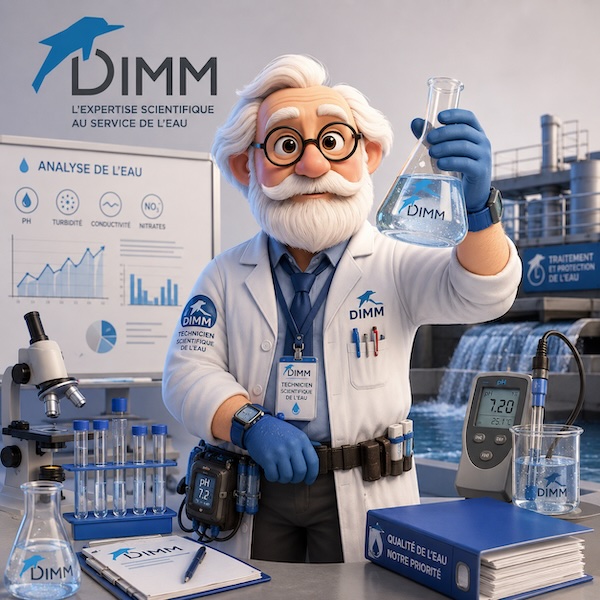
Understand water to treat it better
DIMM has put scientific expertise at the service of water since 1991. As a water-treatment wholesaler in Belgium (Poperinge) and France (Steenvoorde), DIMM supports the installers, plumbers, resellers, distributors and design offices who equip their customers with water-treatment solutions.
This encyclopedia brings together the fundamentals of water treatment: hardness and limescale, nitrates, PFAS and micropollutants, chlorine and taste, plus the main technologies — ion-exchange water softeners, reverse osmosis, ultrafiltration, activated-carbon filtration, UV sterilisation and filter media — to help you argue, size and sell the right solution.
Each one-page fact sheet can be viewed, downloaded as PDF and shared with your customers. To go further, browse our technical articles, explore water quality region by region in France and Belgium, or discover our range of softeners and reverse-osmosis units. If in doubt, the DIMM team will pre-size the solution with you.
Water fact sheets
Ten DIMM educational sheets to view, download and share with your customers.
Water glossary
- Hardness (TH)
- Calcium and magnesium content of water, in French degrees (°f). Above 30 °f the water is hard: a softener is required.
- Limescale / scale
- Calcium-carbonate deposit that scales pipes, heating elements and appliances, raises energy use and shortens their lifespan.
- Nitrates (NO₃)
- Pollutant mainly of agricultural origin. Regulatory limit of 50 mg/L. Treated by reverse osmosis.
- PFAS
- Perfluorinated compounds (“forever chemicals”), persistent and regulated. Removed by reverse osmosis and activated-carbon filtration.
- Chlorine
- Public-network disinfectant; can affect taste and odour. Removed by activated-carbon filtration.
- Reverse osmosis
- Semi-permeable membrane retaining up to 99 % of dissolved contaminants: ultra-pure water at the point of use.
- Water softener
- Device that exchanges calcium and magnesium for sodium via a resin, regenerated with salt.
- Ion-exchange resin
- Media that captures limescale; its capacity is restored at each brine regeneration.
- Regeneration
- Salt-washing cycle that restores the resin's exchange capacity (time- or volume-based).
- Mixing
- Adjustment of the residual hardness of softened water (recommended target: about 5 °f).
- Bypass
- Diversion valve that isolates the unit without cutting the water supply.
- Turbidity
- Fine suspended particles making water cloudy; corrected by filtration.
- Conductivity
- Indicator of the total mineralisation of water, in µS/cm.
- pH
- Measure of acidity or alkalinity; drinking water is generally between 6.5 and 9.
A technical question?
The DIMM team supports you on sizing, solution choice and after-sales.
Contact DIMM