
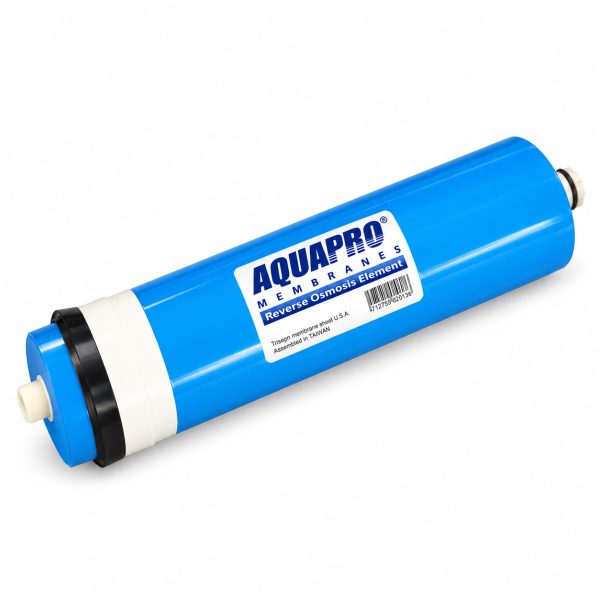
Reverse osmosis membrane 3012 700 GPD - 2650 L/day - Aquapro
Part number ART088233 · Membranes
Net prices excl. VAT and ordering are reserved for signed-in professional accounts.
Reverse osmosis membrane 3012 - 700 GPD
Membrane element in 3012 format, meaning 3 inches in diameter for 12 inches in length. Nominal production 700 GPD, approximately 2 650 litres per day.
This is a high-capacity membrane, well above standard domestic formats.
The 3012 format, and what it entails
The domestic market operates predominantly in 1812: 2 inches in diameter, 12 inches long, for 50 to 100 GPD. This is the format of under-sink reverse osmosis units with storage tank.
The 3012 changes the scale. The diameter increases to 3 inches, the membrane surface area increases accordingly, and production follows: 700 GPD versus 50 to 100, a ratio of 7 to 14.
This capacity jump opens two applications that the 1812 does not cover.
Direct flow reverse osmosis units. With 2 650 litres per day, the membrane produces fast enough to supply a tap without a storage tank. Water is produced on demand. No more under-sink tank, no more stagnant water, no more limited usable volume.
Semi-professional applications. Food service, laboratory, workshop, collective water point, ice machine or coffee machine with high throughput: anywhere sustained flow is required.
The 3012 format requires a dedicated membrane housing. A body designed for 1812 will not accept it.
The principle of reverse osmosis
The membrane is a semi-permeable sheet of TFC polyamide, wound in a spiral around a central collection tube.
Under pressure, water passes through the membrane whilst dissolved salts remain on the upstream side. Two flows exit the element: the osmosed water, which goes to the point of use, and the concentrate, which carries away to the drain what has been retained.
This continuous sweeping is what prevents the membrane from fouling. A reverse osmosis membrane does not accumulate like a cartridge: it separates continuously.
Chlorine destroys the membrane
This is the point to emphasise, because it explains the vast majority of prematurely replaced membranes.
TFC polyamide is chemically attacked by free chlorine. The degradation is irreversible: the membrane does not merely lose rejection rate, its structure is destroyed. Once the damage is done, nothing recovers it.
Upstream activated carbon pre-filtration is therefore not a comfort option, it is a condition for the element's survival. And this pre-filter must be replaced in time: saturated carbon lets chlorine through without any warning, until the membrane fails.
On a well-designed system, the membrane is the most expensive component and the carbon pre-filter the least expensive. The order of maintenance priorities follows from this.
Stated production, and actual production
The 700 GPD is a value measured under standardised test conditions. In operation, actual production depends on two parameters.
Pressure. This is what forces water through the membrane. Insufficient pressure causes production to drop dramatically. On a high-capacity membrane like this one, a booster pump is frequently necessary: mains pressure alone rarely suffices to exploit the full 700 GPD.
Temperature. Cold water is more viscous and passes through less easily. Water at 10 °C, common in winter on a European network, produces noticeably less than water at 25 °C.
A customer who measures production in January on a low-pressure network and is surprised not to reach the stated 2 650 litres does not have a defective membrane. They have an undersized installation, or an expectation poorly set at the point of sale.
Where to use it
As a replacement on a direct flow or semi-professional reverse osmosis unit equipped with 3012. As a new installation on a high-flow system.
Plan a complete pre-filtration chain upstream: sediment, carbon, and on heavily loaded water an additional fine stage. The membrane is the final link, and its service life depends entirely on what is in front of it.
Replacement
A reverse osmosis membrane is not replaced on a schedule but on measurement.
The rejection rate is the objective criterion. It is monitored with a conductivity meter, by comparing the conductivity of the inlet water and that of the produced water. A rejection that degrades noticeably signals a membrane at the end of its life.
Production drop is the second signal, to be interpreted with caution: first check pressure, temperature and the condition of the pre-filters before concluding.
Properly protected, a membrane lasts several years. Poorly protected, it can be destroyed in a few weeks.
Installation
Cut off water and depressurise before opening the membrane housing.
Handle the element with clean hands, without touching the membrane surface. Check that the O-rings on the collection tube are in place, clean and not twisted, and lubricate them lightly with food-grade silicone grease.
Insert the element in the correct direction, respecting the orientation indicated on the membrane housing.
On commissioning, discard the first water produced. A new membrane contains a preservative that must be completely rinsed out.
Membranes
- RO membrane housing 2½" 2521 1 x 21" 300 PSI, DIMM ROEU-H2E1BV ref. ART088070
- RO membrane housing 4" 4040 1 x 40" 450 PSI, DIMM ROEU-H4E3C1 ref. ART088589
- Ecosoft reverse-osmosis membrane ECO-CSV181275ECO 1.2" × 75", ref. ECO-CSV181275ECO ref. ART087716
- Ecosoft reverse-osmosis membrane ECO-CSV181250ECO 1.2" × 50", ref. ECO-CSV181250ECO ref. ART087715
- Aquaporin reverse-osmosis membrane AQUAP-TWRO1812-175 1.8" × 12", ref. AQUAP-TWRO1812-175 ref. ART089150
- Aquaporin reverse-osmosis membrane AQUAP-TWRO1812-75 1.8" × 12", ref. AQUAP-TWRO1812-75 ref. ART089356
- FilmTec reverse-osmosis membrane ECO-XLE4040 4" × 40", ref. ECO-XLE4040 ref. ART089366
- FilmTec reverse-osmosis membrane ECO-LCLE4040 4" × 40", ref. ECO-LCLE4040 ref. ART089633
- FilmTec reverse-osmosis membrane ECO-XLE440, ref. ECO-XLE440 ref. ART089634
- FilmTec reverse-osmosis membrane ECO-BW30400 0.4" × 0", ref. ECO-BW30400 ref. ART089635
- FilmTec reverse-osmosis membrane ECO-ECOPRO440, ref. ECO-ECOPRO440 ref. ART089638
- MannHummel reverse-osmosis membrane OLT-NANO9-2514 2.5" × 14", ref. OLT-NANO9-2514 ref. ART090756
- RO membrane housing 2½" 2540 1 x 40" 300 PSI, DIMM ROEU-H2E1B1 ref. ART091555
- RO membrane housing 4" 4040 1 x 40" 300 PSI, DIMM ROEU-H4E3B1 ref. ART078110
- MannHummel reverse-osmosis membrane OLT-LOW2G-HR-4040 4" × 40", ref. OLT-LOW2G-HR-4040 ref. ART078059
- RO membrane housing 4" 4040 1 x 40" 300 PSI, DIMM ROEU-H4E2B1 ref. ART078033
- RO membrane housing 4" 4040 3 x 40" 300 PSI, DIMM ROEU-H4E2B3 ref. ART077951
- RO Membrane Ecosoft 100 GPD | ECO-CSV1812100ECO ref. ART092909
- Ecosoft reverse-osmosis membrane ECO-CSV3012500ECO 2.5" × 0", ref. ECO-CSV3012500ECO ref. ART092910
- Ecosoft reverse-osmosis membrane ECO-ELP8040 8" × 40", ref. ECO-ELP8040 ref. ART093426
- MannHummel reverse-osmosis membrane OLT-SEA5-8040 8" × 40", ref. OLT-SEA5-8040 ref. ART073158
- MannHummel reverse-osmosis membrane OLT-SEA5-4040-R 4" × 40", ref. OLT-SEA5-4040-R ref. ART073157
- MannHummel reverse-osmosis membrane OLT-SEA5-4021 4" × 21", ref. OLT-SEA5-4021 ref. ART073156
- MannHummel reverse-osmosis membrane OLT-SEA5-2540-R 2.5" × 40", ref. OLT-SEA5-2540-R ref. ART073154
- MannHummel reverse-osmosis membrane OLT-SEA5-2521-R 2.5" × 21", ref. OLT-SEA5-2521-R ref. ART073153
- MannHummel reverse-osmosis membrane OLT-SEA2-4021 4" × 21", ref. OLT-SEA2-4021 ref. ART073151
- MannHummel reverse-osmosis membrane OLT-SEA2-2540-R 2.5" × 40", ref. OLT-SEA2-2540-R ref. ART073150
- MannHummel reverse-osmosis membrane OLT-SEA2-2521-R 2.5" × 21", ref. OLT-SEA2-2521-R ref. ART073149
- MannHummel reverse-osmosis membrane OLT-NANO9-8040 8" × 40", ref. OLT-NANO9-8040 ref. ART073147
- MannHummel reverse-osmosis membrane OLT-NANO9-4040 4" × 40", ref. OLT-NANO9-4040 ref. ART073146