
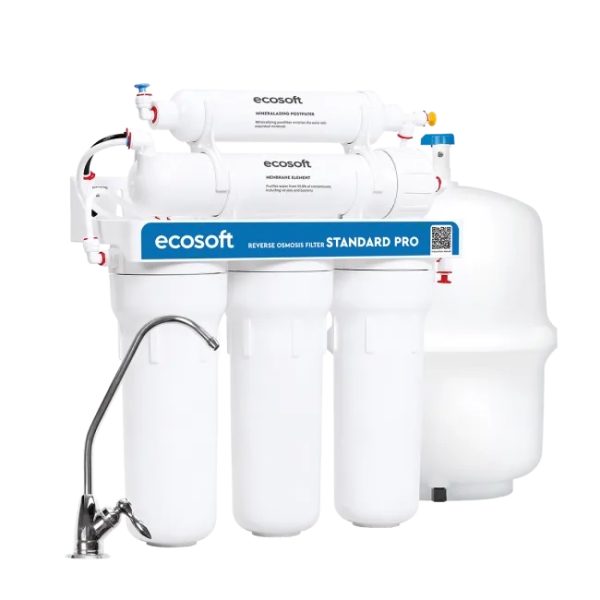
Ecosoft Standard Pro 5-stage reverse osmosis system with mineralisation, ref. ECO-MO550MECOSTD
Part number ART087690 · Domestic reverse osmosis
Net prices excl. VAT and ordering are reserved for signed-in professional accounts.
Ecosoft Standard Pro reverse osmosis system with mineralisation
Under-sink reverse osmosis system with 5 stages, including a mineralisation stage. 50 GPD membrane, production of 190 litres per day. Reference ECO-MO550MECOSTD.
Supplied with a 12-litre tank (usable volume approximately 7 litres) and a chrome ball tap for treated water. Dimensions 414 × 422 × 135 mm, net weight 8.08 kg.
The five stages
Stage 1, PP sediment pre-filter 5 microns. It removes sand, rust and pipe debris. Its role is to protect everything downstream.
Stage 2, AquaGreen cartridge. Ecosoft's carbon stage. It treats free chlorine, a critical point for what follows: chlorine chemically attacks the polyamide membrane, and degradation is irreversible.
Stage 3, PP sediment pre-filter 1 micron. A second, finer mechanical filtration, which removes in particular fine carbon particles released by the previous stage. It is the last barrier before the membrane.
Stage 4, 50 GPD reverse osmosis membrane. The heart of the system. Under network pressure, water passes through a semi-permeable membrane that retains dissolved salts. What is retained goes to the drain, the produced water is stored in the tank.
Stage 5, mineralising post-filter. The stage that distinguishes this version, detailed below.
Mineralisation, and why it is there
A reverse osmosis system produces very lightly mineralised water. This is the direct counterpart to its effectiveness: the membrane does not distinguish between what we want to remove and naturally present minerals.
This water has two characteristics that cause problems in use. It is perceived as flat on the palate, because it is precisely the minerals that give body to the taste of water. And its pH tends towards acidic, which makes it more aggressive towards certain downstream materials.
The mineralising post-filter reintroduces minerals into the produced water, just before the tap. It corrects the taste and rebalances the pH.
In the field, this is often the argument that tips a sale: the customer who has already tasted non-mineralised reverse osmosis water knows exactly what we are talking about.
Supply pressure, the point to check before selling
The unit requires an inlet pressure of 3 to 6 bar. This is not a technical data sheet detail, it is a feasibility criterion.
A reverse osmosis system works by pressure: it is what forces water through the membrane. Below 3 bar, production collapses, the rejection ratio deteriorates, and the customer finds a tank that never fills.
Measure the pressure at the draw-off point before proposing this unit. On a weak network, at high elevation, or at the end of a rural line, you should opt for the version equipped with a booster pump, which is available in the catalogue under a separate reference.
This is the first reason for returns on this type of product, and it is entirely avoidable.
Sizing
190 litres per day of production amply covers the drinking and cooking water consumption of a household.
The 12-litre tank offers a usable volume of approximately 7 litres. The difference between the two values is normal: the tank contains a bladder and a pressurised air cushion, which occupy part of the volume and serve to deliver water to the tap.
These 7 litres correspond to the immediate available draw. Beyond that, you must allow the unit time to reproduce.
Where to use it
On a drinking water point under the sink, in residential as well as light commercial settings.
This is the indicated solution when the objective concerns dissolved salts: high conductivity, nitrates, marked taste, borehole water. If the requirement is limited to taste, chlorine and turbidity on compliant mains water, ultrafiltration meets the need without drain rejection or tank, and costs less in use.
The choice between the two is made on the basis of water analysis, never by default.
Installation
Connection to the cold water inlet under the sink, with the chrome tap supplied drilled into the worktop or sink, and a drain for the reject line.
Allow for the space of the tank, which takes up as much volume as the unit itself, and sufficient clearance under the filter bodies to be able to lower the bowls when changing cartridges.
At commissioning, discard the first two tanks produced. This is the necessary rinsing to remove fine carbon and the preservative from the new membrane.
Replacement
The three pre-filters are replaced together, generally every 6 to 12 months depending on water quality and consumption.
The mineralising post-filter follows its own schedule: its media is consumed by dissolving in the produced water.
The membrane has a significantly longer service life, provided that the pre-filters are replaced on time. A saturated carbon pre-filter allows chlorine to pass through, and chlorine destroys the membrane. This is the sequence that explains the majority of prematurely replaced membranes.
Two signals should alert you: a drop in production and a return of taste. A conductivity check at inlet and outlet gives an objective measure of the membrane's condition.
Domestic reverse osmosis
- Ecosoft Standard Pro (minéralisation + pompe) reverse-osmosis, ref. ECO-MO550MPE-COSTD ref. ART087689
- Ecosoft RObust PRO reverse-osmosis, ref. ECO-ROBUSTCOFFEE ref. ART087814
- Ecosoft P'URE Balance 75 GPD Reverse Osmosis System ready to install, ref. ECO-MO675MPUREBALECO ref. ART089601
- Ecosoft RObust 3000Max reverse-osmosis, ref. ECO-ROBUST3000MAX ref. ART090068
- Ecosoft RObust MINI reverse-osmosis, ref. ECO-ROBUSTMINI ref. ART093886
- Ecosoft Pure Balance Reverse Osmosis Unit (booster pump on stand), ref. ECO-MO675MBALPSECO ref. ART095184
- Aquapro AP-680 reverse osmosis Booster pump + shut-off, 50 GPD (190 L/day) membrane, ref. PR-NOPBAP680SH50 ref. ART059704
- Aquapro RO6 reverse osmosis Shut-off (no pump), 75 GPD (284 L/day) membrane, ref. PR-VH-RO6-SH-75 ref. ART057363
- Aquapro RO6 reverse osmosis Shut-off (no pump), 50 GPD (190 L/day) membrane, ref. PR-VH-RO6-SH-50 ref. ART057362
- Aquapro RO6 reverse osmosis Shut-off (no pump), 125 GPD (473 L/day) membrane, ref. PR-VH-RO6-SH-125 ref. ART057361
- Aquapro RO6 reverse osmosis Shut-off (no pump), 100 GPD (380 L/day) membrane, ref. PR-VH-RO6-SH-100 ref. ART057360
- Aquapro RO6 reverse osmosis Booster pump, 75 GPD (284 L/day) membrane, ref. PR-VH-RO6-PB-75 ref. ART057355
- Aquapro RO6 reverse osmosis Booster pump, 50 GPD (190 L/day) membrane, ref. PR-VH-RO6-PB-50 ref. ART057354
- Aquapro RO6 reverse osmosis Booster pump, 125 GPD (473 L/day) membrane, ref. PR-VH-RO6-PB-125 ref. ART057353
- Aquapro RO6 reverse osmosis Booster pump, 100 GPD (380 L/day) membrane, ref. PR-VH-RO6-PB-100 ref. ART057352
- Aquapro RO5 reverse osmosis Shut-off (no pump), 75 GPD (284 L/day) membrane, ref. PR-NL-RO5-75 ref. ART057056
- Aquapro RO5 reverse osmosis Shut-off (no pump), 100 GPD (380 L/day) membrane, ref. PR-NL-RO5-100 ref. ART057053
- Aquapro RO5 reverse osmosis Booster pump, 75 GPD (284 L/day) membrane, ref. PR-NL-RO5P-75 ref. ART057048
- Aquapro RO5 reverse osmosis Booster pump, 50 GPD (190 L/day) membrane, ref. PR-NL-RO5P-50 ref. ART057047
- Aquapro RO5 reverse osmosis Booster pump, 100 GPD (380 L/day) membrane, ref. PR-NL-RO5P-100 ref. ART057045
- Aquapro RO5 reverse osmosis Shut-off (no pump), 50 GPD (190 L/day) membrane, ref. PR-NL-RO5-50 ref. ART056858
- PRF-RO commercial reverse-osmosis system, continuous-flow (with faucet), ref. PENTAIR-4000462 ref. ART051488
- A2O Pure tankless under-sink reverse-osmosis system, ref. AQUAP-A2O ref. ART100993
- Ecosoft RObust 1500 reverse-osmosis, ref. ECO-ROBUST1500 ref. ART101408
- Ecosoft RObust 4000 reverse-osmosis, ref. ECO-ROBUST4000 ref. ART101568
- Ecosoft Standard Pro (minéralisation + pompe, rack métallique) reverse-osmosis, ref. ECO-MO550MPSE-COSTD ref. ART105693
- Canature RO-UX6 reverse-osmosis, 800 GPD direct flow, tankless, ref. CA-RO-UX6-800G ref. ART105838
- Canature RO-UX7 reverse-osmosis, 1000 GPD direct flow, tankless, ref. CA-RO-UX7-1000G ref. ART106691
- Ecosoft CROSS 90 Balance reverse osmosis unit, direct flow with mineralisation – ref. ECO-MO3600MPECO ref. ART125680
- Ecosoft CROSS 60 reverse-osmosis, ref. ECO-MO3400PECO ref. ART125681