

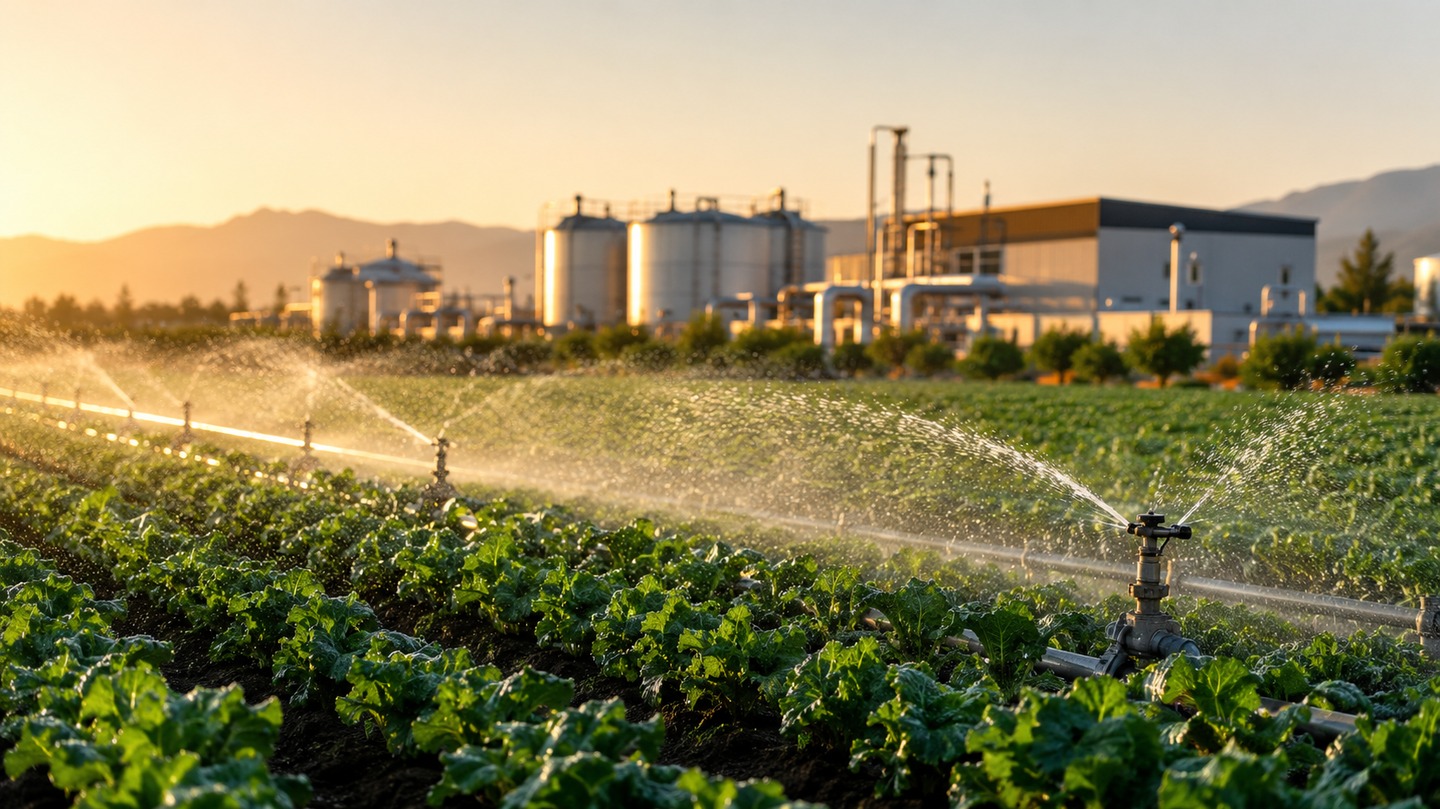
As droughts multiply, reusing water already abstracted rather than pumping new water becomes obvious. Treated-wastewater reuse (known in France as REUT) means giving a second life to the purified water leaving a wastewater-treatment plant, for non-potable uses.
Long under-developed in France (less than 1% of treated wastewater is reused there, far from the Mediterranean leaders), reuse is now regulated by recent European and French texts. Here is the breakdown.
1. What is water reuse?
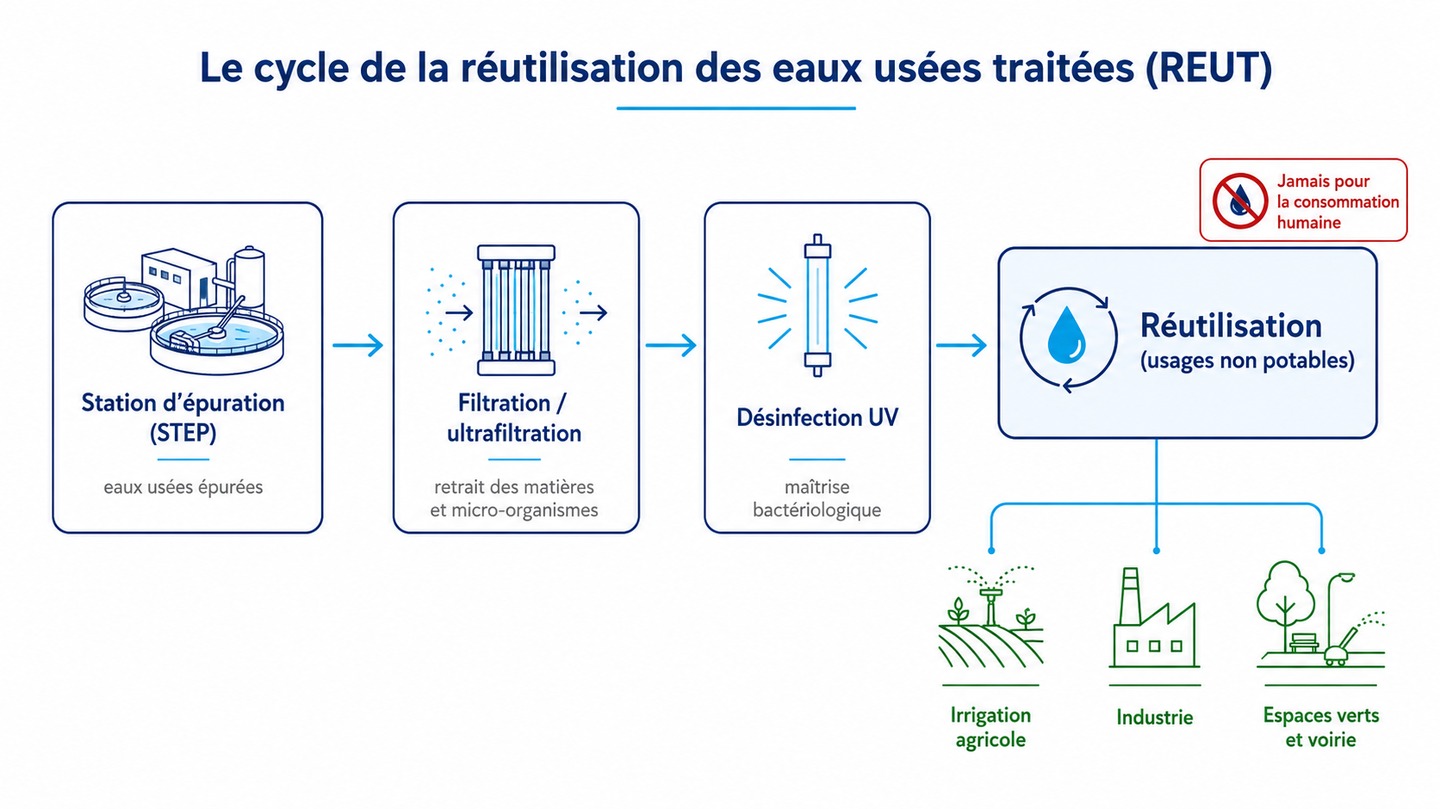
Treated-wastewater reuse means re-employing the purified water leaving a treatment plant (STEP), after possible additional treatment, for a use that does not require potable water: irrigation, cleaning, watering, certain industrial uses.
The aim is twofold: reduce pressure on resources (groundwater, rivers) and secure supply during restrictions. It is a major building block of water frugality.
📊 A largely under-exploited potential
France reuses less than 1% of its treated wastewater, against 8% in Italy, 14% in Spain and up to 80% in Israel. The Water Plan (2023) aims to multiply this volume tenfold by 2030 and deploy 1,000 projects by 2027. The potential is huge: mainland France produces nearly 8.4 billion m³ of treated wastewater per year.
2. The regulatory framework: Europe and France
Two texts structure reuse:
- Regulation (EU) 2020/741 of 25 May 2020, applicable since 26 June 2023: it sets minimum requirements for quality and risk management for water reuse, primarily for agricultural irrigation.
- Decree No. 2023-835 of 29 August 2023 (France): it defines the conditions for using treated wastewater and rainwater for non-domestic uses, and sets the authorisation procedure for reuse projects.
Every project therefore requires an authorisation and a risk-management plan, tailored to the intended use.
3. The 4 quality classes (A to D)
The European regulation defines four quality classes of recycled water, from the most demanding (A) to the least demanding (D), according to the type of crop and irrigation method:
| Class | Typical crops / uses | Irrigation method | Requirement |
|---|---|---|---|
| A | Crops eaten raw (vegetables, roots) | All, including contact irrigation | The strictest |
| B | Crops eaten raw whose eaten part does not touch the water | Sprinkler, drip | High |
| C | Processed crops, arboriculture | Drip (localised irrigation) | Intermediate |
| D | Industrial, energy and non-food crops | All techniques | The least demanding |
Each class has its own thresholds (E. coli, BOD₅, TSS, turbidity) and monitoring measures: the more the use is in contact with food, the higher the required quality.
4. Authorised and prohibited uses
| ✅ Authorised uses | ⛔ Prohibited or restricted |
|---|---|
| Agricultural irrigation (by class) | Any human consumption (drinking) |
| Watering green spaces, golf courses | Growing watercress (excluded) |
| Road cleaning, washing | Fruit trees: from flowering to harvest for raw fruit (except in some cases) |
| Non-sensitive industrial uses (cooling, processes) | Uses in direct contact with raw foodstuffs without class-A quality |
The golden rule: reused water is never intended for human consumption, and the use must be compatible with the quality class produced.
5. The reuse treatment chain
Requalifying purified water for a new use relies on a multi-barrier logic, downstream of the plant:
- Advanced filtration: media filtration or membrane (ultrafiltration) to remove TSS and micro-organisms.
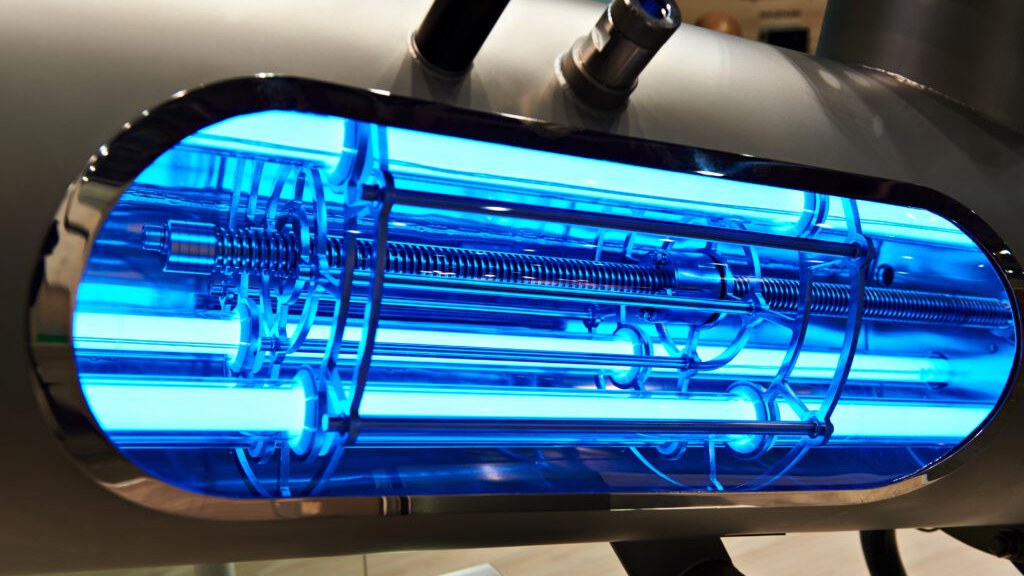
- Disinfection: UV and/or chlorination to control the bacterial load.
- Monitoring: continuous monitoring (turbidity, disinfection) and a control plan.
The treatment level is sized according to the quality class required by the use: the stricter the class (A), the more the chain combines fine filtration, UV disinfection and sometimes reverse osmosis.
6. And in Belgium and the Netherlands?
Regulation (EU) 2020/741 applies across the whole Union. In Belgium, water management falls to the Regions (Flanders, Wallonia, Brussels), with growing pressure on reuse, particularly in Flanders where summer water stress is marked. The European base remains common; the arrangements are set out at regional level. In the Netherlands, a country very advanced in water management, the subject is also a priority (waterschappen, Rijkswaterstaat): DIMM has a significant share of its customers there, alongside Belgium and France.
7. Who is reuse for?
Reuse is of particular interest to farmers and cooperatives in stressed areas, water-intensive industries, communities (watering, roads), golf courses and green spaces, or laundries. The return on investment is all the faster where the resource is scarce and water is expensive.
Conclusion
Reuse is no longer a curiosity: it is a regulated solution, now with a clear European and French framework. Well sized · filtration, disinfection, monitoring, according to the quality class · it turns a constraint (water shortage) into a controlled resource. The starting point remains analysing the intended use and the available water.
The DIMM teams support partner installers, distributors and resellers, in Belgium, France and the Netherlands, in choosing and sizing treatment solutions for water reuse.
🔗 DIMM products & solutions
DIMM supplies the building blocks of a tertiary treatment chain suited to each reuse quality class:
- Filtration and filter media, ultrafiltration
- UV disinfection of water
- Reverse osmosis for the most demanding uses
- The full DIMM product range
Reference points
- Regulation (EU) 2020/741 of 25 May 2020 on minimum requirements for water reuse (applicable since 26 June 2023).
- Decree No. 2023-835 of 29 August 2023 (France): conditions for using treated wastewater and rainwater for non-domestic uses.
- Four quality classes (A to D) by crop and irrigation method; E. coli, BOD₅, TSS, turbidity thresholds.
- Uptake: France < 1% of wastewater reused, against ~8% (Italy), ~14% (Spain), ~80% (Israel). Water Plan (2023): ×10 target by 2030 and 1,000 projects by 2027; ~8.4 billion m³ of treated wastewater/year in mainland France.
- Prohibited/restricted uses: watercress; fruit trees from flowering to harvest for raw fruit (except in some cases). Never potable use.
- Evolving regulations · refer to the texts in force (Légifrance, EUR-Lex) and the Belgian regional frameworks. Information dated August 2026.