



Analytical advances now make it possible to detect micropollutants in water at tiny concentrations — of the order of a nanogram per litre (a billionth of a gram): pharmaceutical residues and endocrine disruptors. An emerging topic, still poorly framed, but rising fast on the European health and regulatory agenda.
The problem is not the quantity — these substances are present in traces — but their nature: designed to act on living organisms (to heal, to regulate hormones), they remain active at very low doses and accumulate in resources later abstracted to produce drinking water.
📊 What the analyses reveal
Carbamazepine (antiepileptic) and metformin (antidiabetic) are detected at nearly 60% of sites studied worldwide. Typical concentrations range from a few ng/L to around a hundred (carbamazepine 6-40 ng/L, paracetamol 30-100 ng/L). Above all, the conventional biological treatment of wastewater plants removes less than 50% of most of these molecules. In France, monitoring (SPAS list) targets carbamazepine, diclofenac, ibuprofen, ketoprofen, paracetamol and metformin.
1. What are we talking about?
We group here two families of organic micropollutants. On one side pharmaceutical residues: antibiotics, synthetic hormones, analgesics like paracetamol, anti-inflammatories like diclofenac and ibuprofen, antiepileptics like carbamazepine, antidiabetics like metformin. On the other, endocrine disruptors: certain bisphenols, phthalates and pesticides that interfere with the hormonal system.
Several hundred pharmaceutical substances have already been detected in aquatic environments worldwide. Their common point: presence in trace amounts, but a persistence and biological activity that raise questions — a medicine is, by definition, a molecule made to produce an effect on an organism.
2. Where do they come from?
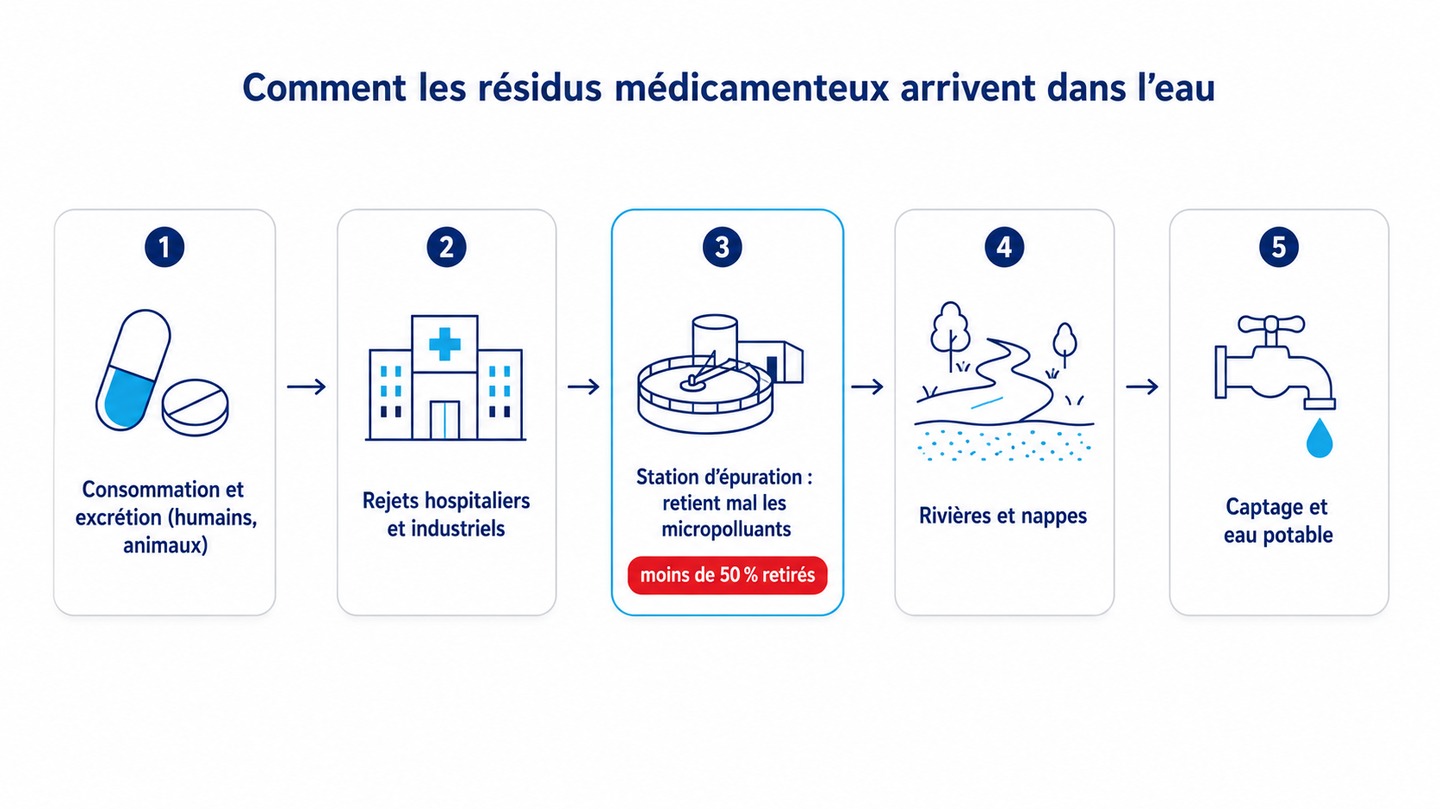
The main route is excretion: part of the medicines consumed by humans and farm animals is eliminated in urine, active or as metabolites. Add to this hospital discharges, industrial effluents (pharmaceutical, cosmetic) and unused medicines thrown down the sink or toilet.
Yet conventional treatment plants were never designed for these molecules: they are optimised for organic matter and nutrients, not for compounds dissolved at the nanogram scale. As a result, a significant fraction passes through the treatment and reaches rivers and groundwater — from which water intended for consumption is then abstracted.
3. What are the stakes?
For ecosystems, the effects are documented: ethinylestradiol (EE2), the synthetic hormone of the contraceptive pill, remains active at a few ng/L and causes feminisation and reproductive disorders in some fish. Designed to act on living organisms, these residues keep acting once in the environment.
Antibiotic resistance is the other major concern: the spread of antibiotics and resistant bacteria in water feeds a phenomenon associated with about 1.3 million deaths per year worldwide (2019 estimates). For human health, levels in drinking water remain very low, but the uncertainties over low-dose effects, mixtures ("cocktail effect") and chronic exposure justify a precautionary approach.
4. The regulatory framework
This is the fastest-moving point. Today there are no generalised "drinking-water" thresholds yet for pharmaceutical residues and endocrine disruptors. Regulation therefore advances through two complementary levers: monitoring of the environment, and the obligation to treat at the plant outlet.
1. Monitoring: the "watch list"
Under the Water Framework Directive, the European Union maintains a watch list: a selection of substances that Member States must measure regularly in water to document their presence. It includes hormones (the synthetic oestrogen EE2, the oestradiol E2) and diclofenac. The aim: to gather the data that will serve, tomorrow, to set possible thresholds.
2. The obligation to treat: "quaternary treatment"
The real turning point comes from the revised Urban Wastewater Treatment Directive (UWWTD2), adopted on 27 November 2024. A conventional treatment plant chains three stages: primary (screening, settling), secondary (biological) and tertiary (nitrogen, phosphorus) treatment. The directive adds a 4th stage — quaternary treatment — specifically dedicated to micropollutants (including pharmaceutical residues).
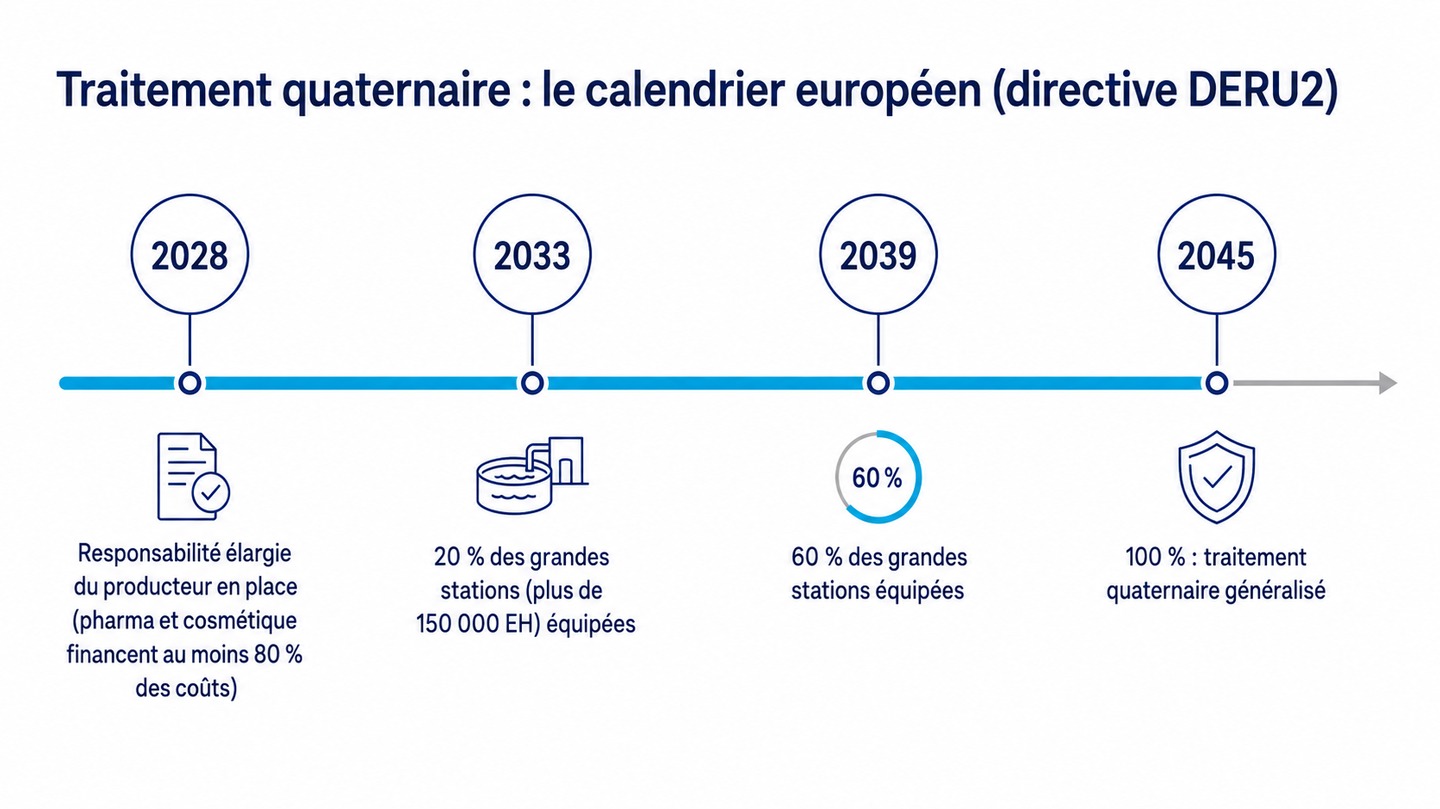
The rollout is gradual and targets first the large plants (over 150,000 population equivalents): 20% equipped in 2033, 60% in 2039, 100% in 2045. Intermediate thresholds also apply to agglomerations of at least 10,000 p.e. located in a micropollutant-risk zone.
3. The polluter-pays principle
A major innovation: an extended producer responsibility (EPR) makes the pharmaceutical and cosmetic industries — the two main sources of micropollutants — bear at least 80% of the extra cost of quaternary treatment. This scheme must be operational by the end of 2028 at the latest. In other words: it is no longer only household water bills that fund depollution, but also the manufacturers of the products behind the discharges.
📅 The key dates to remember
2028 — extended producer responsibility in place (pharma + cosmetics fund ≥ 80% of costs).
2033 — 20% of large plants equipped with quaternary treatment.
2039 — 60% of large plants equipped.
2045 — 100%: quaternary treatment generalised on large plants.
5. Treatment solutions
Faced with molecules that biological treatment largely lets through, several advanced processes make the difference — most often combined:
| Process | Effectiveness on micropollutants |
|---|---|
| Conventional biological treatment (plant) | Low — often < 50% |
| Activated carbon (GAC / PAC) | High — adsorption of a broad spectrum of molecules |
| Ozonation / advanced oxidation | High — degradation, > 80% on most targets |
| Reverse osmosis | Very high — near-complete membrane barrier |
Activated carbon and reverse osmosis are the reference barriers to secure production or process water; ozonation is used mainly at the plant outlet. As no single process is universal, the logic remains multi-barrier.

6. Points of vigilance
Three pitfalls call for caution: the great variability of the molecules (hundreds, with very different properties); the presence of recalcitrant compounds that a single process cannot remove; and the risk of oxidation by-products (for example bromates when ozonating bromide-rich waters). Hence the importance of sizing suited to the water matrix and of regular analytical monitoring.
7. Who is this solution for?
Healthcare establishments (discharge treatment), pharmaceutical and cosmetic industries (now concerned by extended responsibility), communities and water operators, as well as any use requiring very-high-quality water: laboratories, sensitive food processing, dialysis, cosmetics.
Conclusion
Pharmaceutical residues and endocrine disruptors illustrate a new generation of micropollutants: present in traces but active, hard to frame, long ignored for lack of measurement tools. The framework is now shifting — quaternary treatment mandatory by 2045 and polluter-pays for industry. On the treatment side, the answer is multi-barrier (activated carbon, reverse osmosis, advanced oxidation) and is sized according to the use and the resource. The starting point remains, always, the water analysis.
The DIMM teams support partner installers, distributors and resellers in Belgium, France and the Netherlands in choosing and sizing water-treatment solutions.
🔗 DIMM solutions
Activated carbon, reverse osmosis and advanced processes: DIMM helps remove micropollutants for the most demanding uses (healthcare, industry, laboratories).
Reference points
- Micropollutants detected in traces (ng/L): carbamazepine 6-40 ng/L, paracetamol 30-100 ng/L, etc. Carbamazepine and metformin detected at ~60% of sites (worldwide data).
- France: SPAS list (relevant substances to monitor) — carbamazepine, diclofenac, ibuprofen, ketoprofen, paracetamol, metformin.
- Conventional biological treatment: removal often < 50%; advanced treatments (carbon, ozonation) > 80%.
- Water Framework Directive: watch list including hormones (EE2, E2) and diclofenac.
- Revised Urban Wastewater Treatment Directive (UWWTD2, adopted 27/11/2024): quaternary treatment (>150,000 p.e. — 20% in 2033, 60% in 2039, 100% in 2045); extended producer responsibility ≥ 80% of costs (pharma + cosmetics), scheme by 31/12/2028 at the latest.
- Antibiotic resistance: ~1.3 million deaths/year worldwide (2019 estimates).
- Treatments: activated carbon, reverse osmosis, advanced oxidation / ozonation — multi-barrier approach. Information dated August 2026, evolving regulation (ANSES, EU).