


A decree published in the Official Journal confirms the date. Industrial sites (permitted ICPE facilities) discharging PFAS into water above 100 g/year will owe €100 per 100 g discharged, on a list of 28 substances (including TFA). Good news: an 80% abatement applies to sites that treat their effluent. Act before the autumn.
It is now official. A decree in the Official Journal confirms that the levy on PFAS discharges introduced by law no. 2025-188 ("forever pollutants") will take effect on 1 September 2026. For industrial sites discharging these substances into water, the bill starts running. Here is what you need to know · and above all, how to reduce it.
⏱ The deadline is set: 1 September 2026
Initially due on 1 March 2026, entry into force was postponed by six months "to secure its legal certainty". The decree now locks the date at 1 September 2026. Discharges are counted from that date: there is no more waiting room.
1. What the decree changes
Law no. 2025-188 of 27 February 2025 established the "polluter-pays" principle for aqueous PFAS discharges. Its terms and date remained to be set. That is now done: the decree in the Official Journal confirms application from 1 September 2026.
The message is clear: every gram of PFAS discharged into water will now carry a cost, calculated on quantities measured from autumn 2026.
2. Who is concerned?
The levy targets permitted ICPE facilities (classified installations for environmental protection) whose activities cause PFAS discharges into water once the annual mass exceeds 100 grams.
On the front line: chemicals, surface treatment, plastics, technical textiles, paper, metallurgy, agri-industry, waste management… If your site is under the authorisation regime and discharges PFAS, ask the question now.
3. How much will it cost?
The rate is €100 per 100 g of PFAS discharged, with automatic indexation to inflation. The base is a list of 28 substances in the decree, including the widely reported TFA (trifluoroacetic acid).
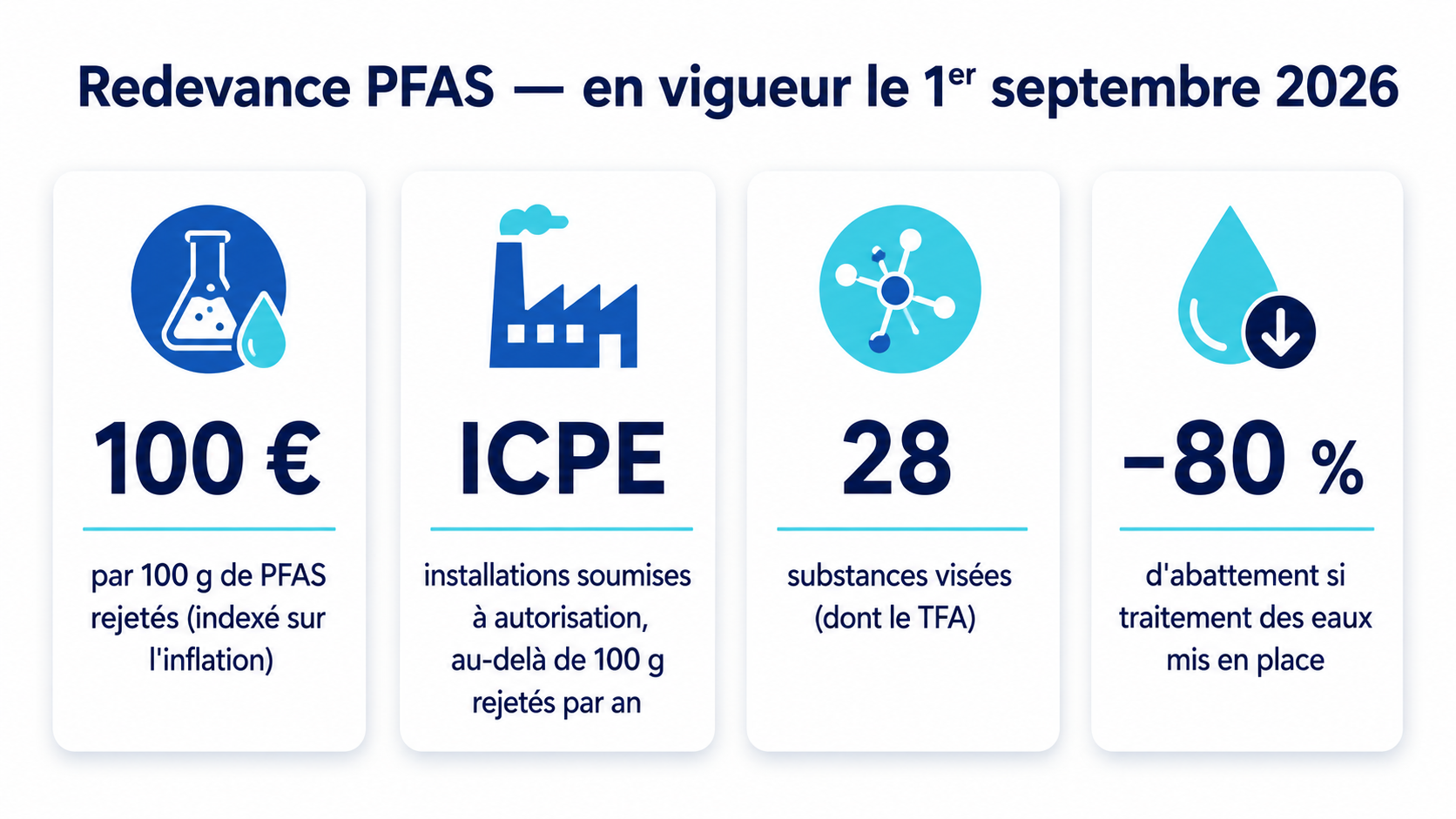
The bill can climb fast. A site discharging 5 kg of PFAS a year faces a levy of around €5,000 (5,000 g ÷ 100 g × €100) · before indexation and abatement. For large emitters, the stakes run into tens of thousands of euros per year.
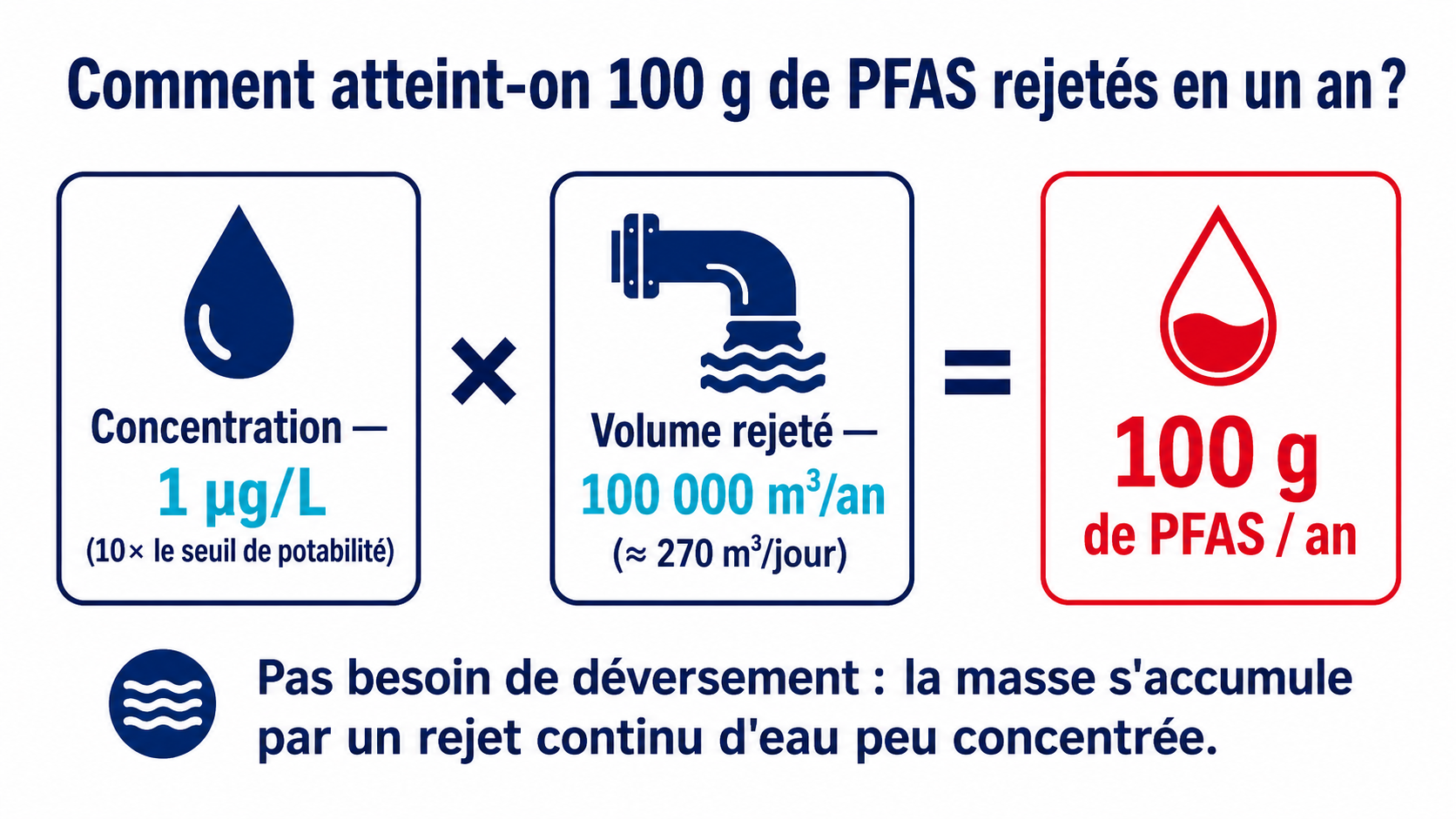
How do you reach 100 g of PFAS?
Not through a spectacular spill, but through accumulation. Annual mass = concentration in discharged water × volume discharged. Water at 1 µg/L (10× the drinking-water threshold) discharged at 100,000 m³/year (≈ 270 m³/day) already reaches 100 g a year. A continuous flow of weakly concentrated water is enough.
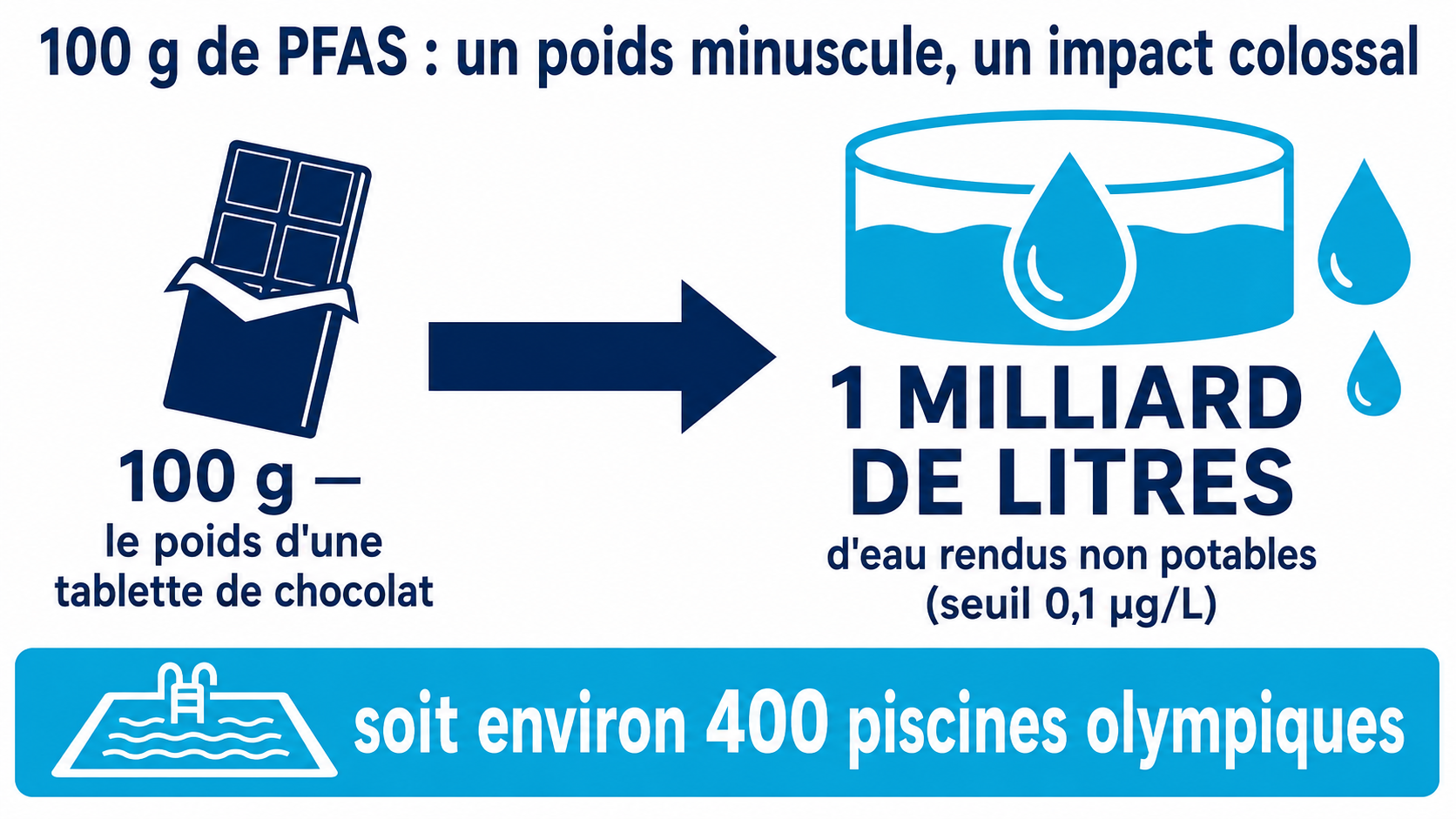
And 100 g is almost nothing by weight · the weight of a chocolate bar · yet because PFAS are measured in billionths of a gram, that is enough to make 1 billion litres of water unfit for consumption (0.1 µg/L threshold), about 400 Olympic pools.
4. Measurement & self-monitoring: what is expected
The amount is not declared by guesswork: it relies on measurements. Two cases:
- Above 2 kg/year: continuous self-monitoring. Analyses start in September 2026.
- Below: a measurement campaign over a representative period, at start-up then at least every 5 years.
⚠️ Anticipate the measurement
Without reliable discharge data, you cannot estimate the levy or prove a treatment's effectiveness. Characterising your effluent (which PFAS, at what concentration, for what flow) is the essential first step · to launch before the autumn.
5. The way out: −80% by treating your discharges
The decisive point, too often ignored: the text grants an 80% abatement on the levy base for sites that implement water treatment. Treating effluent is not only about compliance: it massively cuts the bill.
A site that invests in treating its PFAS discharges reduces both the quantity discharged and the taxable base. The levy becomes an ROI accelerator for treatment solutions.

Three technology families are the reference to reduce PFAS in water:
- Granular activated carbon (GAC): very effective on long-chain PFAS.
- Specific ion-exchange resins: high capacity, useful on short-chain PFAS.
- Reverse osmosis: the most complete membrane barrier, across a very broad PFAS spectrum.
DIMM's solutions against PFAS
DIMM distributes all of these technologies and supports their implementation:
- Granular activated carbon (GAC) & carbon cartridges (Pentair/Pentek, Ecosoft): PFAS adsorption, in columns for effluent or in cartridges at the point of use.
- Specific ion-exchange resins: high capture capacity, including short-chain PFAS.
- Ecosoft domestic reverse osmosis (Cross Max, A2O Pure): drinking water free of PFAS, direct-flow under-sink.
- Professional & industrial reverse osmosis (MO6500 → MO10000 range): large volumes of ultra-pure water (98–99% of impurities removed).
- Housings, media & water analysis: PFAS diagnosis, sizing and consumables.
🔗 A chain tailored to each case
Whether treating an industrial discharge (to cut the mass discharged and earn the abatement) or securing drinking water, DIMM combines carbon, resins and osmosis in the most effective configuration · always from a PFAS-targeted water analysis.
6. Not just the levy: drinking-water monitoring
The levy is only one part. Since 1 January 2026, testing for 20 PFAS substances is mandatory in the sanitary control of water for human consumption. A government report, expected by the end of 2026, should propose even stricter standards.
7. The overall PFAS-law timeline
Beyond water, the law progressively bans products containing PFAS. The main milestones:
8. What to do now
- Check your status: permitted ICPE? More than 100 g of PFAS discharged per year?
- Characterise your effluent: a PFAS analysis of your discharges (substances, concentrations, flow).
- Estimate the levy and compare it to the cost of treatment · including the 80% abatement.
- Choose and size the solution (carbon, resin, osmosis or a combination) before 1 September.
💡 The right reflex
The more you anticipate, the more you control the bill. A PFAS-targeted water analysis followed by proper sizing lets you both comply and earn the abatement. DIMM's teams support this diagnosis and the choice of technologies.
Conclusion: act before the autumn
With this decree, the PFAS levy is no longer a distant prospect: it applies from 1 September 2026. Waiting means paying full price. Anticipating · measuring discharges, treating effluent · means complying and halving the bill thanks to the 80% abatement.
DIMM supports professionals in PFAS diagnosis and the choice of treatment technologies (activated carbon, specific resins, reverse osmosis) suited to each discharge.
Key points & references
- Decree in the Official Journal: PFAS levy in force on 1 September 2026 (six-month postponement from 1 March 2026).
- Basis: law no. 2025-188 of 27 February 2025 protecting the population from PFAS risks.
- Rate: €100 per 100 g discharged, indexed. Scope: permitted ICPE, above 100 g/year.
- Base: 28 substances in the decree, including TFA.
- Measurement: continuous self-monitoring above 2 kg/year; otherwise a representative campaign at start-up then at least every 5 years.
- 80% abatement for sites implementing water treatment.
- Drinking water: mandatory testing of 20 PFAS in sanitary control since 1 January 2026. Evolving regulation · information dated June 2026, to be confirmed on Légifrance.
Affected by the PFAS levy? Anticipate now.
DIMM has supported water-treatment professionals since 1991. PFAS-targeted water analysis, activated carbon, specific resins, reverse osmosis: our teams help you measure your discharges, treat them and reduce your levy.
Contact our experts View the catalogue