

Important note
This article gives technical guidance. For any real situation (suspected lead, young child, pregnant woman), contact your water utility, the relevant health authority and a healthcare professional; a water test is the only way to conclude.
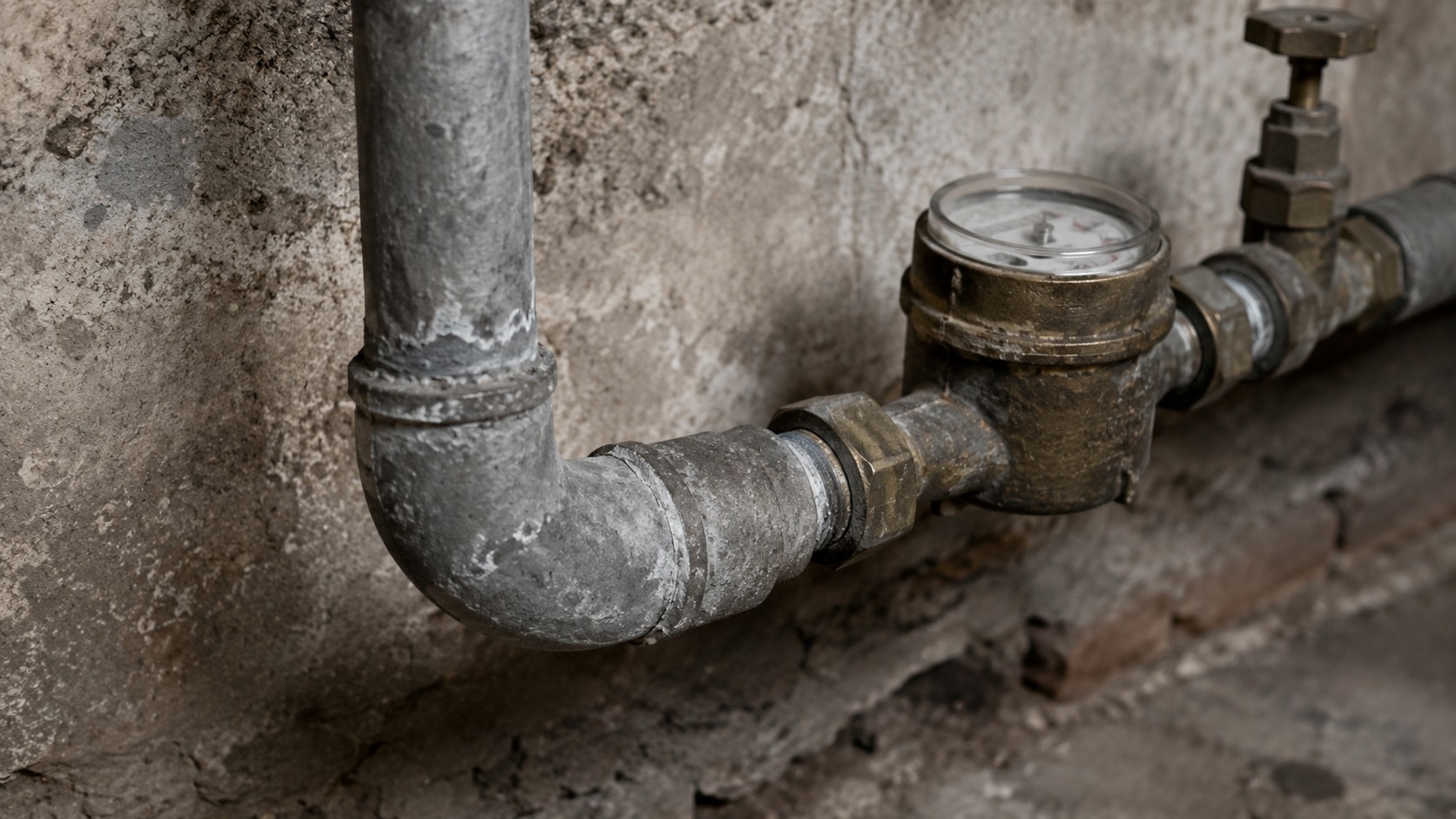
Lead is a toxic metal that has no place in drinking water. The good news: it has been massively removed from public networks, and its use has been banned in new installations for decades. Yet it still remains, in isolated spots, wherever old pipes have not been replaced.
The key point to understand: lead does not come from the abstracted water, but from the network materials it flows through. Water picks it up while circulating · above all while standing · in lead pipes. Let's see exactly where it persists, why it is a problem, and what solutions exist.
1. Lead comes from the pipes, not the source
As it leaves the treatment plant, the distributed water is compliant and free of lead. It is afterwards, in the pipes, that the metal can dissolve: when water flows through a lead pipe, part of it goes into solution and reaches the tap. The effect grows with contact time · hence higher levels after standing (overnight, weekends, absences).
One factor clearly makes things worse: aggressive water (soft, acidic, low in minerals) dissolves lead far more easily. Water quality and the nature of the pipes therefore combine to set the real risk.
2. Where does lead still remain?
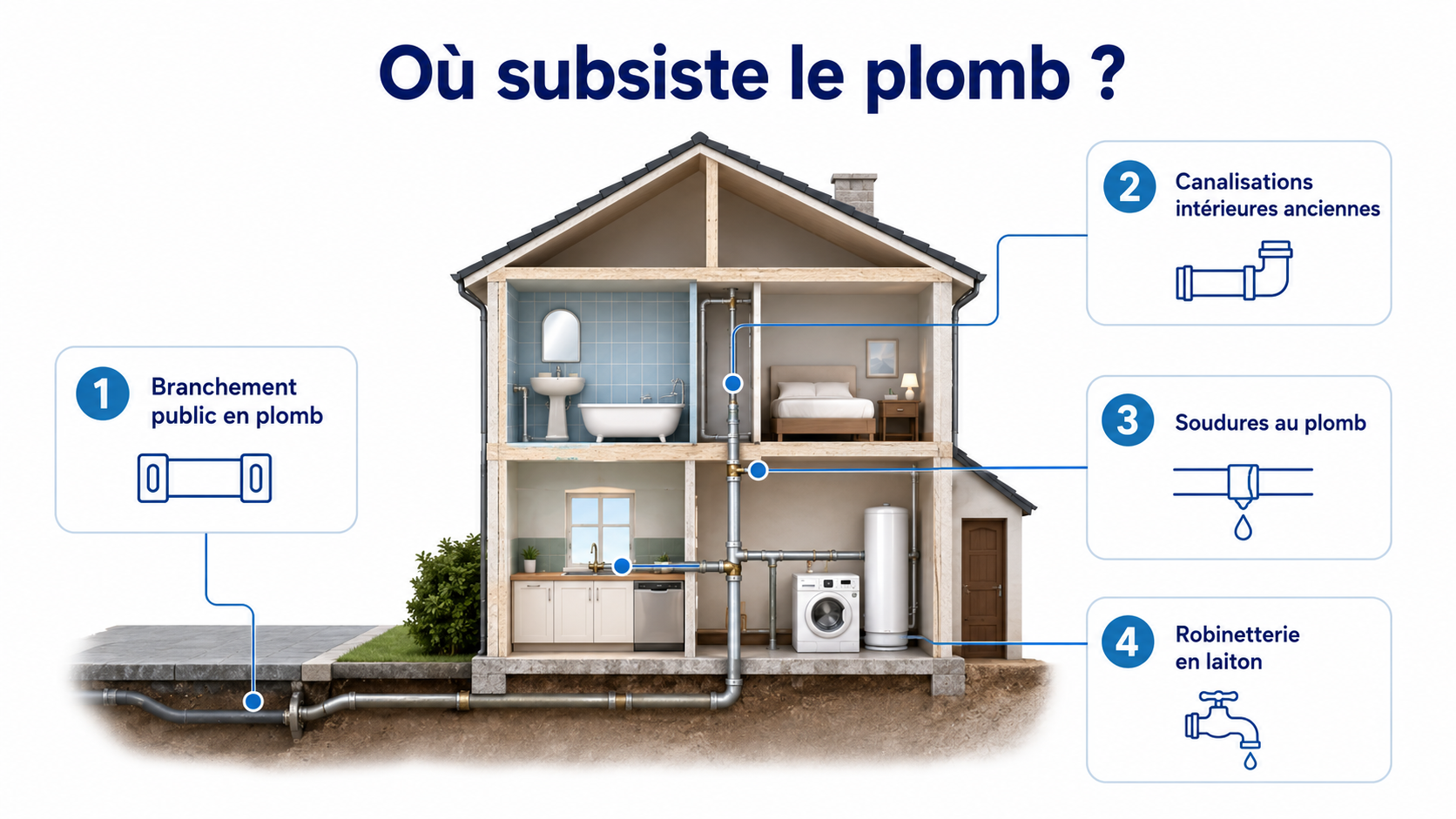
Four main sources persist, mostly in older buildings:
- Lead service pipes: the line connecting the public network to the building in old constructions (often pre-1960). This is the most common source.
- Old internal lead pipework in un-renovated buildings.
- Lead solder joining old copper pipes.
- Old brass fittings and taps, which could contain some lead (before recent "lead-free" standards).
3. Why it is a health issue
Lead is a neurotoxin: ingesting it, even at low doses and repeatedly, causes lead poisoning. The most exposed groups are children under 6, infants, pregnant women and the foetus. In children, lead can affect intellectual development, behaviour, growth and hearing.
No "safe" threshold
For lead there is no fully safe dose: the goal is to reduce exposure as much as possible. Vigilance is highest where young children live, and when water is used to prepare infant bottles.
4. What the regulations say
The quality limit for lead in drinking water is currently 10 µg/L. The European directive 2020/2184 lowers it to 5 µg/L, effective on 1 January 2036. This stricter requirement drives the replacement of the last lead service pipes and heightened vigilance.
Authorities also require particular attention to premises hosting sensitive groups (nurseries, schools…), with lead checks at the tap.
5. How to find out: diagnosis
Lead cannot be seen, tasted or smelled. Only a water test can conclude. A few pointers to target the risk:
- Building age: an old home (pre-1960) that has not been renovated is more likely to have lead pipes.
- Sampling after standing: the first draw in the morning is the most loaded · useful to gauge real exposure.
- Aggressive water: if the water is soft and acidic, the dissolution risk is higher.
6. The solutions
Replacement: the definitive fix
Removing lead at source remains the best answer: replacing the lead service pipe and internal pipework. This is the underlying goal driven by the regulations, on the utility side (public part) and the owner side (private part).
Good everyday habits
- Let the water run for a moment (until it is clearly cold) before drinking it, especially after standing.
- Cold water only for drinking, cooking and infant bottles: hot water dissolves metals more.
Point-of-use treatment
While awaiting replacement, or as a complement, at-the-tap treatment is effective:
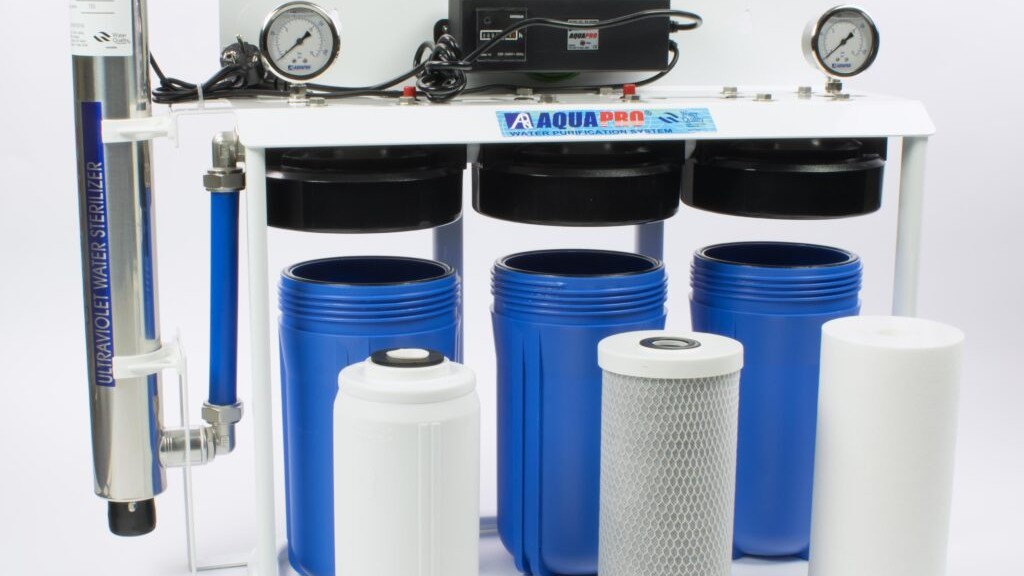
- Block activated-carbon filtration certified for lead reduction (NSF/ANSI 53 standard): a simple point-of-use solution.
- Reverse osmosis: very effective on lead and heavy metals (retention up to 99.99%).
Beware of aggressive water
Reverse-osmosis units and softeners produce less mineralised water, hence more corrosive towards any lead solder or pipework located downstream. Installing them on a network containing lead must be supervised by a professional, ideally after re-balancing the water.
Network side: conditioning
At the utility scale, lead dissolution is limited by controlling the calco-carbonic balance and, in some cases, dosing orthophosphates that form a protective film inside the pipes.
DIMM solutions · lead reduction
- Point-of-use filtration: block-carbon cartridges and under-sink systems.
- Reverse osmosis: thorough removal of heavy metals for drinking water.
- Re-balancing & testing: neutralising aggressive water and measuring lead.
7. Who should be vigilant?
Older homes & families
In a pre-1960 un-renovated building, especially with young children, diagnosis followed by a point-of-use solution (lead-certified filtration or osmosis) provides immediate protection while awaiting replacement.
Public bodies & sensitive premises
Nurseries, schools and healthcare facilities are a priority: lead checks at the tap, replacement of lead components and, if needed, suitable treatment.
Conclusion: target, measure, treat
Lead in water is a residual but serious problem, concentrated in old networks and amplified by aggressive water and standing. The approach is clear: target the at-risk situations (old buildings, young children), measure with a test, then treat · ideally by replacement, and without delay via certified filtration or point-of-use osmosis. The future 5 µg/L limit confirms the direction: aim for zero lead.
DIMM's teams support partner installers, distributors and resellers in the diagnosis and the choice of filtration, osmosis and water-rebalancing solutions, in France and Belgium.
Key points & references
- Lead in water comes from pipes (old service lines, solder, brass), not from the resource.
- Quality limit: 10 µg/L today; 5 µg/L on 1 January 2036 (EU directive 2020/2184).
- Sensitive groups: children < 6, infants, pregnant women; no "safe" threshold.
- Standing and aggressive water increase lead dissolution.
- Solutions: replacing lead components; run the tap + cold water; NSF/ANSI 53 certified block-carbon filtration; reverse osmosis; orthophosphates on the network side.
- General information · does not replace a water test or the advice of a health authority or professional.