

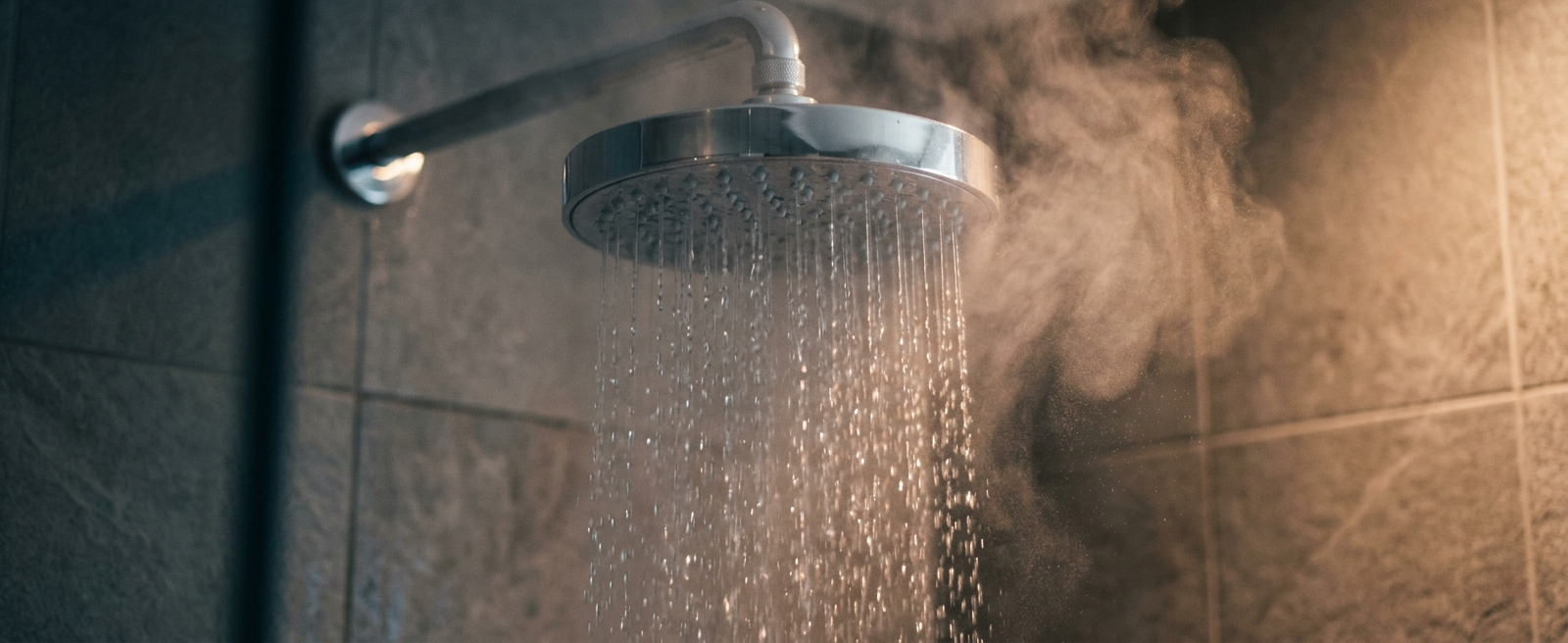
Every spring, thousands of water installations resume activity after a long period of winter inactivity: hotels reopened, campsites restarted, indoor pools relaunched, air conditioning systems reactivated. This moment also marks the silent awakening of a major bacteriological danger: Legionella and other pathogens that have developed during the months of stagnation.
Legionellosis, a serious pulmonary disease caused by Legionella pneumophila, accounts for more than 1,200 reported cases in France each year, with a mortality rate of 10 to 20% in severe forms. Water treatment professionals and managers of establishments open to the public (ERP) are on the front line to prevent this risk – with precise regulatory obligations.
This article explains why spring is the most critical season, which installation points to monitor as a priority, the applicable regulations in France and Belgium, and DIMM solutions to effectively protect your installations.
1. Legionella: understanding the enemy
A natural bacterium that becomes dangerous in artificial circuits
Legionella pneumophila is a bacterium naturally present in fresh water (lakes, rivers, underground aquifers) at low concentrations, without particular danger in its natural environment. The problem arises when it colonises hot artificial water systems: domestic hot water tanks (DHW), distribution networks, showers, spas, cooling towers. There it finds ideal conditions to proliferate and can reach dangerous concentrations.
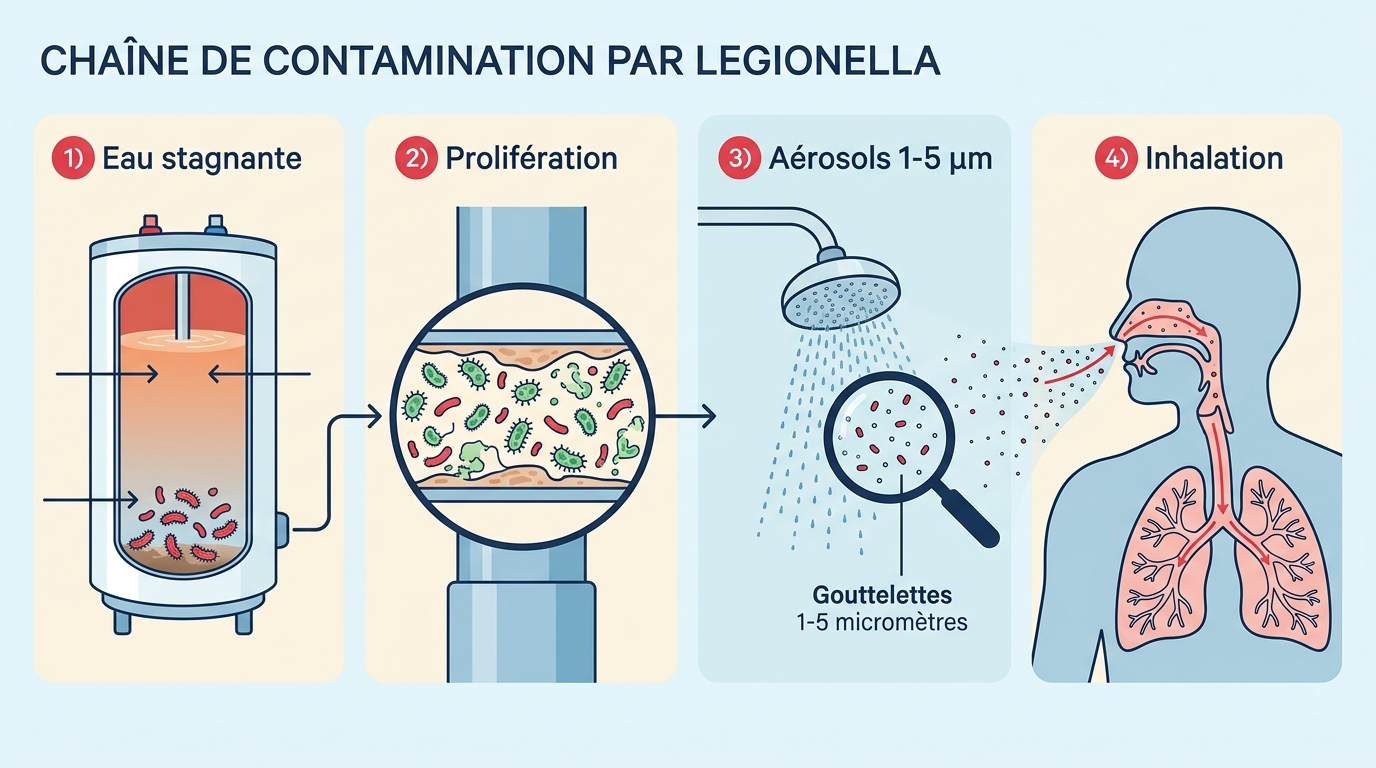
Human contamination occurs exclusively through inhalation of aerosols – microdroplets of 1 to 5 microns suspended in the air, mainly from showers, spas and cooling towers. You cannot contract legionellosis by drinking water: the bacterium does not survive in the stomach. Inhalation is the exclusive vector.
🚨 Particularly vulnerable populations
- Elderly people (nursing homes, care homes): reduced immunity – higher mortality rate.
- Hospitalised patients (especially immunocompromised): critical risk – zero tolerance Legionella threshold in healthcare facilities.
- Smokers, people with chronic lung diseases (COPD, asthma).
- Diabetics, renal insufficiency patients: increased sensitivity.
- Men > 50 years old: the most represented population in confirmed cases.
The 3 conditions that promote proliferation
1. Temperature: Legionella multiplies actively between 25 and 45 °C, with a growth peak at 37 °C – human body temperature. It is inhibited below 20 °C and destroyed above 60 °C.
2. Stagnation: water that does not circulate constitutes an ideal environment for bacterial colonisation. Dead legs in the network, little-used or unused tanks and dead-end pipes are the most critical areas.
3. Biofilm and limescale: the bacterium lodges in deposits of scale, sludge and corrosion products that line the inside of pipes and tanks. These environments protect it from thermal and chemical treatments.
2. Why is spring the highest-risk season?
The trap of resuming activity after winter
Spring concentrates a combination of aggravating factors that make it the most dangerous season for water circuits in public establishments:
- Prolonged winter stagnation: installations little used during winter have left water stagnating for weeks, even months, at 15-25 °C – the ideal range for progressive colonisation.
- Gradual temperature rise: network water temperature naturally rises in spring. DHW circuits not maintained at temperature find themselves in the thermal danger zone (25-45 °C) for several weeks.
- Restart without precautions: many managers reopen their installations without thermal shock or mandatory regulatory disinfection.
- Biofilm established during winter: the long stagnation has allowed Legionella to settle deep in the biofilm. They are then difficult to eliminate by simple temperature increase.
- Resumption of collective showers: the reopening of changing rooms, sports showers and bathing facilities concentrates dozens of people simultaneously exposed to aerosols.
💡 Did you know? Legionella can survive at 80 °C
Under laboratory conditions (bacteria in suspension), 90% of Legionella are destroyed at 60 °C in 5 minutes. But in real installations, Legionella protect themselves within amoebae – microorganisms more resistant to heat and chlorine. Some amoebae survive at 80 °C and release still-living Legionella during cooling. This is why simple thermal shock is not sufficient in scaled installations: you need to combine descaling + thermal treatment + UV.
3. Key temperatures: from proliferation to destruction
Temperature control is the primary prevention tool against Legionella. Here are the thresholds to know and respect imperatively.
| Water temperature | Zone | Legionella risk | Consequence |
|---|---|---|---|
| < 20 °C | Cold water | Bacteria inactive | Legionella dormant, no multiplication |
| 20 – 25 °C | Tepid zone | ⚠️ Risk begins | Slow multiplication possible – avoid stagnation |
| 25 – 45 °C | Danger zone | 🔴 Active proliferation | Rapid multiplication – peak at 37 °C |
| 46 – 50 °C | Borderline zone | ⚠️ Slowdown | Growth slowed but bacteria alive |
| 50 – 55 °C | Safe zone (DHW storage) | ✅ Inhibition | 90% of Legionella destroyed in 2 to 6 h |
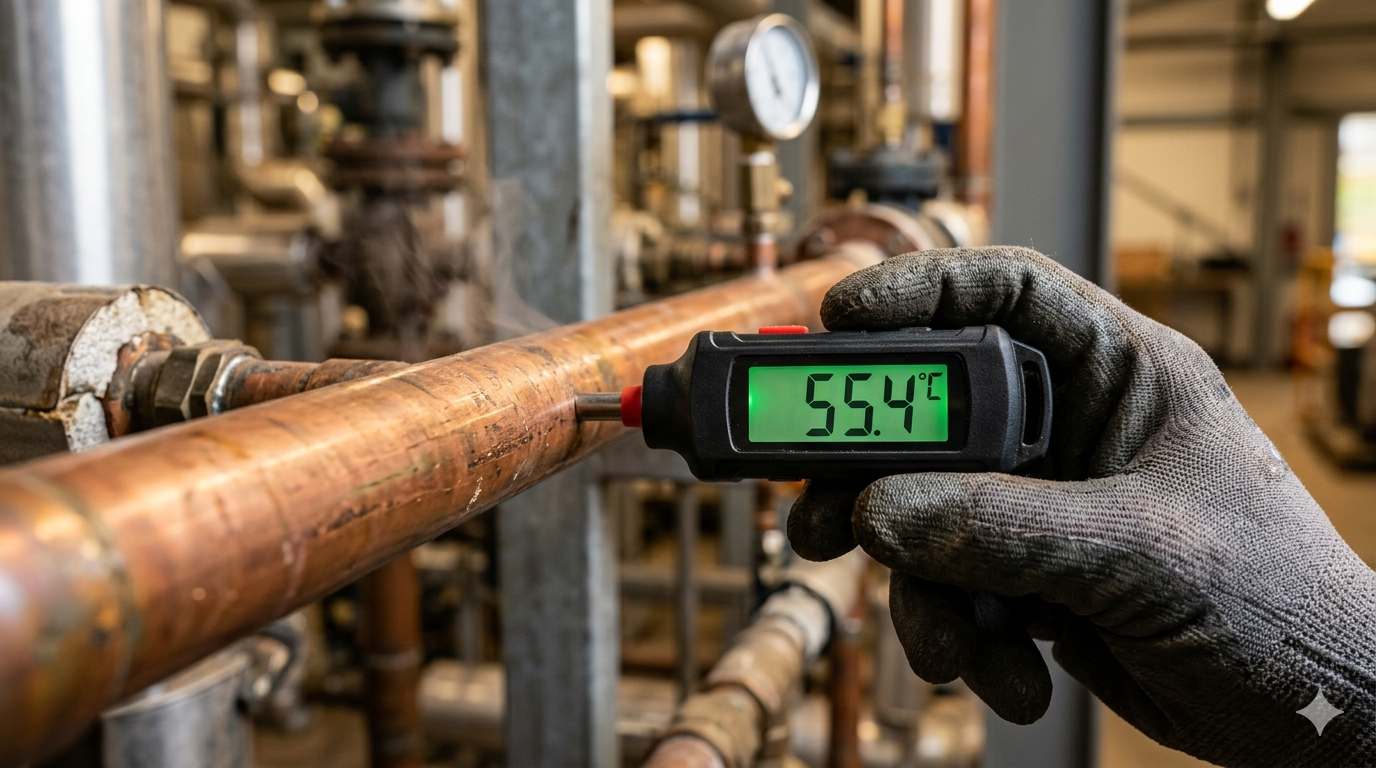
| 60 °C | Regulatory threshold | ✅ Rapid destruction | 90% destroyed in 5 min – mandatory DHW threshold FR/BE |
| 70 °C | Thermal shock | ✅ Total destruction | Curative treatment – rapid and complete destruction |
| ≥ 55 °C (distribution) | Network temperature | ✅ Regulatory threshold | Minimum distribution temperature (FR decree 2010) |
4. Priority points of use to monitor
Not all water circuits present the same level of risk. Here are the professional installations that merit increased vigilance, particularly in spring.
| At-risk point of use | Contamination mode | Key preventive measures |
|---|---|---|
| Showers (hotel, sports, camping) | Direct inhaled aerosols | Inspection 2×/year min. – thermal or UV disinfection – weekly purge of little-used points |
| Spa, jacuzzi, whirlpool bath | Aerosols + stagnant warm water | Enhanced monitoring – chemical + UV disinfection – regular draining and cleaning |
| Cooling towers (TAR) | Wide aerosol dispersion | Mandatory sanitary logbook – monthly analyses – biocide per protocol |
| DHW tanks > 400 L | Water stagnation at tank bottom | Storage temp. ≥ 55 °C – annual Legionella analysis – regular bottom-of-tank purge |
| Little-used networks / dead legs | Stagnation and biofilm | Weekly purge – eliminate dead legs – network mapping |
| Ornamental fountains / humidifiers | Continuous aerosols | Regular maintenance and disinfection – avoid stagnant warm water |
| Ice machines / beverage dispensers | Indirect water-aerosol contact | Cleaning and disinfection per manufacturer protocol |
| Installations resumed after winterisation | Prolonged stagnation in cold water | Mandatory thermal shock before recommissioning + Legionella analysis |

5. Regulations in France and Belgium: managers' obligations
Legionella regulation in France is primarily based on the decree of 1 February 2010 (amended 2022), supplemented by the Public Health Code (articles L.1335-1 et seq.). In Belgium, the Flemish government decree of 4 May 2007 constitutes the main regulatory framework, with regional specificities.
| Obligation | 🇫🇷 France | 🇧🇪 Belgium |
|---|---|---|
| Reference text | Decree 1 Feb. 2010 (amended 2022) + Public Health Code | Flanders decree 4 May 2007 + Brussels environmental permit |
| DHW production temperature | ≥ 60 °C (storage > 400 L) | ≥ 60 °C – distributed ≥ 55 °C |
| DHW distribution temperature | ≥ 50 °C at points of use | ≥ 50 °C – thermostatic mixer recommended |
| Cold water | ≤ 25 °C (piping) | ≤ 25 °C – avoid DHW contact |
| DHW production analyses | 1×/year (tank bottom) | Per regional decree + installation type |
| Point-of-use analyses | Per ERP type | Per decree + sanitary logbook |
| Legionella alert threshold | ≥ 1,000 CFU/L (ERP) | ≥ 1,000 CFU/L – point-of-use closure |
| Critical health threshold | < detection limit | Zero tolerance – specific protocol |
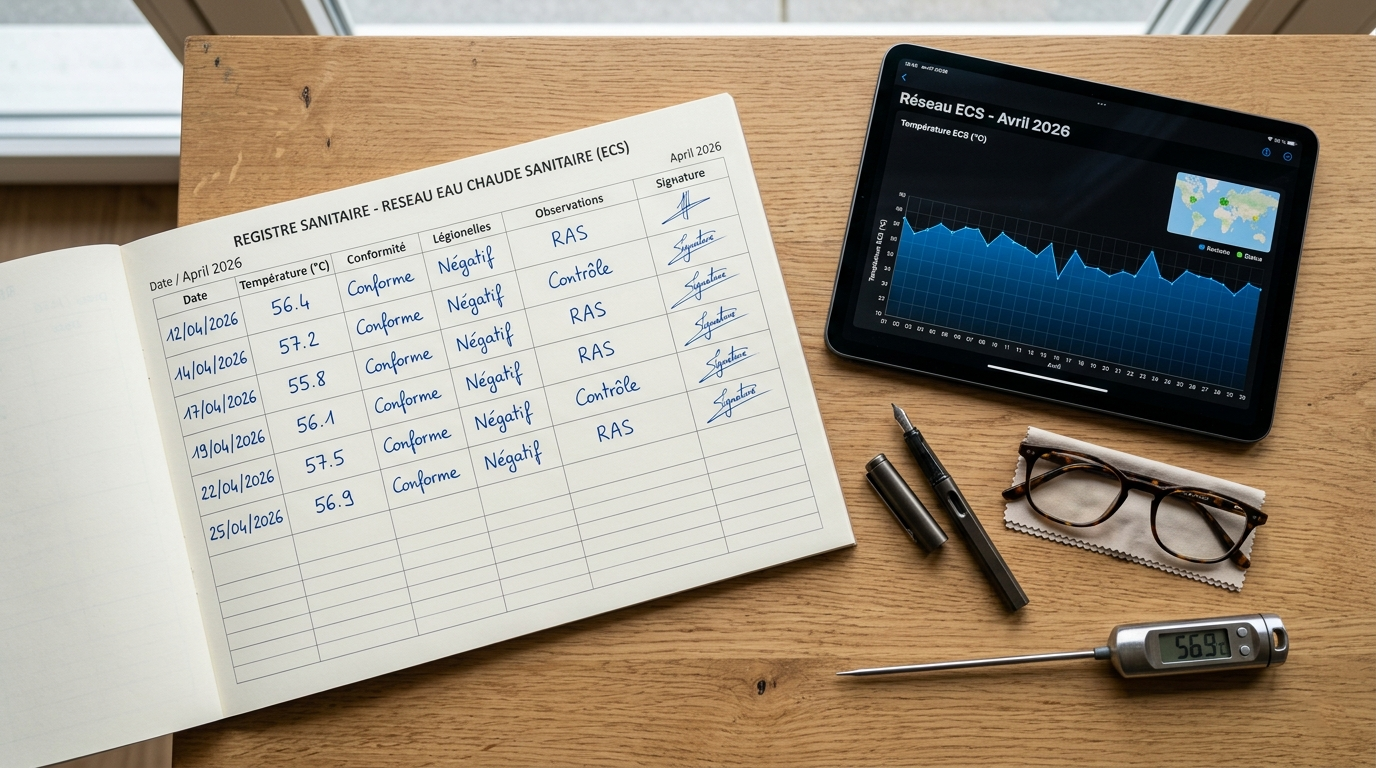
| Sanitary logbook | Mandatory for ERP | Mandatory – available to authorities |
| Authority notification | Mandatory if > 1,000 CFU/L | Notification to competent authority |
⚠️ Mandatory disinfection before recommissioning (France)
According to article R1321-56 of the Public Health Code, it is mandatory to clean, rinse and disinfect water networks and installations before commissioning or recommissioning. This obligation fully applies to the spring reopening of seasonal hotels, campsites, sports changing rooms and any establishment that has experienced a prolonged interruption of activity.
6. DIMM solutions for preventing and treating bacteriological risk
Solution 1 – UV sterilisation: chemical-free disinfection
Disinfection by ultraviolet light is the most recommended solution for bacteriological prevention in professional water circuits. UV-C lamps at 254 nanometres alter the DNA and RNA of bacteria, viruses and microorganisms, rendering them incapable of reproducing – without any addition of chemical products and without altering the taste or composition of the water.
UV sterilisation is particularly suitable for water entry points (wells, boreholes), post-DHW distribution systems, collective showers and rainwater harvesting installations. It must be preceded by pre-filtration to eliminate particles that create a shadow effect.
🔗 DIMM Solutions – UV Sterilisation
- DIMM UV systems (domestic use) – compact, easy to maintain, for private wells, boreholes and rainwater. Immediate protection without chemicals. Annual UV lamp replacement.
- DIMM professional UV units – sized according to flow rate and risk level. Suitable for ERP, hotels, campsites, nursing homes and healthcare facilities.
- High-flow twin UV systems – for high flow rates or critical redundancy in healthcare.
Solution 2 – Filtration to protect UV and purify upstream
Before any UV steriliser, effective pre-filtration is essential. Turbidity, suspended matter, iron and manganese create a shadow effect that reduces UV efficiency. DIMM filter media and filter housings form the first line of defence in the microbiological treatment chain.
🔗 DIMM Solutions – Pre-filtration before UV
- DIMM filter housings and automatic filters – retain particles, sediments and suspended matter. Essential first stage before any UV steriliser.
- Filter media (sand, activated carbon, KDF) – sand for mechanical filtration, activated carbon for taste/chlorine/VOC, KDF for heavy metals and bacteria reduction.
Solution 3 – Water softening: fighting limescale biofilm
Limescale is Legionella's best ally: scale deposits create crevices where bacteria settle and protect themselves from thermal and chemical treatments. A professional water softener upstream of the DHW network significantly reduces limescale biofilm formation and improves the effectiveness of anti-Legionella treatments.
🔗 DIMM Solutions – Softening and anti-biofilm
- DIMM professional water softeners – ion exchange to eliminate limescale, reduce biofilm, protect heat exchangers and improve the effectiveness of anti-Legionella treatments in DHW networks.
- DIMM anti-scale inhibitors – complementary solution for networks where a softener is not feasible.
Solution 4 – Water testing: detect before you act
Legionella is invisible, odourless and tasteless. Without analysis, it is impossible to know if an installation is contaminated. DIMM tests allow rapid on-site diagnosis. For regulatory Legionella analyses, an accredited laboratory is required – but field tests allow intermediate monitoring of parameters promoting proliferation (turbidity, temperature, pH).
🔗 DIMM Solutions – Testing and monitoring
- DIMM water tests – test strips, reagents and analysis kits for rapid measurement of pH, turbidity, hardness, temperature and other parameters. Essential for field diagnosis and monitoring between regulatory Legionella analyses.
7. Spring recommissioning protocol: step-by-step guide
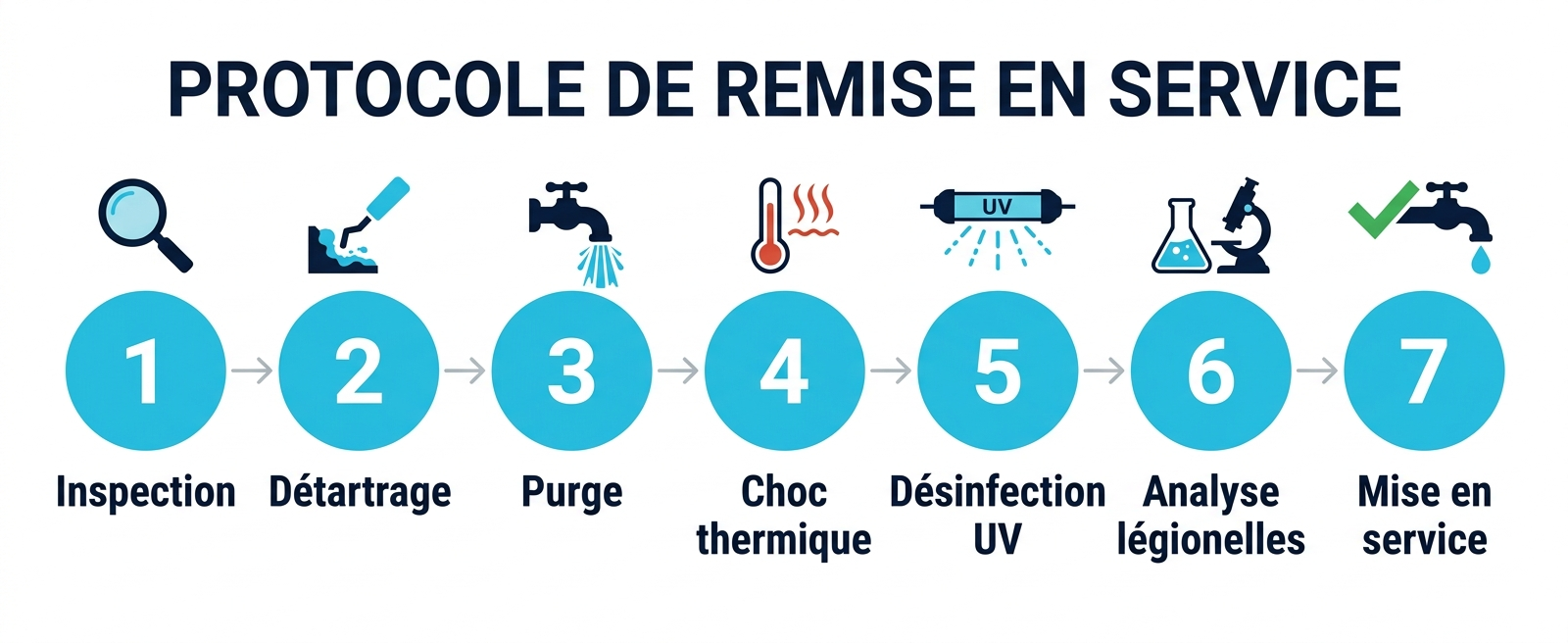
🔧 Spring recommissioning protocol – Key steps
- Visual inspection → Check the condition of tanks, pipes, showerheads, flexible hoses. Replace if biofilm or visible corrosion.
- Descaling → DIMM filter media and inhibitors – eliminate limescale deposits that protect bacteria.
- Complete purge → Drain all tanks, purge all points of use, including little-used rooms and branches.
- Thermal shock → Raise to 70 °C for a minimum of 30 minutes at all points (temperatures to be recorded in the sanitary logbook).
- UV disinfection → Activation or installation of UV sterilisers upstream of sensitive points.
- Legionella analysis → Sampling by accredited laboratory before welcoming the public.
- Commissioning → Weekly monitoring of temperatures and purging of little-used branches for the first 4 weeks.
8. Specificities by type of establishment
Hotels and tourist accommodation
The spring reopening of a hotel is the moment of maximum risk. Rooms little used in winter have had their showers stagnating for months. Every room must be purged before welcoming the first guests. The hotelier is responsible for the quality of sanitary water – their civil and criminal liability may be engaged in case of legionellosis attributable to the establishment.
Campsites and outdoor accommodation
Collective campsite showers are among the highest-risk installations: water stagnant all winter in often uninsulated pipes, temperatures close to the critical range in spring, sudden high attendance from the first fine days. A thermal shock and Legionella analysis are essential before the first opening of the season.
Healthcare facilities and nursing homes
These establishments are subject to the strictest requirements: Legionella tolerance at points of use accessible to patients is below the detection limit. The management protocol must be formalised, documented and audited regularly. DIMM UV systems are particularly recommended at terminal points of use.
Sports centres, swimming pools and spas
Collective showers, changing rooms, whirlpool baths and jacuzzis constitute a cluster of multiple risk points within a single establishment. Spring reopening after winterisation requires a rigorous protocol including spa draining, descaling and thermal shock of the entire network.
Conclusion: act now, before Legionella acts for you
Legionellosis is not inevitable. It is a 100% preventable disease with the right equipment and proper maintenance practices. But it requires permanent vigilance, particularly in spring during recommissioning, and a prevention chain with no weak link: temperature, circulation, filtration, UV disinfection and regular monitoring.
ERP managers have a legal and moral responsibility towards their users. Specialised installers and distributors are their trusted partners for designing, installing and maintaining compliant installations.
At DIMM, we have been supporting professionals for over 30 years in the microbiological safety of their water installations – swimming pools, hotels, campsites, healthcare facilities. Contact our technical team for an audit of your installations before spring reopening.
References & sources
- Viessmann – Legionellosis: DHW temperature, proliferation, prevention
- Energie Plus – Legionellosis: critical temperatures, biofilm, amoebae, 80 °C resistance
- Thermor – Legionellosis: water heater settings, temperature zones, prevention
- Nicoll – Legionellosis DHW: dead legs, stagnation, ERP regulations
- Légifrance – Decree of 1 February 2010 – Legionella monitoring DHW (amended 2022)
- Herli / Légifrance – Legionella ERP regulation – frequencies, thresholds, sanitary logbook
- Guide Bâtiment Durable (BE) – Legionella Belgium – Flemish, Brussels regulations, NBN standards
- Advizeo – Legionella risk: sanitary logbook, alert thresholds, corrective procedures