


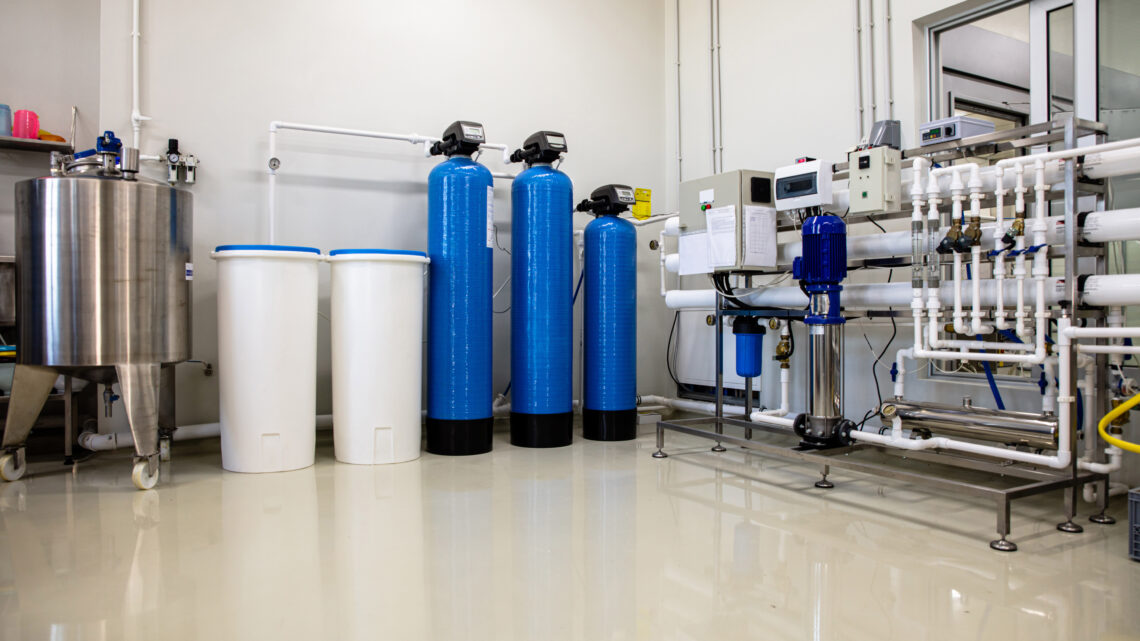
This technical guide, written by the DIMM NV technical department, is intended for site managers, maintenance technicians and engineering consultants working on industrial and food-processing water softeners. It covers preventive maintenance protocols, critical regeneration parameters, disinfection and regulatory compliance.
For residential water softeners, see our dedicated domestic maintenance guide.
Professional intervention only · All maintenance and interventions on industrial or food-processing water softeners must be carried out by a qualified specialist technician. These systems involve chemical parameters, disinfection protocols and regulatory requirements (NSF, EC 1935/2004, HACCP) that require specific training and appropriate tools. Never attempt any intervention without the required expertise.
1. Industrial maintenance: specific challenges
In industrial settings, a softener failure or non-compliant water can have major consequences: production shutdowns, damage to expensive equipment (boilers, cooling towers, RO systems), food safety non-compliance, or impact on finished product quality.
Industrial softeners differ from residential systems in:
- Much larger flow rates and resin volumes (hundreds of litres to several m³)
- Stricter purity requirements (hardness leakage < 0.5 °f or even < 0.1 °f)
- Specific regulatory constraints (NSF, EC 1935/2004, ACS, HACCP standards)
- Continuous operation often requiring duplex or triplex alternating systems
2. Industrial resins: types and monitoring
2.1 Resin types
| Resin type | TEC (meq/L) | Granulometry | Application |
|---|---|---|---|
| Strong acid gel (SAC gel) | 1.7 – 2.0 | 0.3 – 1.2 mm | Municipal water, standard process |
| Strong acid macroporous (SAC mac.) | 1.5 – 1.8 | 0.4 – 1.2 mm | Water high in chlorine, oxidants, organics |
| Fine mesh (FM) | 1.9 – 2.1 | 0.2 – 0.6 mm | Advanced demineralisation, food processing |
| Inert resin / ballast layer | · | 1.0 – 2.5 mm | Mixed bed, active resin support |
2.2 Exchange capacity control (TEC)
Total exchange capacity (TEC, in meq/L or kg CaCO₃/m³) is the key monitoring parameter in industrial settings. It decreases due to oxidation, organic fouling and iron/manganese poisoning.
DIMM laboratory test protocol:
- Sample 100 mL of wet resin at end of service
- Condition to H⁺ form (4% HCl, 3 cycles × 30 min)
- Elute with 0.1 N NaOH; potentiometric titration
- Calculate: TEC (meq/L) = (V_NaOH × C_NaOH) / V_resin
Critical threshold · A TEC reduction exceeding 20% from original value requires partial or total replacement. In food processing, some specifications require a 15% threshold.
2.3 Preventive treatments based on source water quality
- Dissolved iron > 0.2 mg/L · 5% citric acid injection (target pH 3.5–4.0), monthly maintenance cycle, ≥ 4 h contact
- Colloidal silica > 30 mg/L · monthly 2% NaOH treatment, water T° > 35 °C preferred
- Organic fouling (NOM, humates) · hot brine regeneration (40 °C) combined with food-grade non-ionic surfactant
- Manganese > 0.05 mg/L · upstream oxidation pre-treatment (KMnO₄ or H₂O₂) mandatory
WARNING · Never use concentrated sulphuric acid on SAC resin without a specific protocol: risk of irreversible CaSO₄ precipitation within the resin.
3. Regeneration: critical parameters and optimisation
3.1 Regeneration rate
| Regeneration mode | Salt (g NaCl / L resin) | NaCl efficiency (%) | Hardness leakage (°f) |
|---|---|---|---|
| Standard co-current | 80 – 120 | 40 – 55% | 0.5 – 2.0 |
| Economy co-current | 50 – 80 | 55 – 65% | 2.0 – 5.0 |
| Counter-current (upflow) | 60 – 100 | 65 – 80% | < 0.5 |
| Counter-current double bed | 80 – 120 | 70 – 85% | < 0.1 |
Brine volume formula:
V_brine (L) = (Q_salt × V_resin) / C_brine
3.2 Brine injection rate
- Too fast (> 5 BV/h) · insufficient contact, incomplete regeneration, salt overconsumption +15 to +25%
- Too slow (< 1.5 BV/h) · brine stratification and channeling risk
- DIMM recommended range · 2 to 4 BV/h for standard SAC resin
3.3 Rinse water · industrial volumes
- Backwash · 2 to 3 BV at 6–10 m/h until clear (max 50% bed expansion)
- Slow rinse · 2 BV at brine rate
- Fast rinse · 3 to 6 BV at nominal service rate (8–15 m/h). Stop at conductivity < 50 µS/cm above source
- Typical total · 8 to 15 L rinse water per litre of resin per cycle
Effluent management · Regeneration brine is an effluent. Maintenance must ensure rinse and regeneration waters are disposed of in compliance with local environmental regulations.
4. Brine tank: industrial maintenance
4.1 Periodic inspections
| Frequency | Action | Validation criterion |
|---|---|---|
| Weekly | Salt level check, no salt bridge, float verification | Salt ≥ 1/3 tank capacity |
| Monthly | Brine well: no sludge, clean screen, level sensor | No deposit > 5 mm |
| Bi-annual | Complete drain, HP cleaning, tank bottom inspection, float seal replacement | Clean bottom, no cracks |
| Annual | Brine concentration check (densimetry/refractometry), connection leak test | C = 260–310 g/L NaCl |
4.2 Industrial salt specifications
- Salt pellets · NaCl ≥ 99.5%, EN 973 Type A
- Compressed tablets · NaCl ≥ 99.8%, recommended for industrial and food-processing
- Refined evaporated salt · NaCl ≥ 99.9%, ultra-pure process water installations
PROHIBITED · De-icing salt, unrefined sea salt and salts with anti-caking agents (potassium ferrocyanide > 20 mg/kg) are strictly forbidden.
5. Multi-port control valve: industrial maintenance
5.1 Industrial valve technologies
- Rotary valve (Fleck, Autotrol, Clack) · cam disc, high reliability, standardised parts. Suitable for medium-capacity single-vessel installations.
- Multi-piston valve (Pentair, GE, Grundfos) · independent electric actuators, full programming flexibility, onboard diagnostics. Preferred for large capacities and duplex/triplex systems.
5.2 DIMM annual maintenance kit
- O-rings replacement · EPDM or silicone compatibility
- Cycle disc / pistons · 5% citric acid cleaning (no abrasive tools)
- Drive motor · torque, axial play, connectors
- Bypass · full open/close test, no seat leakage
- Venturi injectors · disassemble, ultrasonic or citric acid cleaning, bore diameter (±0.05 mm)
- Lubrication · NSF H1 approved food-grade grease only
Food processing compliance · All lubricants, cleaning products and contact parts must be NSF International approved or EC 1935/2004 compliant. Keep data sheets in maintenance file.
6. Water quality control · industrial requirements
| Parameter | Method | Frequency | Target |
|---|---|---|---|
| Residual hardness (TH) | Strip / EDTA titrator | Weekly minimum | < 1 °fH (< 0.5 for critical process) |
| Conductivity | Inline meter | Continuous or daily | Per process sheet |
| Sodium | ICP-OES / flame photometry | Monthly | ≤ 200 mg/L or per process |
| Total dissolved iron | Phenanthroline colorimetry | Monthly | < 0.1 mg/L |
| pH | Calibrated pH meter | Monthly | 6.5 – 9.5 |
| Bacteriology (CFU/mL) | R2A or HPC culture | Quarterly or after shutdown | < 100 CFU/mL |
7. Disinfection · DIMM industrial protocols
7.1 When to disinfect?
- Initial commissioning or after resin replacement
- After any shutdown exceeding 72 h without regeneration
- Quarterly on food and medical installations
- After confirmed bacteriological contamination (> 1,000 CFU/mL)
7.2 Sodium hypochlorite (NaOCl) protocol
- Prepare NaOCl solution at 50–100 mg/L active chlorine
- Inject 3 BV in service mode, nominal flow
- Contact: 30 min (gel) to 60 min (macroporous)
- Rinse minimum 10 BV until residual chlorine < 0.5 mg/L
- Complete salt regeneration before returning to service
WARNING · Active chlorine must not exceed 100 mg/L on in-service resin. On gel resin, limit to 50 mg/L.
7.3 Hydrogen peroxide (H₂O₂) protocol · food processing
H₂O₂ is preferred over chlorine in food applications for its favourable by-products (water and oxygen):
- Concentration: 30–50 mg/L H₂O₂ (technical 35%, 1/10,000 dilution)
- Contact: 2 h minimum in recirculation
- Rinse: 15 BV until undetectable residual H₂O₂
- Verify absence of catalysts (Fe, Mn, Cu) that decompose H₂O₂
8. Industrial preventive maintenance plan
| Frequency | Actions | Responsible |
|---|---|---|
| Weekly | Softened water TH · Salt level · Valve alarms | Site operator |
| Monthly | TH + conductivity + pH · Brine well · Valve programme · Iron analysis | DIMM technician or qualified operator |
| Quarterly | Preventive disinfection (food) · Bacteriology · Volumetric counter | DIMM technician |
| Bi-annual | Brine tank cleaning · Resin inspection · Timed full cycle · Venturi | DIMM technician |
| Annual | Valve seals · Resin TEC · Full water analysis (ICP) · Motor/programmer · Sensor calibration | Certified DIMM technician |
| 3 to 5 years | Resin replacement · Pressure vessel inspection · Smart valve firmware | DIMM NV + approved body |
9. Quick troubleshooting · industrial installations
| Symptom | Probable causes | Corrective actions |
|---|---|---|
| Permanently hard output | Bypass open, exhausted resin, channeling, stuck valve | Check bypass, force regeneration, inspect resin, disassemble valve |
| Salty output | Insufficient rinsing, blocked Venturi, valve stuck in brine | Extend rinsing, clean Venturi, check valve sequence |
| No brine suction | Blocked Venturi, low brine, air in line, failed check valve | Clean Venturi, check level/density, bleed line |
| Abnormal salt consumption | Over-regeneration, brine leak, frequency too high | Recalculate dosing, inspect seals, revise programme |
| Significant flow loss | Resin blockage, insufficient backwash, partial screen | Extended backwash, screen inspection, fines/TEC analysis |
| Post-regeneration conductivity alarm | Insufficient fast rinse, low rinse flow, concentrated brine | Increase rinse volume, check flow, control concentration |
10. DIMM technical support
For preventive maintenance, water analysis, resin replacement or installation audit, the DIMM technical team is at your disposal.
- Industrial salt and consumables → view catalogue
- Valves and spare parts → view catalogue
- Test and analysis kits → view catalogue
- Industrial resins and bottles → view catalogue
- Industrial softeners → view range
For any technical enquiry or installation audit, contact the DIMM team.
Note · This document is reserved for internal DIMM NV use and its professional clients. Technical values are given for guidance and must be adapted to each specific installation.