



Compliant drinking water must be clear, with no unpleasant taste or smell: these are the so-called organoleptic parameters, governed by the rules on water intended for human consumption (European Directive 2020/2184, transposed in France and Belgium). Yet an abnormal taste or smell remains the leading source of consumer dissatisfaction · with chlorine at the top.
Good news for the professional: a taste or smell is not inevitable, it is a symptom. Each manifestation points to an identifiable cause · network, water heater, pipes, borehole water · and to a specific treatment technology. You just have to know how to read the signals.
This guide reviews the six most common tastes and odours, their probable origin and the DIMM solution to recommend. A diagnostic tool to keep at hand during your customer visits.
1. Why does water take on a taste or smell?
The taste and smell of water depend on compounds present in very low concentrations, sometimes detectable at a millionth of a gram per litre. They come from four broad families of origins:
- Network treatment: disinfection chlorine, essential, leaves a characteristic taste.
- Private installations: water heater, metal or plastic pipes, dead legs where water stagnates.
- The source: borehole or surface water loaded with iron, manganese, sulphur or organic matter.
- Microbiological growth: bacteria and biofilms that produce odorous compounds.
Identifying the family concerned is already half the diagnosis. The simple test to do at the customer's home: does the water smell at the cold tap, the hot tap, or both? Does the problem disappear after letting it run for a few minutes? These two questions immediately steer the search.
2. The 6 common tastes and odours · express diagnosis
The table below sums up the essentials; the following sections detail the most frequent cases.
| Symptom | Probable cause | Where? | DIMM solution |
|---|---|---|---|
| Chlorine taste/smell (bleach, pool) | Disinfection of the public network | Cold tap | Activated-carbon filtration, osmosis |
| Rotten egg (sulphur) | Hydrogen sulphide (H₂S), sulphate-reducing bacteria | Mostly hot tap / borehole | Heater disinfection, oxidation + filtration, UV |
| Earthy / musty | Geosmin & MIB (algae, organic matter) | Surface or well water | Activated carbon, ultrafiltration |
| Metallic | Iron, manganese, sometimes copper/zinc | Borehole, corroded pipes | Iron removal / oxidation + filtration |
| Plastic / chemical | VOCs, solvents, new pipes | Private network | Activated carbon, reverse osmosis |
| Salty / brackish | Chlorides, saline intrusion, misadjusted softener | Coastal borehole / installation | Reverse osmosis, softener check |
3. Chlorine taste and smell: complaint No. 1
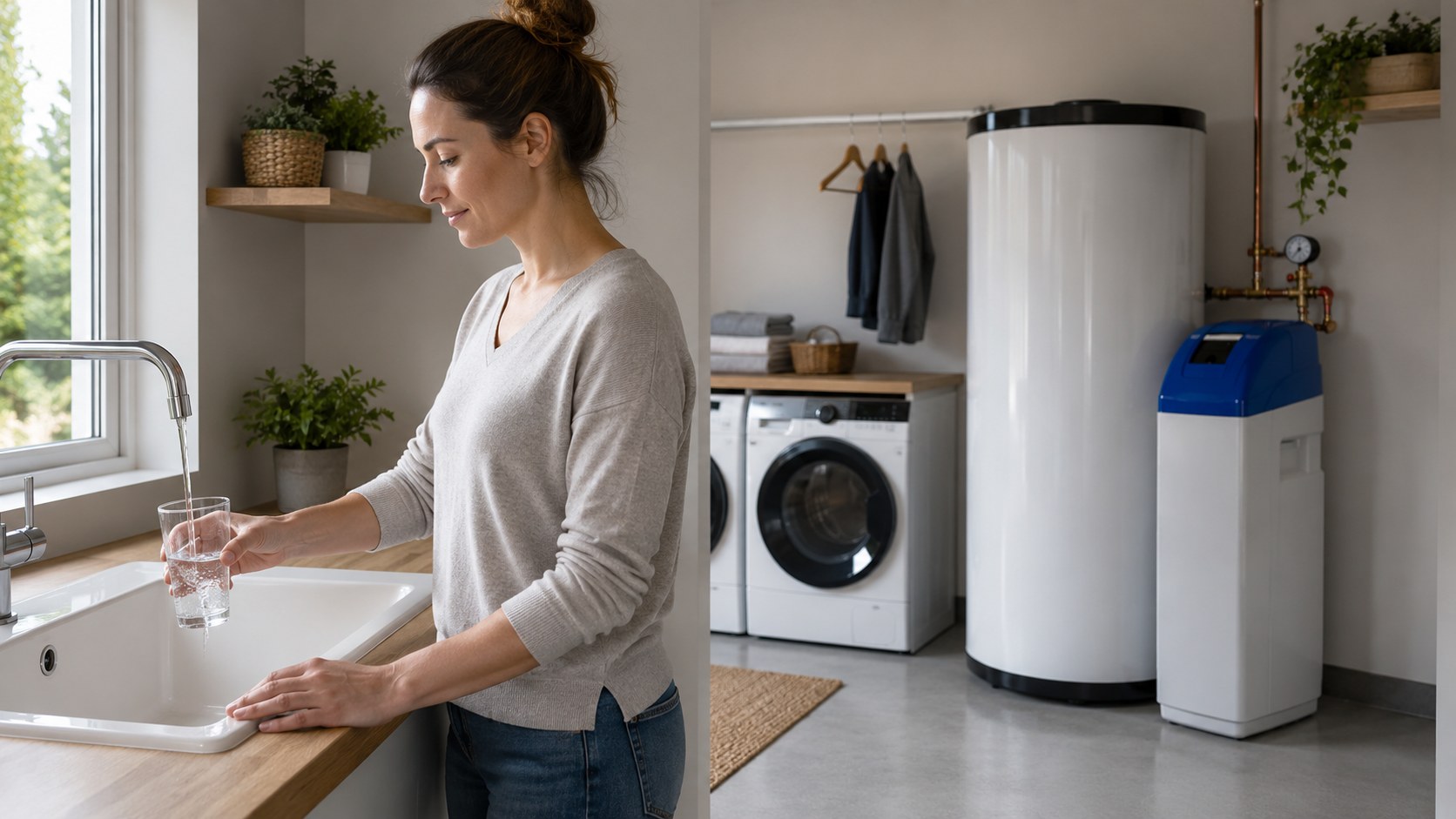
Chlorine is essential: it guarantees water potability throughout the network. But its taste and smell · close to pool water · are the main reason consumers drink bottled water. The symptom is typical: it appears at the cold tap and fades if the water rests for a few minutes or in the fridge.
The most effective solution is activated carbon, which adsorbs chlorine and disinfection by-products. Depending on the customer's need, it takes the form of an under-sink cartridge, a point-of-use filter or a reverse-osmosis unit for optimal drinking water.
4. Rotten-egg smell: watch the water heater
The sulphur / rotten-egg smell betrays the presence of hydrogen sulphide (H₂S), perceptible from 0.05 mg/L. The key diagnostic point: if the smell appears only at the hot tap, the cause is almost always the domestic water heater. Sulphate-reducing bacteria develop there, favoured by too low a temperature and the reaction with the magnesium anode.
The responses: disinfect the heater, raise the thermostat above 55–60 °C, or even replace the anode. If the smell is present at both taps, the origin is the source (borehole): you then need to oxidise then filter, and consider a UV treatment against bacterial growth.
⚠️ The test that steers everything
Smell only at the hot water → water heater. Smell at cold AND hot water → source or network. This simple reflex avoids treating in the wrong place.
5. Earthy, metallic, plastic: the other signatures
Earthy or musty taste
Typical of surface and borehole water, it comes from geosmin and MIB, compounds released by algae and the decomposition of organic matter. Harmless but very perceptible, they are effectively treated with activated carbon, supplemented if needed by ultrafiltration.
Metallic taste
A sign of excess iron or manganese (borehole water) or of pipe corrosion (copper, zinc, galvanised steel). Beyond taste, iron and manganese stain laundry and sanitaryware. The typical response: oxidation then media filtration (iron/manganese removal).
Plastic or chemical taste
Often linked to new pipes, to volatile organic compounds (VOCs) or to solvents. Activated carbon and reverse osmosis are the safest barriers.
6. The multi-barrier approach: the right professional response
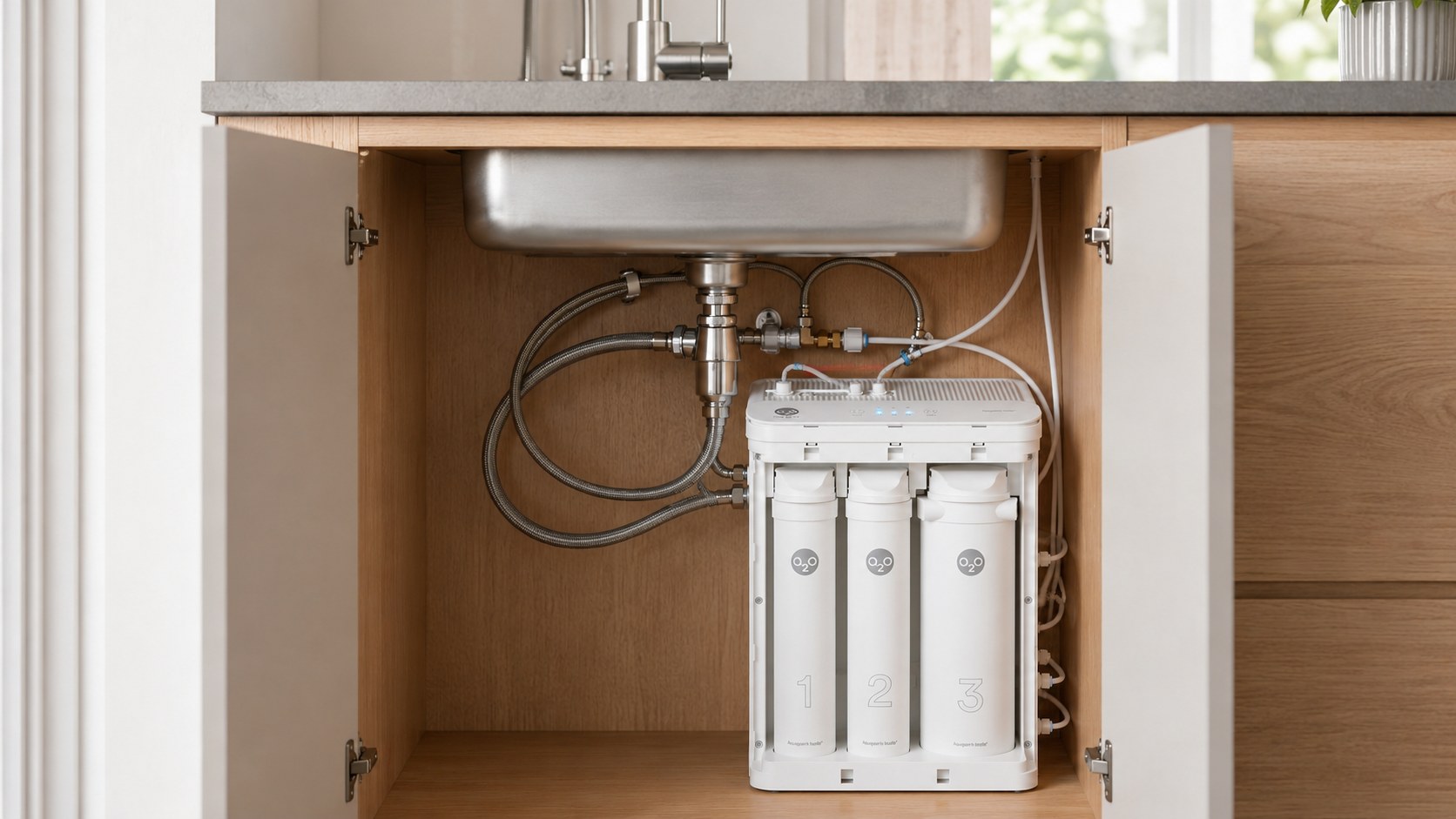
A taste or smell rarely results from a single cause. The reliable response is to stack barriers according to the diagnosis:
- Sediment prefiltration · retains particles, rust and turbidity upstream.
- Activated carbon · removes chlorine, VOCs, geosmin, MIB and most tastes/odours.
- Oxidation + media filtration · for iron, manganese and sulphur.
- Reverse osmosis · complete purification for drinking water (dissolved salts, residual tastes).
- UV · secures microbiologically without chemicals.
The right treatment is not the most complete, but the most suited to the symptom and the source. That is where the value of professional advice lies.
🔗 DIMM solutions · Tastes & odours
- DIMM activated-carbon filters & cartridges · against chlorine, VOCs and unpleasant tastes, at point of use or point of entry.
- DIMM reverse-osmosis units · purified drinking water, with no residual taste.
- Iron removers & media filtration · iron, manganese and sulphur smell.
- DIMM UV sterilisers · chemical-free disinfection against odours of bacterial origin.
7. Who is this diagnosis for?
Individuals and installers
For residential, symptom-based diagnosis is an excellent sales argument: it turns a vague complaint ("the water has a taste") into a clear, costed solution, and showcases the installer's expertise.
Hospitality, communities and industry
In hospitality, the taste of water directly affects coffee, tea, ice and cooking. In communities and food industry, organoleptic parameters also relate to compliance and image. Controlling tastes and odours there is a service-quality issue.
Conclusion: one symptom, one cause, one solution
Tastes and odours are not inevitable: they are valuable indicators which, read correctly, lead directly to the right solution. Chlorine at the cold tap, rotten egg at the hot water, earthy in surface water, metallic in boreholes: for each signature, a proven technical response.
The DIMM teams support partner installers, distributors and resellers in the diagnosis and choice of treatment solutions · carbon filtration, osmosis, iron removal, UV · suited to each water, in France and Belgium.
Reference points
- Directive (EU) 2020/2184 on the quality of water intended for human consumption · organoleptic parameters (odour, taste, clarity).
- Hydrogen sulphide (H₂S): olfactory detection threshold in water ≈ 0.05 mg/L.
- Earthy/musty tastes: geosmin and 2-methylisoborneol (MIB) of algal origin.