


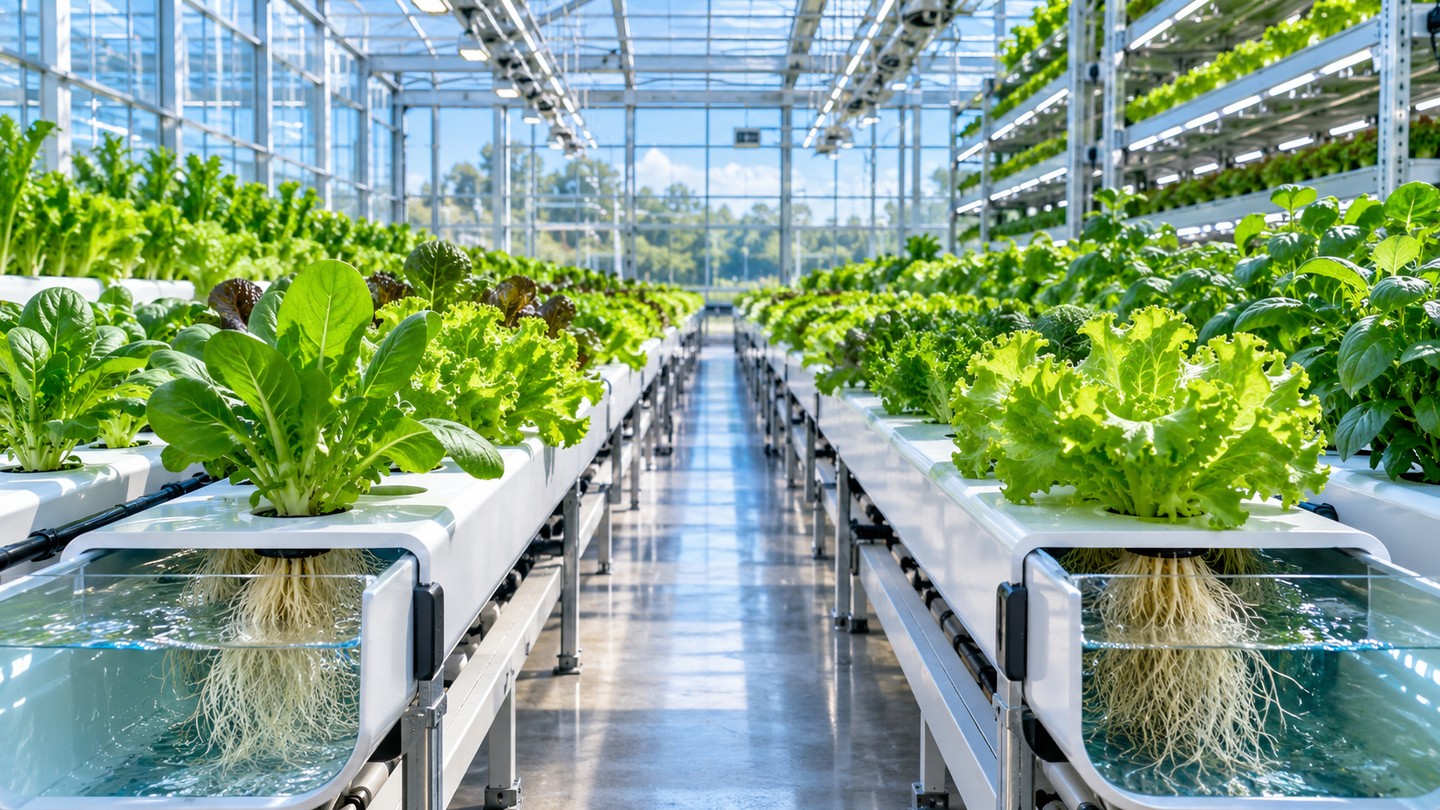
In hydroponics, plants grow without soil, their roots fed directly by a nutrient solution (water + mineral salts). Water thus becomes the living medium and the carrier of every nutrient: its quality drives growth, yield and crop health.
Yet tap water already contains variable minerals (limescale, sodium, bicarbonates) and chlorine, which skew fertiliser dosing and disturb uptake. Hence a golden rule among serious growers: control the source water. Here is how, in depth.
1. Hydroponics: growing in water
Hydroponics covers all soil-free growing techniques where roots are fed by a nutrient solution, with or without an inert substrate (rockwool, clay pebbles, coco fibre). The main systems:
- NFT (Nutrient Film Technique): a thin film of solution flows continuously through channels.
- DWC (Deep Water Culture): roots sit in an oxygenated solution.
- Ebb & flow: the substrate is flooded then drained in cycles.
- Drip: the solution is delivered at the base of each plant.
- Aeroponics: roots, in open air, are misted with solution.
In every case, one common point: everything goes through the water. There is no soil left to buffer mistakes, so the water must be perfectly controlled.
2. Why water quality is decisive
In open ground, soil acts as a reservoir and a buffer: it stores nutrients, corrects excesses, cushions variations. In hydroponics this buffer disappears. The slightest variation in the water hits the plant immediately.
Another problem: tap water contains a variable and unknown amount of minerals. When you add fertiliser, the maths no longer add up. Concrete example: on city water at 0.8 mS/cm, adding the fertiliser dose meant to reach 1.5 mS/cm actually yields 2.3 mS/cm, much of it from ions the plant cannot use (and sometimes harmful). Hence the value of starting from neutral water.
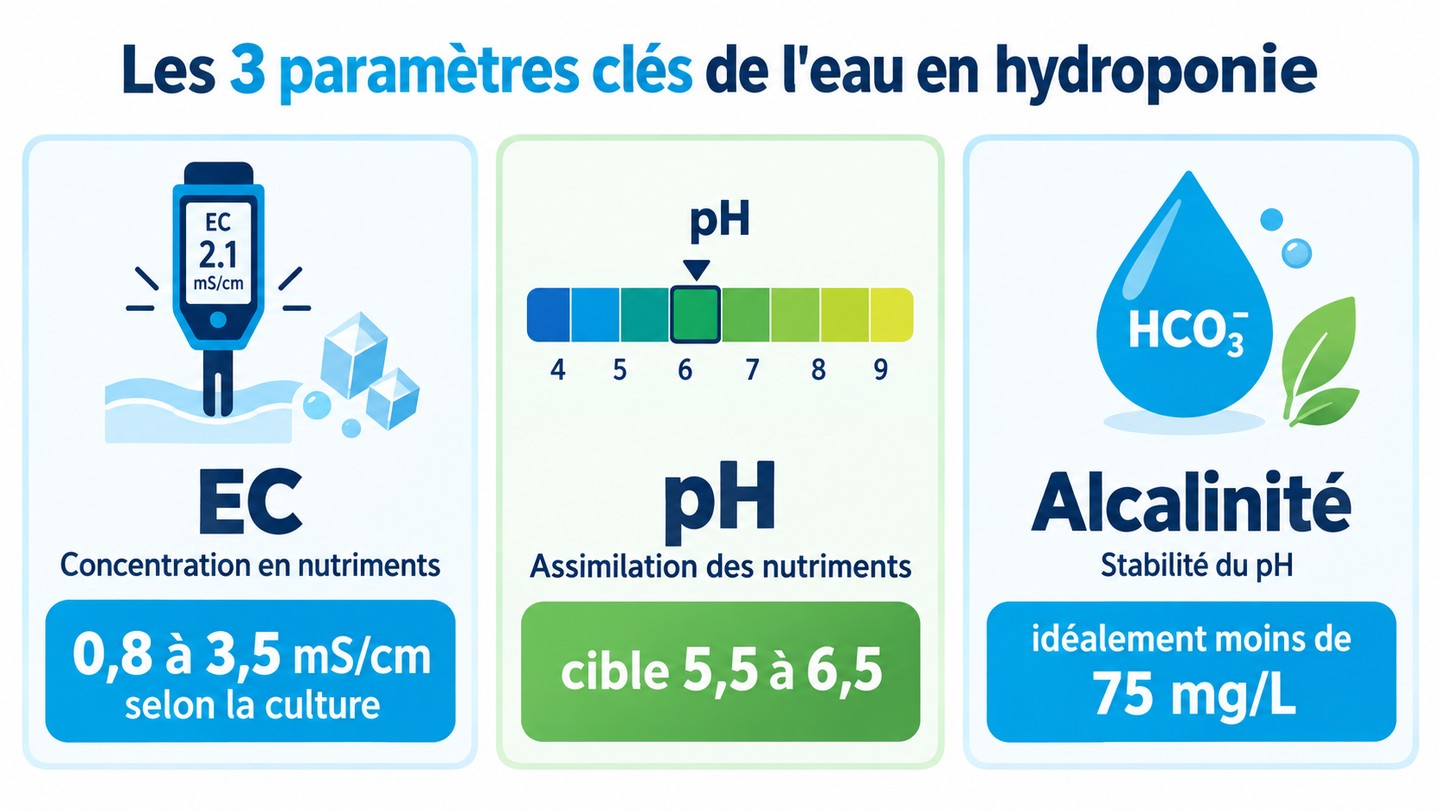
3. The 3 key parameters: EC, pH, alkalinity
Three indicators steer all of hydroponics. You must know how to measure and correct them.
| Parameter | What it measures | Target range |
|---|---|---|
| EC (conductivity) | Total concentration of dissolved salts (nutrients) | By crop (0.8 to 3.5 mS/cm) |
| pH | Acidity, which governs nutrient uptake | 5.5 to 6.5 |
| Alkalinity (bicarbonates) | The water's ability to buffer pH | Low (ideally < 75 mg/L) |
EC tells how many nutrients are present, but not which. pH governs the availability of each element: outside the 5.5-6.5 range, some nutrients get locked out (deficiencies despite a rich solution). Alkalinity, finally, explains why a corrected pH keeps climbing back: water too rich in bicarbonates resists adjustment.
4. EC and pH by crop
Every crop has its needs. Leafy greens want a low EC, fruiting plants a higher EC. pH stays within a close band.
| Crop | EC (mS/cm) | pH |
|---|---|---|
| Lettuce, salads | 1.2 to 1.8 | 5.6 to 6.0 |
| Herbs (basil…) | 1.0 to 1.6 | 5.5 to 6.5 |
| Strawberry | 1.4 to 2.0 | 5.5 to 6.2 |
| Tomato, cucumber, pepper | 2.0 to 3.5 | 5.5 to 6.5 |
On fruiting crops, raise EC gradually: around 2.0 at planting, up to 2.4-3.5 in full fruiting. Too low an EC caps yield; too high stresses the plant (salt burn).
5. Source water: the traps
Before even discussing fertiliser, raw water can contain elements that sabotage the crop:
| Element | Effect in hydroponics | Solution |
|---|---|---|
| Bicarbonates / alkalinity | Continuously pushes pH up, hard to stabilise | Reverse osmosis, acidification |
| Hardness (Ca, Mg) | Inflates the starting EC, skews dosing | Reverse osmosis |
| Sodium (Na) | Toxic, builds up in recirculation, non-nutritive | Reverse osmosis (never softened water) |
| Chlorine / chloramine | Attacks roots and beneficial micro-organisms | Activated carbon, osmosis |
Beware of a common misconception: softened water is not a solution. A softener replaces limescale with sodium, precisely the ion to avoid in hydroponics. For growing water you need osmosis, not softening.
6. Why reverse osmosis is essential
Reverse osmosis removes almost all dissolved salts and delivers water with EC close to 0 (0 to 50 ppm). This neutral starting point changes everything:
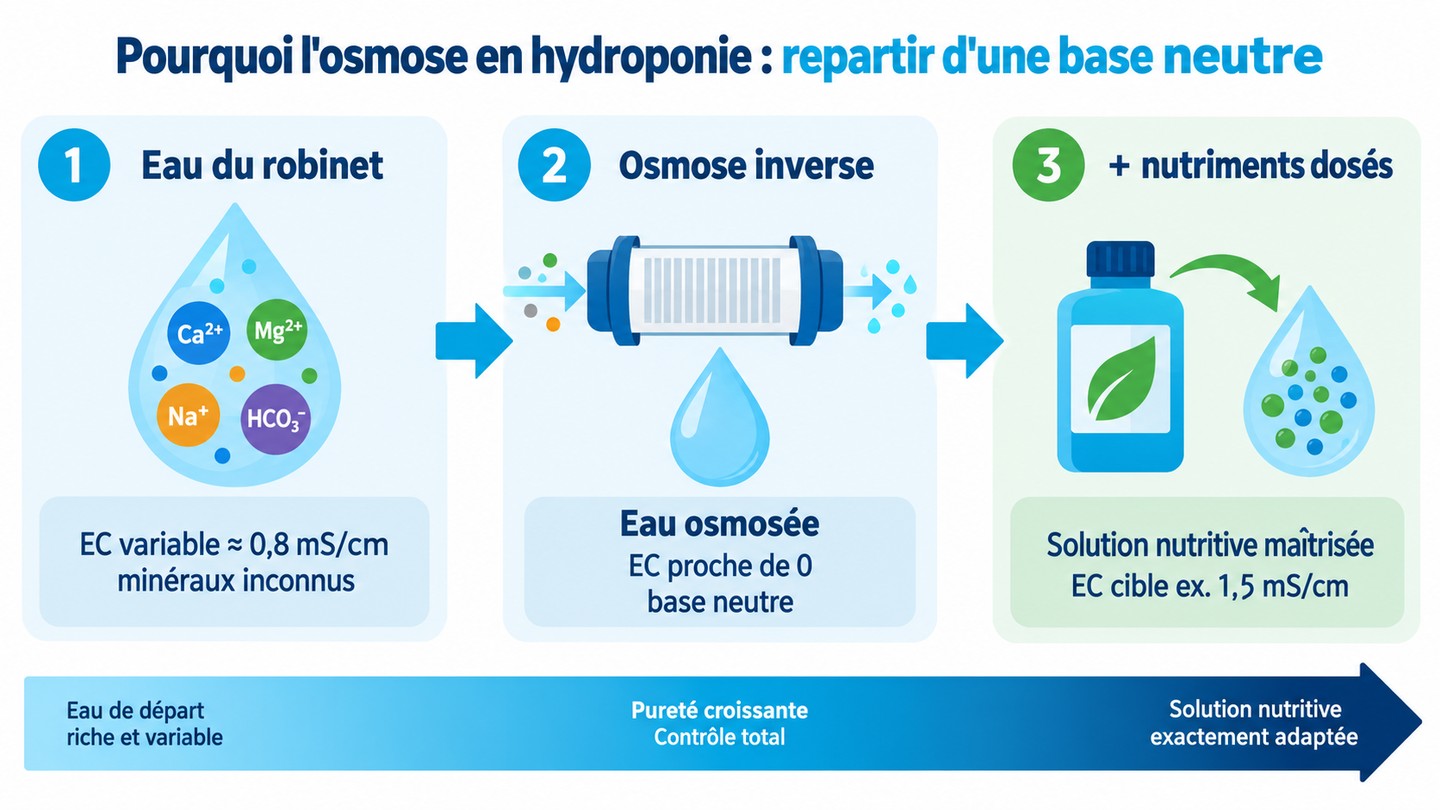
- Exact dosing: all the final EC comes from the fertilisers you add, nothing else. Recipes become reproducible.
- Stable pH: without bicarbonates, pH is set and holds.
- Zero sodium or chlorine: you remove the toxins and the nutrient competitors.
- Independence from the network's seasonal variations.
This is why most serious hydroponic growers start from RO water, which they then remineralise deliberately, with exactly the nutrients they want.
7. Systems and water needs
The system choice affects water management (volume, oxygenation, frequency):
| System | Principle | Water challenge |
|---|---|---|
| NFT | Flowing nutrient film | Continuous recirculation, watch EC/pH closely |
| DWC | Submerged roots | Oxygenation, thermal stability |
| Ebb & flow | Flooding / draining | Buffer volume, homogeneity |
| Drip | Targeted delivery | Fine filtration (anti-clogging) |
| Aeroponics | Root misting | Very clean water (fine nozzles), pressure |
The more closed and recirculating the system, the more the base-water quality and its monitoring matter, because imbalances build up.
8. Recirculation, sodium and disinfection
Recirculating systems reuse the nutrient solution, saving water and fertiliser, but create two difficulties:
- Sodium build-up: plants take up nutrients and leave Na, which concentrates cycle after cycle. An RO base water (no Na) strongly delays this; otherwise you must flush more often.
- Health risk: a recirculating solution can spread root pathogens (Pythium, Fusarium). UV disinfection of the circulating solution secures it without chemicals.
The combination osmosis (base water) + UV (recirculation loop) is today the reference for clean, sustainable growing.
9. In practice: the ideal water chain
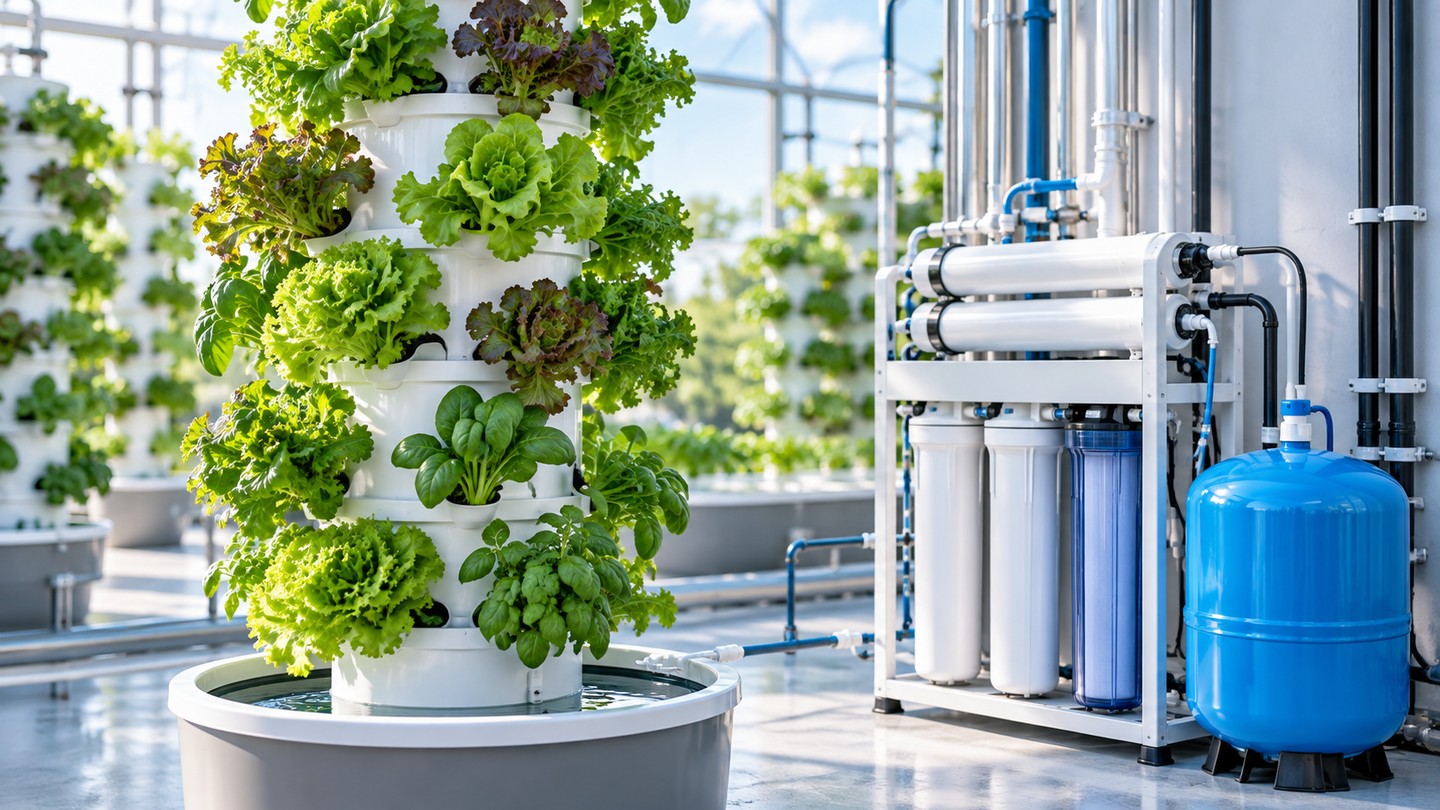
A well-designed hydroponic setup chains:
- Pre-filtration and activated carbon (removes particles and chlorine).
- Reverse osmosis: produces the neutral base water (EC close to 0).
- Nutrient remineralisation: metered fertiliser addition (target EC), pH adjustment.
- UV disinfection on the recirculation loop.
- Continuous monitoring of EC, pH and temperature.
Sizing (flow, storage, RO capacity) depends on the growing area and the system type. This is exactly what DIMM helps calibrate.
Conclusion
In hydroponics, water is not a mere support: it is the liquid soil that feeds the plant, and everything rests on controlling it. Steering the EC, holding the pH in the 5.5-6.5 range, neutralising alkalinity and sodium: none of this is reliable without clean, reproducible base water. That is why reverse osmosis, completed by UV disinfection in recirculation, has become the foundation of high-performing soil-free growing. Mastering the water means mastering the crop.
DIMM's teams support partner installers, distributors and resellers in Belgium, France and the Netherlands in choosing and sizing water-treatment solutions.
DIMM products & solutions
To build the water chain of a hydroponic crop:
- Reverse osmosis (neutral, reproducible base water)
- UV disinfection (securing recirculation)
- Filtration & activated carbon · the full DIMM range
Key points & references
- Nutrient-solution pH: optimal range 5.5 to 6.5 for most crops (lettuce optimum ≈ 5.6-6.0); outside this range some nutrients become less available.
- EC by crop: lettuce ≈ 1.2-1.8 mS/cm, herbs ≈ 1.0-1.6, strawberry ≈ 1.4-2.0, tomato/cucumber/pepper ≈ 2.0-3.5 (gradual rise from 2.0 to 2.4-3.5 in fruiting).
- Source water: above about 0.4 mS/cm, water brings bicarbonates, hardness and sulphates that compete with Ca, Mg and Fe. Example: 0.8 mS/cm city water + fertiliser gives ≈ 2.3 mS/cm instead of the expected 1.5.
- Alkalinity: water above ~75 mg/L of bicarbonates pushes the solution pH up; reverse osmosis removes it.
- Reverse osmosis: recommended base 0 to 50 ppm, then add nutrients up to the target EC; guarantees exact, reproducible dosing. Softened water (sodium-rich) must be avoided in hydroponics.
- Recirculation: sodium build-up over cycles (limited by RO base water) and root-pathogen risk (Pythium, Fusarium) controlled by UV disinfection. Information dated September 2026.