

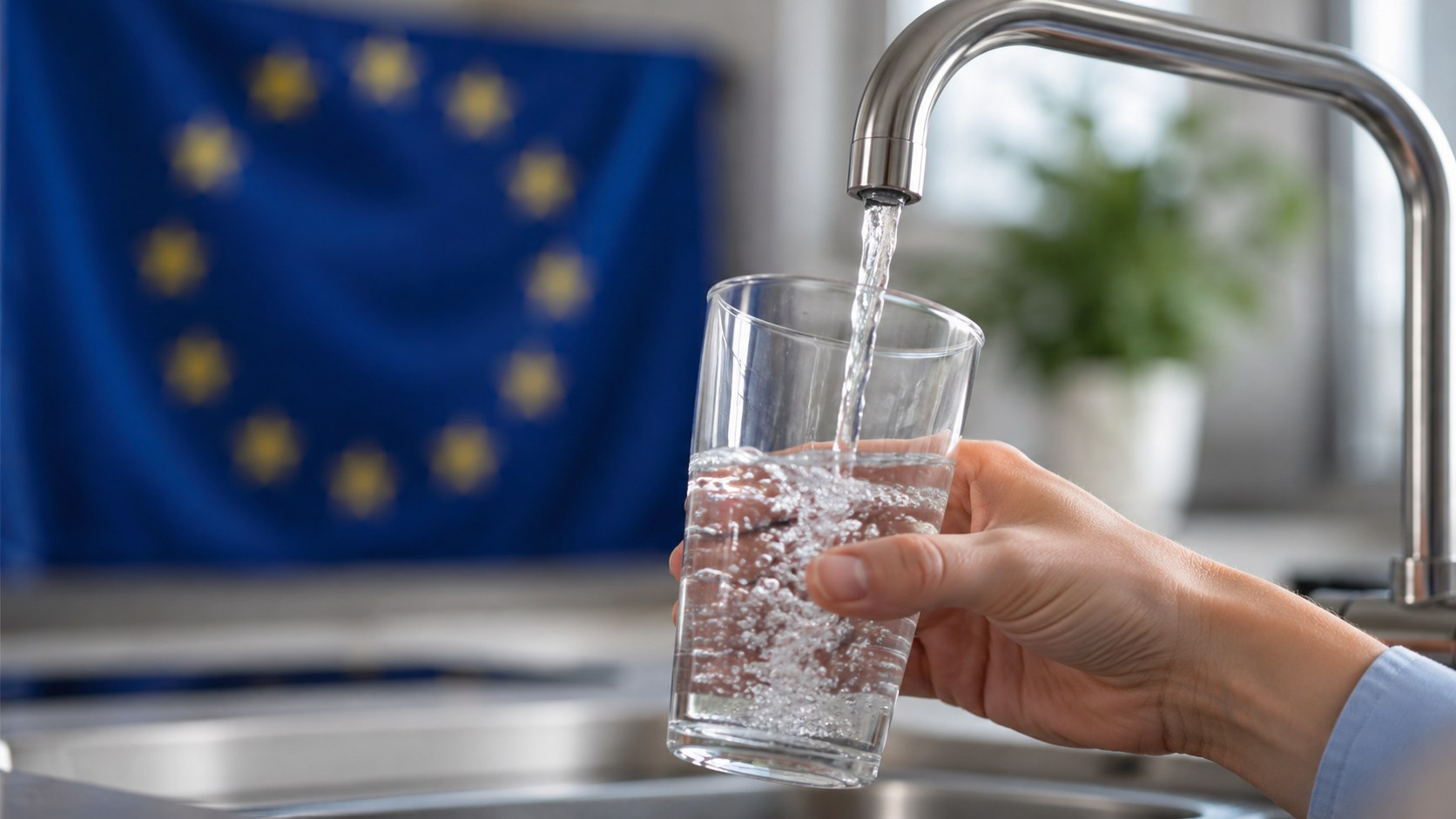
Adopted on 16 December 2020 and in force since 12 January 2021, Directive (EU) 2020/2184 replaces the former Directive 98/83/EC of 1998. It is the first major overhaul in more than twenty years of the European rules on water intended for human consumption.
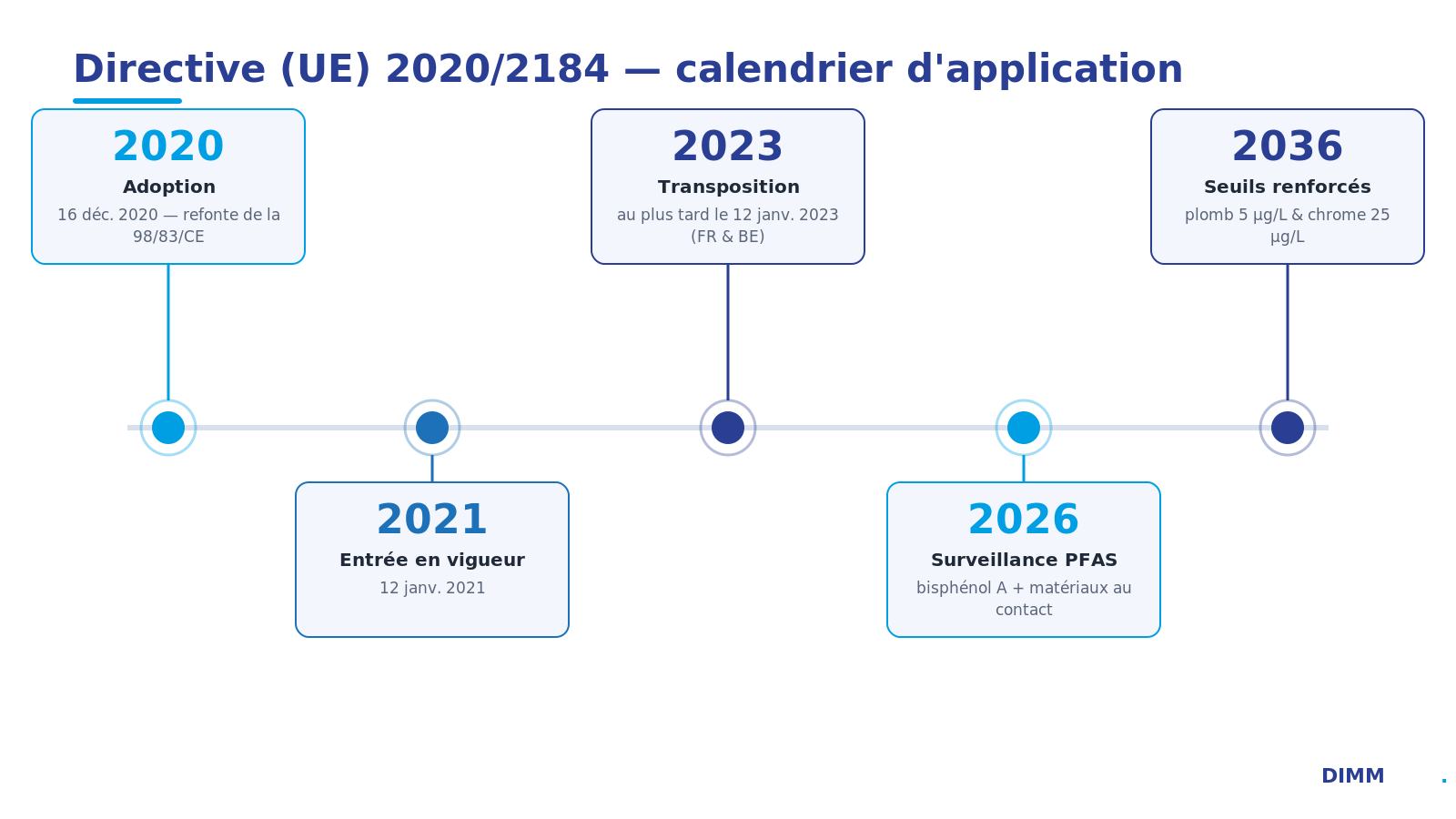
Transposed into national law by 12 January 2023 at the latest (by ordinance in France, by the Regions in Belgium), it changes the very logic of control: from checking quality at the tap to managing risks across the whole chain, from catchment to point of use. It also introduces new monitored pollutants · PFAS, bisphenol A · and tightens several thresholds.
For water-treatment professionals, this is not just a legal matter: it is a market shift. Here is what changes concretely, the timeline to remember, and the opportunities on the treatment side.
1. A change of logic: the risk-based approach
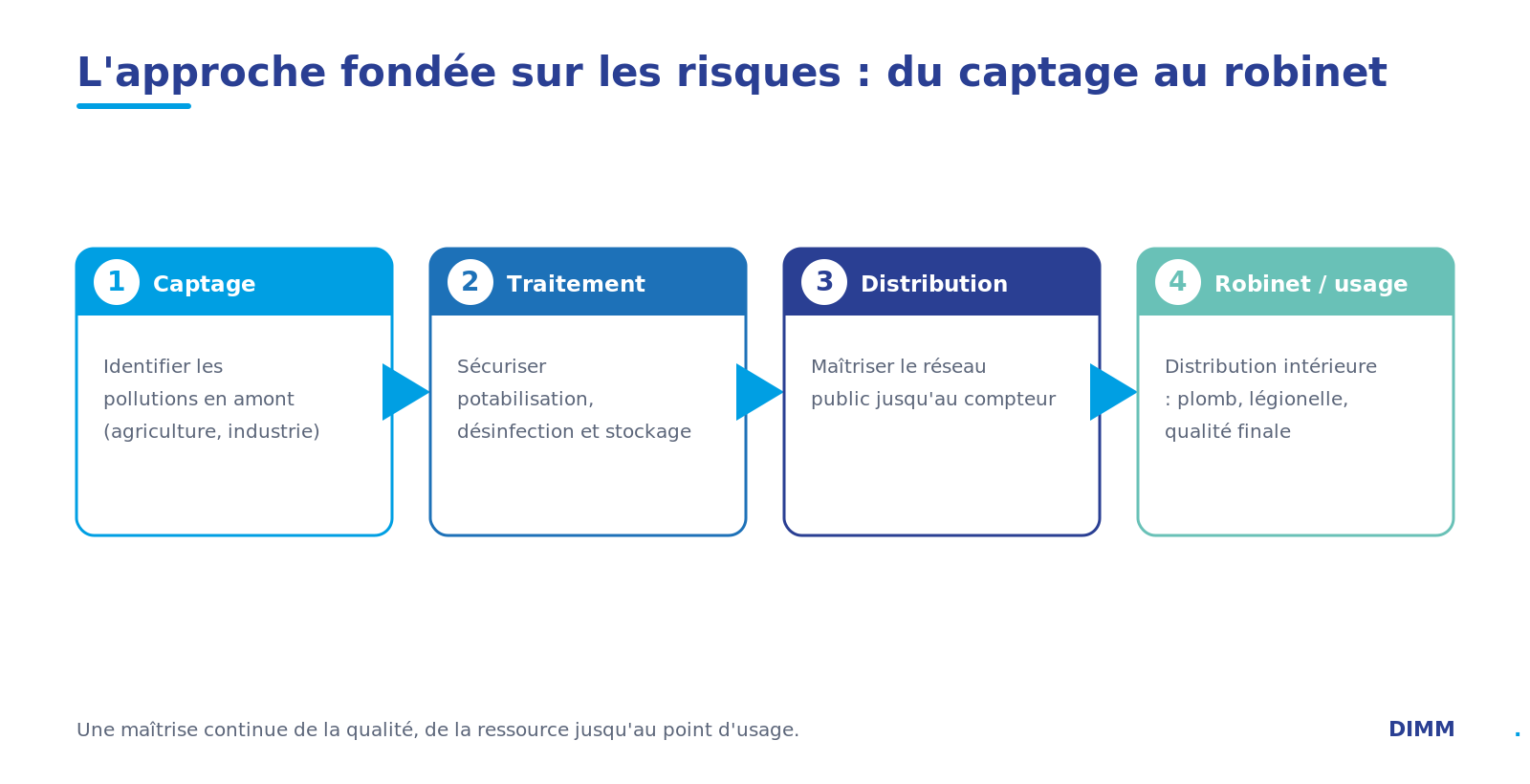
The heart of the directive is the risk-based approach applied to the whole supply chain. Where the old rules mainly checked compliance at the tap, 2020/2184 requires assessing and managing hazards at three levels:
- Catchment areas · identifying upstream sources of pollution (agriculture, industry, discharges).
- The distribution system · securing treatment, storage and the public network.
- Private installations · assessing risks in the internal distribution, particularly in priority buildings (hospitals, schools, hotels…), with attention to lead and legionella.
It is this last point that opens the most opportunities: quality no longer stops at the meter, it plays out up to the point of use · the natural playing field of treatment solutions.
2. New parameters and tightened thresholds
The directive updates the list of monitored substances and lowers several limit values. The most notable changes for professionals:
| Parameter | Value (Directive 2020/2184) | New / change |
|---|---|---|
| PFAS · sum of 20 | 0.10 µg/L | New · monitored since 2026 |
| PFAS · total | 0.50 µg/L | New (optional monitoring) |
| Bisphenol A | 2.5 µg/L | New · monitored since 2026 |
| Lead | 5 µg/L (by 12/01/2036 at the latest) | Lowered from 10 → 5 µg/L |
| Total chromium | 25 µg/L (by 12/01/2036 at the latest) | Lowered from 50 → 25 µg/L |
| Chlorate / Chlorite | 0.25 mg/L each | New (disinfection by-products) |
| Haloacetic acids (HAA5) | 60 µg/L | New (disinfection by-products) |
| Uranium | 30 µg/L | New |
| Microcystin-LR | 1.0 µg/L | New (cyanotoxin) |
Indicative values from Directive (EU) 2020/2184; refer to the text and its national/regional transposition for the exact arrangements.
⚠️ PFAS & bisphenol A: monitoring has begun
Since 12 January 2026, water services must monitor the new parameters, including the sum of 20 PFAS (0.10 µg/L) and bisphenol A. Exceedances will mechanically create demand for treatment solutions (activated carbon, reverse osmosis, specific resins).
3. The timeline to remember
The directive applies in stages: some obligations are already in force, others are spread out until 2036.
4. Materials and products in contact with drinking water
A major new feature: the directive harmonises at European level the hygiene requirements for materials and products in contact with drinking water (pipes, fittings, membranes, media, cartridges…). The aim: positive lists of authorised substances and common certification, to prevent the materials themselves from leaching contaminants.
Concretely, manufacturers and distributors must ensure they offer compliant products that meet these new requirements (phased implementation 2026-2027, set out in national decrees). For the installer, this reinforces the importance of choosing certified components.
5. Access to water and consumer information
Beyond quality, the directive carries two societal objectives:
- Improve access to water for all, particularly vulnerable groups, and promote tap water in public places and catering.
- Strengthen information: consumers must have regular, clear, online information on the quality, price and consumption of their water.
Promoting tap water assumes… that it tastes good and is trusted. This is a direct argument for filtration and organoleptic-improvement solutions in hospitality and communities.
6. What it changes concretely for professionals
The directive turns a regulatory framework into market demand. Four concrete levers:
- PFAS & micropollutants: growth of dedicated treatments · activated carbon, reverse osmosis, ion-exchange resins.
- Lead at 5 µg/L: replacing old pipes and point-of-use filtration in older buildings.
- Priority buildings: risk assessment of internal distribution (legionella, lead) → UV, filtration, softening, monitoring.
- Compliant materials: favour certified components in contact with drinking water.
🔗 DIMM solutions to anticipate 2020/2184
- Activated carbon & reverse osmosis · reducing PFAS, bisphenol A and organic micropollutants.
- Specific resins & media · targeted treatment by parameter (metals, nitrates, micropollutants).
- Point-of-use filtration · securing internal distribution, including against lead in older buildings.
- UV sterilisers · microbiological control in priority buildings.
7. Who is this change for?
Communities & water services
First concerned by the risk-based approach and the monitoring of new parameters, they need proven treatment solutions and reliable partners.
Priority buildings (healthcare, schools, hospitality)
Assessing the internal distribution becomes strategic here: lead, legionella, quality at the point of use. A market for compliance and maintenance.
Installers & resellers
The directive creates advisory opportunities: diagnose, propose the right treatment, choose compliant materials. An expertise argument in front of customers.
Conclusion: anticipate rather than endure
Directive (EU) 2020/2184 does not merely add thresholds: it moves quality management to the whole chain, up to the tap, and puts pollutants (PFAS, bisphenol A) · that only suitable treatments can reduce · centre stage. For professionals, it is a window of opportunity as much as an obligation.
The DIMM teams support partner installers, distributors and resellers in understanding the regulations and choosing suitable treatment solutions · filtration, osmosis, UV, resins · in France and Belgium.
Reference points
- Directive (EU) 2020/2184 of 16 December 2020 on the quality of water intended for human consumption (recast) · EUR-Lex.
- Transposition: France (ordinance of 22 December 2022); Belgium (Regions: Flanders/VMM, Wallonia, Brussels).
- Monitoring of the new parameters (sum of 20 PFAS at 0.10 µg/L, bisphenol A) from 12 January 2026.
- Lead lowered to 5 µg/L and total chromium to 25 µg/L by 12 January 2036 at the latest.