

🚨 Time-sensitive information · verify carefully
Grant schemes and VAT rates change frequently. The figures below are up to date as of June 2026 and given for guidance only. Before any quote, check the current rules with official sources (France: service-public.fr, impots.gouv.fr, ANIL, your water agency and municipality; Belgium: FPS Finance, your Region and municipality).
Let's be clear from the start: there is no dedicated national grant for buying a water softener or a reverse-osmosis unit, in France or in Belgium. The reason is simple: these devices relate to comfort and water quality, not energy renovation · the field covered by the major schemes (MaPrimeRénov', regional energy grants, etc.).
That doesn't mean there is no lever. The main one is the reduced VAT on supply and installation by a professional, plus a few local options and, for professionals, specific arrangements. Let's sort it out, country by country.
1. The reality: no dedicated national grant
In France, neither MaPrimeRénov', nor energy-saving certificates (CEE), nor any tax credit funds the purchase of a softener or an osmosis unit: these devices are not on the list of eligible equipment, which targets energy savings.
In Belgium, same story: the regional grants (Wallonia, Flanders, Brussels) cover insulation, renewable heating or ventilation · not water treatment. So the question is not "which grant?", but "which favourable taxation and which local aid?".
2. France: reduced VAT at 10%
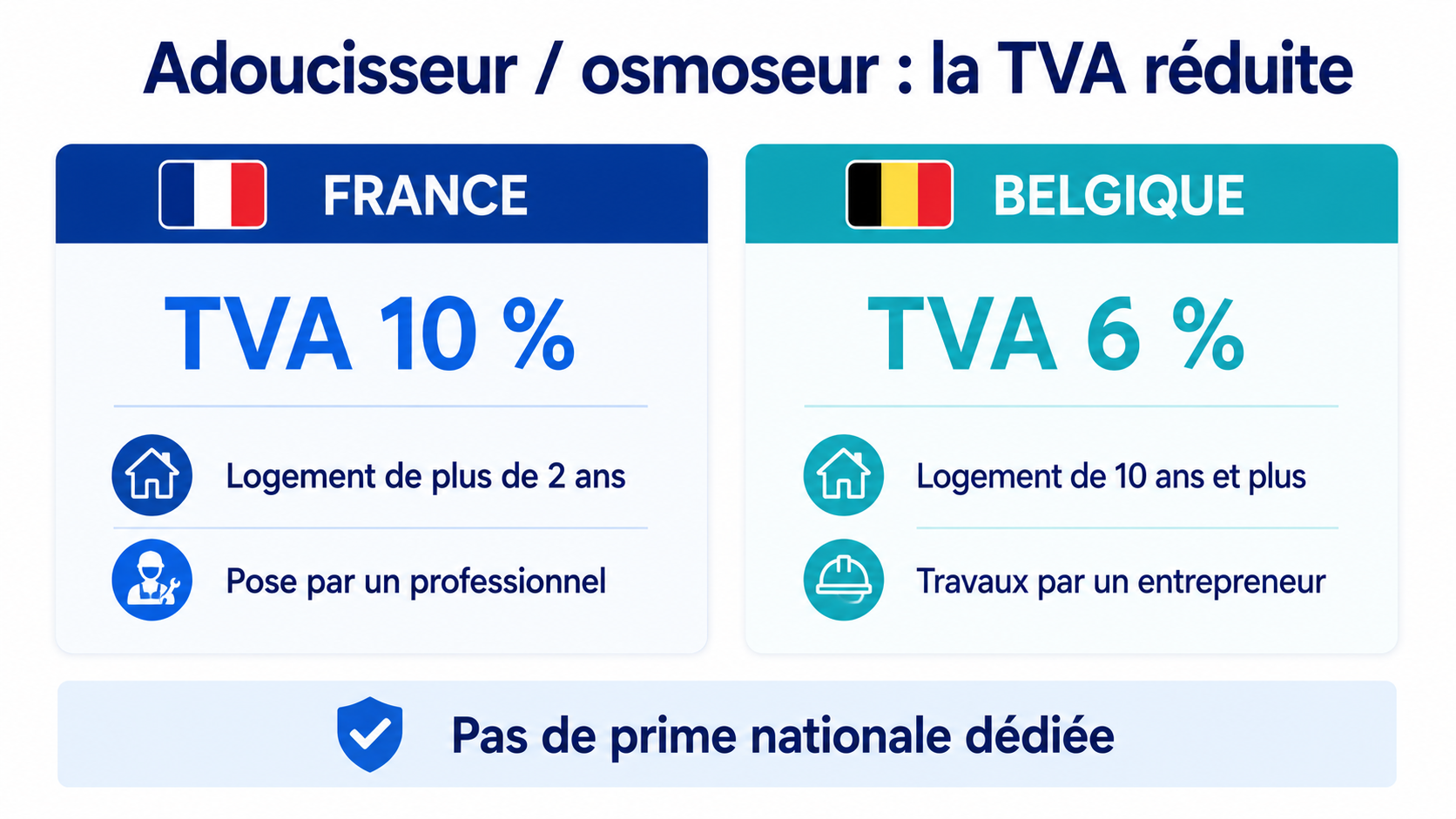
This is the main lever. The supply and installation of a softener (or osmosis unit) by a professional can benefit from 10% VAT (instead of 20%), as home-improvement works.
Key conditions:
- Home completed more than 2 years ago, used as a dwelling (main or secondary residence).
- Work carried out and invoiced by a professional (supply + installation) · not an online purchase fitted yourself.
- The reduced VAT then applies to the equipment and labour shown on the installer's invoice.
⚠️ The 5.5% rate does not apply
The 5.5% VAT is reserved for energy-improvement works (listed equipment: insulation, high-performance heating…). A softener or osmosis unit on its own is not eligible: the correct rate is 10%.
3. France: other options
- Local aid: some municipalities or inter-municipal bodies offer water-treatment aid, especially where water quality is a problem. It is rare and highly variable · check case by case.
- Water agencies: their aid mainly targets local authorities, industry and agriculture (water saving, quality), not the residential softener.
- Zero-rate eco-loan & works credit: the eco-loan targets energy renovation; a softener alone is out of scope. Standard works financing (loans) remains, without specific benefit.
4. Belgium: reduced VAT at 6%
In Belgium, the softener is considered a fixed appliance built into the plumbing installation. Its supply and installation by a contractor can benefit from 6% VAT (instead of 21%) as immovable works.
The central condition concerns the age of the home:
- The dwelling must be at least 10 years old (first occupied no later than the tenth calendar year before the first works invoice).
- Works carried out and invoiced by a registered contractor, for a private dwelling.
5. Belgium: regional grants
The major grant schemes do not cover the softener, but it is worth knowing the framework · especially as it keeps changing:
- Wallonia: a temporary support scheme for Housing grants applies (running until 30 September 2026), with reduced amounts; it targets energy/renovation, not water treatment.
- Flanders: the Mijn VerbouwPremie covers renovation and energy · excluding softeners.
- Brussels: the grants (Renolution) also target energy and renovation.
💡 Don't confuse them
In Wallonia, there is a grant for individual wastewater treatment (autonomous sanitation system). It concerns wastewater treatment, not the softening or osmosis of drinking water.
6. France / Belgium: the summary
| France | Belgium | |
|---|---|---|
| Dedicated national grant | No | No |
| Reduced VAT | 10% (instead of 20%) | 6% (instead of 21%) |
| Home condition | Over 2 years old | 10 years or older |
| Installation condition | Professional (supply + install) | Contractor (immovable works) |
| Regional energy grants | Not eligible | Not eligible |
| Additional options | Local aid (rare) | Municipal aid (rare) |
7. How to benefit in practice
- Go through a professional: reduced VAT requires a supply + installation invoice from an installer. That is the basic condition.
- Check the home's eligibility (age) and keep the supporting documents; in France, a VAT certificate is generally required.
- Ask locally: municipality, inter-municipal body, water agency (FR) or municipality/Region (BE) for any one-off aid.
- Confirm the current rules with official sources before signing · rates and schemes change.
🔗 The DIMM side
- Network of partner installers: installation by a professional unlocks the reduced VAT.
- Advice & sizing: choosing the right equipment, the condition for a lasting investment.
- Up-to-date information: we point you to the right regulatory sources by country.
Conclusion: few grants, but real levers
For a softener or an osmosis unit, don't expect a miracle grant: no dedicated national scheme exists, in France or Belgium. The real lever is the reduced VAT (10% FR, 6% BE) via a professional, sometimes topped up by rare local aid. And because taxation and grant schemes change regularly, the golden rule is to check the rules in force before committing.
DIMM's teams support partner installers, distributors and resellers in advising on and choosing water-treatment equipment, in France and Belgium.
Key points & references (up to date June 2026, subject to change)
- No dedicated national grant (MaPrimeRénov', CEE, tax credit in FR; regional energy grants in BE) for softener/osmosis.
- France: 10% VAT (instead of 20%) for supply + installation by a pro, home over 2 years old; the 5.5% rate does not apply.
- Belgium: 6% VAT (instead of 21%) for works by a contractor, home 10 years or older.
- Local aid (municipalities, inter-municipal bodies, water agencies) possible but rare and variable.
- Wallonia: temporary support scheme for Housing grants (until 30 September 2026), excluding water treatment; separate "individual wastewater treatment" grant.
- Sources to consult: service-public.fr, impots.gouv.fr, ANIL (FR); FPS Finance, Regions' websites (BE).