
Under-sink purifier 3-stage ultrafiltration - Aquapro
Part number ART056423 · Water purifiers
Net prices excl. VAT and ordering are reserved for signed-in professional accounts.
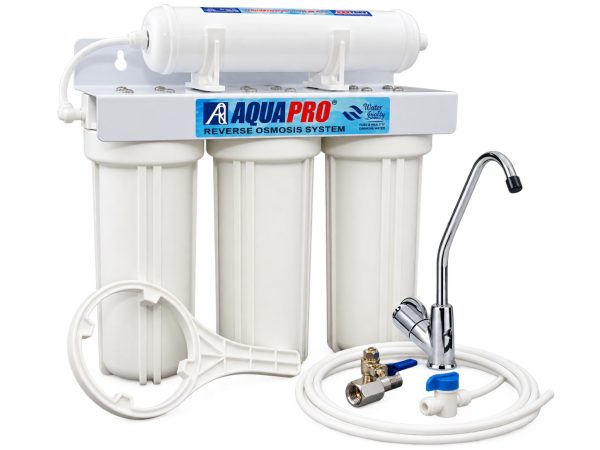
Under-sink purifier 3-stage
Filtration system under sink with three stages, in meter-free version. It combines mechanical pre-filtration, ultrafiltration and activated carbon polishing on a single unit to be connected to the cold water inlet. Aquapro reference PR-AUS3-UM.
Cartridges supplied: PPS-10, UPF-10, APC-10, and D-UF02 membrane.
The three stages
Stage 1, the PPS-10 cartridge. A polypropylene sediment cartridge, 10" format. It traps sand, rust, clay particles and pipe deposits. Its role is to protect the following stages: without it, the membrane and carbon bear the entire particulate load and clog prematurely.
Stage 2, ultrafiltration. This is the heart of the system, detailed below.
Stage 3, the APC-10 cartridge. Activated carbon block, placed as final stage. It treats free chlorine and chlorine taste and odour, as well as earthy or musty notes. This is the stage that makes the water pleasant to drink, once the first two have done the separation work.
Ultrafiltration, and why it is a different positioning
Ultrafiltration is membrane filtration. The membrane is made of hollow fibres pierced with pores of very small diameter: water passes through, anything larger than the pore does not. It is a physical barrier, not a chemical reaction and not adsorption.
The comparison that matters in the field is with reverse osmosis.
Reverse osmosis retains dissolved salts. It produces very pure water, but it rejects water to drain, often requires a pressure tank, sometimes a booster pump, and it demineralises the produced water.
Ultrafiltration works on a wider threshold: it retains suspended matter, turbidity and colloidal particles, but allows dissolved minerals to pass through. Direct consequences, and these are the selling points:
No water rejection to drain. All water entering the system comes out usable.
No tank, no pump. The system operates on mains pressure, in direct flow. Space under the sink is significantly reduced.
No demineralisation. Water retains its original mineral composition.
In return, ultrafiltration does not treat dissolved salts. On hard water, salty water, or water with a nitrate or conductivity problem, reverse osmosis should be proposed, not this system. The choice between the two is made on water analysis, never by default.
The meter-free version
This model is supplied without volumetric meter. There is no monitoring electronics, no display, no replacement alert.
This is a deliberate choice: fewer components, so fewer possible failures and a lower purchase price. On a standard domestic installation, a simple calendar reminder is sufficient to manage maintenance.
The trade-off is that you must keep the replacement schedule yourself. In practice, the installer who fits the unit notes the commissioning date and sets up a customer reminder.
Where to use it
On a drinking water point under sink, in residential as well as light commercial settings: office, break room, surgery, shop.
This is the solution indicated when the objective is to treat taste, chlorine and turbidity on mains water already compliant, without resorting to reverse osmosis and its installation constraints.
Replacement
The PPS-10 and APC-10 cartridges are generally replaced every 6 to 12 months, depending on water quality and consumption. The carbon saturates, the sediment cartridge clogs.
The ultrafiltration membrane has a longer service life than the cartridges, but it remains a consumable. Its longevity depends directly on the quality of the pre-filtration upstream: a PPS-10 left in place too long clogs the membrane and shortens its life.
Two signals should trigger intervention: a drop in flow rate at the tap, and a return of chlorine taste. The first points to sediments or the membrane, the second to the carbon.
Installation
Connection to the cold water inlet under sink, with a dedicated tap for treated water.
Provide sufficient clearance under the filter housings to be able to lower the bowls when changing cartridges. This is the most common installation error on an under-sink system, and it costs at every maintenance.
An isolation valve upstream simplifies all future interventions.
At commissioning, rinse for several minutes before use: new cartridges, particularly the carbon, release fines at start-up.
Water purifiers
- Aquapro 3-stage purifier + inline ultrafiltration, Aquapro PR-AUS3-UMV ref. ART056430
- Filter cartridge, Aquapro PR-AUS2-X ref. ART056415
- Filter cartridge, Aquapro PR-AUS3-NX ref. ART056431
- Filter cartridge, Aquapro PR-AUS1-NX ref. ART056407
- Filter cartridge, Aquapro PR-AUS1 ref. ART056403
- Filter cartridge, Aquapro PR-AUS2 ref. ART056399
- Bracket, Aquapro PR-BK-1A ref. ART056448
- Bracket, Aquapro PR-BK-1A-SS ref. ART056449
- Bracket, Aquapro PR-BK-1BB ref. ART056450
- Bracket, Aquapro PR-BK-1BB-SS9 ref. ART056451
- Bracket, Aquapro PR-BK-1H-SS ref. ART056452
- Bracket, Aquapro PR-BK-2A-SS ref. ART056453
- Bracket, Aquapro PR-BK-2-SS-R ref. ART056454
- Bracket, Aquapro PR-BK-2A ref. ART056455
- Bracket, Aquapro PR-BK-2BB-SS ref. ART056457
- Bracket, Aquapro PR-BK-2HN ref. ART056458
- Under-sink water purifier, Aquapro PR-BK-3A-SS-L ref. ART056460
- Bracket, Aquapro PR-BK-3-BB ref. ART056461
- Bracket, Aquapro PR-BK-3HN ref. ART056462
- Bracket, Aquapro PR-BK-680 ref. ART056464
- Bracket, Aquapro PR-BK-AHS3 ref. ART056465
- Bracket, Aquapro PR-BK-AP999 ref. ART056467
- Faucet, Aquapro PR-BK-FT-SS ref. ART056468
- Bracket, Aquapro PR-BK-PBRO55 ref. ART056469
- Under-sink water purifier, Aquapro PR-BK-RO4P ref. ART056471
- Under-sink water purifier, Aquapro PR-BK-RO5 ref. ART056472
- Under-sink water purifier, Aquapro PR-BK-RO5P ref. ART056473
- Purifier component, Aquapro PR-BUSHING-12M38F ref. ART056476
- Purifier component, Aquapro PR-BUSHING-34M12F ref. ART056477
- Purifier component, Aquapro PR-BUSHING-34M14F ref. ART056478