
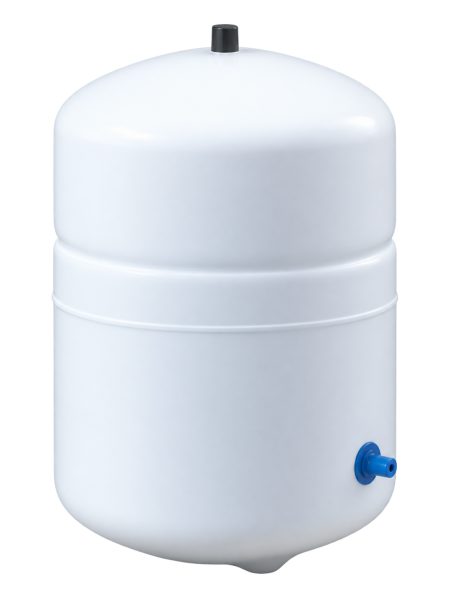
Reverse osmosis tank 8 L epoxy steel NSF - Aquapro PR-A2
Part number ART056145 · Pressure vessels & tanks
Net prices excl. VAT and ordering are reserved for signed-in professional accounts.
Pressurised storage tank 8 litres
Storage tank for reverse osmosis, nominal capacity 8 litres (2 gallons). Steel body with epoxy coating, NSF certified. Diameter 202 mm, height 297 mm. Aquapro reference PR-A2.
What is a tank for on a reverse osmosis unit
This is the component that end users understand least, yet it is what makes the system usable.
A reverse osmosis membrane produces slowly. A domestic reverse osmosis unit produces only a few litres per hour, not per minute. Without storage, opening the tap would give only a trickle.
The tank solves this by decoupling production from withdrawal. The reverse osmosis unit produces continuously and fills the tank. When the user opens the tap, they draw from the stored water at a comfortable flow rate.
How it actually works
A reverse osmosis tank is not a simple container.
Inside, a flexible bladder divides the volume into two sections. On one side treated water, on the other a pressurised air cushion, pre-charged at the factory.
As water enters, it compresses the air. When the tap opens, it is the compressed air that pushes the water towards the outlet. This is what delivers a strong flow at the tap whilst the membrane itself produces drop by drop.
Two practical points to understand.
Water never touches the steel. It remains confined within the bladder. The metal body serves as a pressure vessel, not as contact with drinking water.
Usable volume is less than nominal volume. The 8 litres stated corresponds to the body capacity. The air cushion takes up part of this, and residual pressure prevents complete drainage. Expect actually drawable volume of around half. This is normal, it applies to all tanks on the market, and is a classic source of misunderstanding with users.
The 8 litre format
The 8 litre is the compact format in the range. With 202 mm diameter and 297 mm height, it fits where a 12 litre cannot.
This is the choice for cramped under-sink installations, shallow cabinets, light commercial draw-off points, and all cases where space constraint takes priority over autonomy.
Conversely, for a large household or a heavily used draw-off point, a larger volume prevents the user waiting for the tank to refill between uses. Sizing should be based on consumption, not on available space alone.
Epoxy steel and NSF certification
The steel body provides mechanical strength under pressure. The epoxy coating protects it from corrosion, including in humid environments such as under-sink cupboards or plant rooms.
NSF certification covers materials in contact with water intended for human consumption. On a component that stores drinking water for hours, sometimes days during absence, this is a point not to overlook.
Where to use it
As a replacement tank on an existing reverse osmosis unit whose tank is punctured, deflated or no longer working. As a supplement on an installation to be assembled. And on any compact reverse osmosis where available space requires a reduced format.
Commissioning and checking
The air pre-charge is set at the factory, and it is this that determines all operation.
An under-pressurised tank fills more but delivers poorly: tap flow becomes weak and the tank no longer empties completely. An over-pressurised tank delivers strongly but stores little, and the user feels constantly short of water.
Pre-charge is checked with a pressure gauge, tank completely empty, and never otherwise: measured with water inside, the reading is meaningless. Refer to the value stated by the manufacturer.
This check is the first diagnostic step when a user reports reduced tap flow without reduced production: in most cases, it is the pre-charge that has dropped, not the membrane that is at fault.
Installation
Position the tank vertically, valve at the top, on a stable surface. When full, it weighs accordingly.
Connect the line and open the tank valve: this is the classic oversight at the end of installation, resulting in an apparently faulty reverse osmosis unit when everything is correctly assembled.
At first commissioning, discard the first two tanks produced. This rinsing removes fines from new cartridges and membrane preservative.
Pressure vessels & tanks
- Wellmate bladder pressure tank WELLMATE-WM0060, 55 L ref. ART057976
- Wellmate bladder pressure tank WELLMATE-WM0075, 75 L ref. ART057977
- Wellmate bladder pressure tank WELLMATE-WM0235, 235 L ref. ART057981
- Wellmate bladder pressure tank WELLMATE-WM0330, 328 L ref. ART057982
- Wellmate bladder pressure tank WELLMATE-WM0450, 453 L ref. ART057983
- Storage tank, Dimm BOST-0020210 ref. ART044019
- Storage tank, Dimm BOST-0020252 ref. ART066636
- Storage tank, Dimm BOST-0020223 ref. ART067456
- Storage tank, Dimm BOST-0020225 ref. ART067460
- Storage tank, Dimm BOST-0020214 ref. ART067463
- Storage tank, Dimm BOST-0020208 ref. ART067465
- Storage tank, Dimm BOST-0020227 ref. ART067466
- Storage tank, Dimm BOST-0020215 ref. ART067467
- Storage tank, Dimm BOST-0020209 ref. ART067469
- Level float, Calpeda CAL-FB-5 ref. ART069420
- Storage tank, Dimm BOST-0020237 ref. ART069431
- Level float, Calpeda CAL-FB-20 ref. ART069432
- Storage tank, Dimm BOST-7015316 ref. ART069546
- Pentair Structural composite tank STRUC-Q-1054-DH-A, 10" × 54", 60.7 L ref. ART070131
- Storage tank, Dimm BOST-0020235 ref. ART070415
- Wellmate bladder pressure tank WELLMATE-WM0120, 112 L ref. ART071790
- Pentair Structural composite tank STRUC-Q-0717-A8, 7" × 17", 8.8 L ref. ART071841
- Pentair Structural composite tank STRUC-Q-0717-A9, 7" × 17", 8.8 L ref. ART071842
- Pentair Structural composite tank STRUC-Q-0730-A8, 7" × 30", 16.8 L ref. ART071843
- Pentair Structural composite tank STRUC-Q-0730-A9, 7" × 30", 16.8 L ref. ART071844
- Pentair Structural composite tank STRUC-Q-0735-A9, 7" × 35", 20.4 L ref. ART071846
- Pentair Structural composite tank STRUC-Q-0817-A8, 8" × 17", 11 L ref. ART071847
- Pentair Structural composite tank STRUC-Q-0817-A9, 8" × 17", 11 L ref. ART071848
- Pentair Structural composite tank STRUC-Q-0830-A8, 8" × 30", 22 L ref. ART071849
- Pentair Structural composite tank STRUC-Q-0830-A9, 8" × 30", 22 L ref. ART071850