
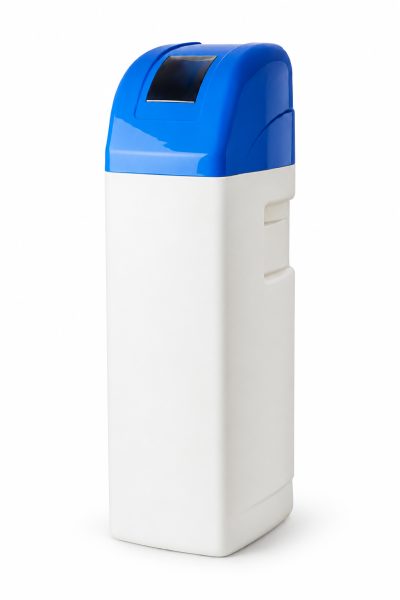
Water softener Fleck 5600 Adriatica 22 L, blue - ref. FL-5600-ADRIATICA-22-BLEU
Part number ART071913 · Domestic water softeners
Net prices excl. VAT and ordering are reserved for signed-in professional accounts.
Adriatica Grand 22 L single-unit water softener
Water softener in single-unit configuration, equipped with 22 litres of ion-exchange resin, an 8" × 35" tank and the Fleck 5600 volumetric mechanical valve. Supplied with double safety device, stainless steel bypass and mixing valve. Casing with blue cover, white brine tank.
The single-unit format
In a conventional two-unit softener, the resin tank and brine tank are two separate elements, placed side by side.
In single-unit design, the tank is housed inside the brine tank. The entire assembly fits in a single cabinet, with a significantly reduced footprint.
This is the format that allows installation of a softener where a two-unit model will not fit: cramped utility room, technical cupboard, cluttered basement, space under stairs. In residential applications, this often determines whether the project is feasible.
The Fleck 5600, a reference installed for decades
The 5600 is the most widespread valve on the residential market. This is not a marketing claim, it is an operational fact.
A considerable installed base means spare parts available everywhere, abundant documentation, and above all technicians who know it inside out. Servicing a 5600 requires neither specific training nor waiting for parts.
On a device expected to last fifteen years or more, this availability weighs more heavily than many ancillary functions.
Volumetric, and what that changes
A time-based valve regenerates at fixed intervals, for example every three days, whether water has been consumed or not.
A volumetric valve counts the litres actually consumed via an integrated meter, and only triggers regeneration when the resin capacity is genuinely exhausted.
The consequences are direct: less salt, less waste water, and automatic adaptation to consumption variations. Two weeks away, and the unit does not regenerate unnecessarily. A full house at the weekend, and it regenerates earlier without anyone having to reprogram anything.
Mechanical or electronic: the real selection criterion
This is the point that distinguishes this version from the 5600 SXT variant, available in the catalogue on the same unit.
Here, control is entirely mechanical. A water meter drives a programming disc; settings are made using physical markers, with no electronic card or display.
What this provides. Fewer components, therefore fewer failure modes. No settings to reset after a power cut: parameters are physical, not stored in memory. And a lower purchase price than the electronic version, with identical volumetric function.
What this does not allow. No display, no on-screen diagnostics, no fine cycle adjustments, no history. Reading the unit status is done on the valve itself, which requires knowing how to read it.
How to choose. Mechanical suits standard installations, customers who want a robust and simple unit, and configurations where maintenance will be carried out by a professional. Electronic SXT is justified when programming comfort, fine adjustment, or direct reading of operating status by the end customer is desired.
Both regenerate by volume. The debate is about the interface, not the principle.
The double safety device
The softener is equipped with a double safety device on the brine circuit. This is the mechanism that prevents the brine tank from overflowing in the event of brine valve or float malfunction.
On an installation in a utility room or finished basement, this is the safeguard that prevents water damage, and a concrete argument to present to the end customer.
The stainless steel bypass
The bypass allows isolation of the softener from the network without cutting off the water supply to the property. Maintenance, resin replacement, service intervention, prolonged absence: switch the bypass, and water continues to flow directly.
The stainless steel version is the right choice on a unit designed to last: no dezincification, no valve sticking, superior mechanical durability compared to polymer versions.
The mixing valve
This is the component most often overlooked, yet one of the most useful.
An ion-exchange resin produces water at 0 °fH, completely devoid of calcium and magnesium. This is generally not what you want to distribute. Water that is too soft is more aggressive towards certain piping materials, and most installers aim for a residual hardness of around 8 to 15 °fH at outlet.
The mixing valve does exactly that: it reintroduces a metered fraction of raw water into the softened water, to adjust the outlet hardness to the desired level. The adjustment is made at commissioning, using a TH test. This is what distinguishes a properly installed system from a unit simply connected.
The 22 litres of resin
The resin volume determines the exchange capacity between regenerations, and thus the sizing of the unit relative to the household and water hardness.
The 22 L combined with the 8" × 35" tank positions this unit in the family residential segment. Correct sizing must be validated case by case, based on inlet water hardness and daily consumption: an undersized softener regenerates too often and consumes salt, an oversized softener leaves the resin stagnant between cycles.
Installation
Provide nearby a water inlet, a drain for regeneration waste, an electrical supply, and sufficient clearance to open the cover and load salt.
Place the unit level on a stable floor: a single-unit loaded with salt and water is heavy.
Adjust the mixing at TH test at commissioning, then programme the capacity on the valve disc according to the measured inlet hardness. On a mechanical valve, this initial setting is critical: there is no display to indicate if it is wrong.
Maintenance
Maintain the salt level in the tank, using pellets designed for softeners.
Periodically check for the absence of salt bridging: the hardened crust that forms above the water and makes it appear the tank is full when brine is no longer forming. This is the most common failure, and the most silent.
Check the outlet hardness with a TH test once or twice a year, and readjust the mixing if necessary.
Domestic water softeners
- AUTOTROL Adriatica monobloc water softener 18 L blue cabinet, 255-760 Easy-iQ valve ref. ART071975
- Fleck 5600 Adriatica water softener 30 L resin, blue - ref. FL-5600-ADRIATICA-30-BLEU ref. ART072116
- Fleck 5600 ECO Bi-Bloc 30 L water softener ref. ART072117
- Adriatica blue water softener 22 L 8100 electronic volumetric valve — ref. FL-8100-ADRIATICA-22-BLEU ref. ART072128
- Water softener Fleck 5600 SXT Arca mini 8 L - ref. FL-5600-SXT-ARCA-08 ref. ART072140
- Water softener Fleck 5600 Adriatica 18 L, blue - ref. FL-5600-ADRIATICA-18-BLEU ref. ART072158
- Fleck 5600 ECO Bi-Bloc 18 L water softener ref. ART072172
- Fleck 5600 SXT Adriatica water softener 22 L resin, blue - ref. FL-5600-SXT-ADRIATICA-22-BLEU ref. ART071457
- Fleck 5600 SXT Adriatica water softener 30 L resin, blue - ref. FL-5600-SXT-ADRIATICA-30-BLEU ref. ART071443
- AUTOTROL Adriatica monobloc water softener 25 L blue cabinet, 255-760 Easy-iQ valve ref. ART071432
- Fleck 5600 ECO Bi-Bloc 8 L water softener ref. ART072286
- Fleck 5600 ECO Bi-Bloc 16 L water softener ref. ART072287
- Fleck 5600 ECO Bi-Bloc 22 L water softener ref. ART072289
- Fleck 5600 ECO Bi-Bloc 25 L water softener ref. ART072290
- Fleck 5600 ECO Bi-Bloc 50 L water softener ref. ART072291
- Fleck 5600 SXT Bi-Bloc 8 L water softener ref. ART072295
- Fleck 5600 SXT Bi-Bloc 16 L water softener ref. ART072296
- Fleck 5600 SXT Bi-Bloc 22 L water softener ref. ART072298
- Fleck 5600 SXT Bi-Bloc 25 L water softener ref. ART072299
- Fleck 5600 SXT Bi-Bloc 75 L water softener ref. ART072300
- Fleck 5600 SXT Bi-Bloc 18 L water softener ref. ART071189
- Fleck 5600 SXT Bi-Bloc 30 L water softener ref. ART071162
- Fleck 5600 SXT Bi-Bloc 50 L water softener ref. ART070911
- Water softener Fleck 5600 SXT Arca mini 6 L - ref. FL-5600-SXT-ARCA-06 ref. ART070802
- Fleck 5600 Adriatica water softener 10 L resin, blue - ref. FL-5600-ADRIATICA-10-BLEU ref. ART072989
- Fleck 5600 Adriatica water softener 16 L resin, blue - ref. FL-5600-ADRIATICA-16M-BLEU ref. ART072990
- Fleck 5600 Adriatica water softener 25 L resin, blue - ref. FL-5600-ADRIATICA-25-BLEU ref. ART072992
- Fleck 5600 SXT Adriatica 10 L water softener, blue - ref. FL-5600-SXT-ADRIATICA-10-BLEU ref. ART072993
- Fleck 5600 SXT Adriatica water softener 16 L resin, blue - ref. FL-5600-SXT-ADRIATICA-16M-BLEU ref. ART072994
- Fleck 5600 SXT Adriatica water softener 18 L resin, blue - ref. FL-5600-SXT-ADRIATICA-18-BLEU ref. ART072995