



After the "classic" PFAS, a newcomer is raising concern: TFA (trifluoroacetic acid), the smallest of the "forever chemicals". A large study by France's ANSES recently described it as near-ubiquitous in drinking water. Yet it is particularly hard to remove.
1. What is TFA?
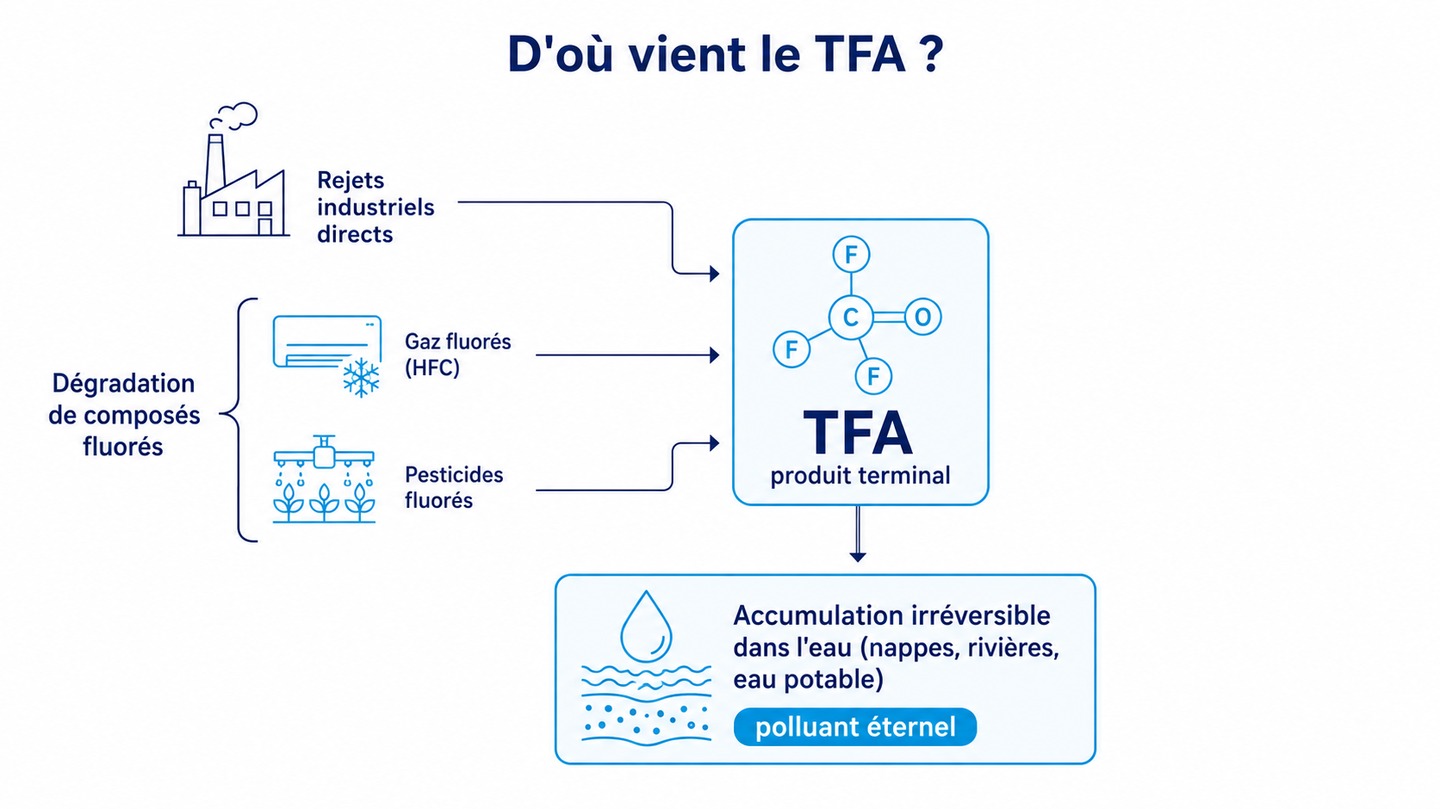
TFA is an ultra-short-chain PFAS (two carbon atoms). Highly soluble and mobile in water, extremely persistent, it disperses widely in the environment and accumulates in water resources.
2. Where does it come from?
Two main origins: direct industrial discharges and the degradation of other fluorinated compounds · notably certain fluorinated gases (HFC-type refrigerants) and fluorinated pesticides used in agriculture. TFA is thus an "end product" of many molecules.
3. Where do the regulations stand?
TFA is indeed a PFAS according to the OECD, but it is not included in the list of 20 PFAS regulated by Directive (EU) 2020/2184 (sum limited to 0.1 µg/L, in force since 1 January 2026). In France, pending the work of EFSA (expected in summer 2026), an indicative health value of 60 µg/L has been adopted, with a more protective target of 10 µg/L.
4. Why it is hard to treat
Its small size and polarity make it poorly retained by conventional treatments: activated carbon, effective on long-chain PFAS, is much less so on TFA. It is one of the major technical challenges of the moment.
5. Treatment avenues
No solution is fully effective, but several avenues exist:
- Reverse osmosis: partial retention, variable depending on conditions.
- Specific ion-exchange resins (PFAS adsorbents): targeted capacities.
- Advanced processes under development.
Effectiveness depends heavily on the molecule and the water matrix.
6. Anticipate
The right reflex: a targeted analysis, regulatory monitoring (PFAS levy, upcoming thresholds) and a multi-barrier strategy. The framework is changing fast: it is best to be prepared.
7. Who should be vigilant here?
Communities and water operators, industrials discharging PFAS or fluorinated gases, and all sectors sensitive to drinking-water quality.
Conclusion
TFA is the symbol of a new frontier of "forever chemicals": tiny, mobile, ubiquitous and resistant to treatment. Lacking a miracle solution, the answer combines regulatory monitoring, targeted analysis and a multi-barrier approach (osmosis, specific resins). Regulations are evolving rapidly · information dated August 2026, to be confirmed.
The DIMM teams support partner installers, distributors and resellers in Belgium, France and the Netherlands in choosing and sizing water-treatment solutions.
🔗 DIMM solutions
Reverse osmosis and specific PFAS adsorbent resins: DIMM supports the diagnosis and treatment avenues for TFA and PFAS.
Reference points
- TFA: ultra-short-chain PFAS (C2), highly mobile and persistent; near-ubiquitous in drinking water (ANSES 2026 study).
- Sources: industrial discharges + degradation of fluorinated gases (HFC) and fluorinated pesticides.
- Not included in the 20 PFAS of Directive 2020/2184 (sum 0.1 µg/L since 1 January 2026).
- France: indicative health value 60 µg/L; more protective target 10 µg/L; EFSA work expected summer 2026.
- Conventional treatments of limited effectiveness (carbon); avenues: reverse osmosis, specific resins. Evolving information, dated August 2026.