

Chaque été, à mesure que les températures grimpent et que les précipitations se raréfient, un phénomène invisible se produit sous nos pieds : les nappes phréatiques se vident progressivement. Ce processus naturel – appelé étiage – entraîne des conséquences directes sur la qualité de l'eau prélevée dans les puits et forages privés : moins d'eau signifie moins de dilution des polluants, et des contaminants comme le fer, le manganèse, les nitrates ou les bactéries se concentrent de manière parfois alarmante.
Pour les professionnels du traitement de l'eau, l'été est donc une saison de vigilance accrue – et une opportunité commerciale réelle pour équiper ou renforcer les installations chez les clients alimentés par forage ou puits privé. En France, les eaux souterraines représentent près des deux tiers de la consommation d'eau potable. En Belgique, ce chiffre atteint 80 % en Wallonie – autant dire que la qualité des eaux souterraines est un enjeu sanitaire de premier rang.
Cet article explique les mécanismes de dégradation de la qualité de l'eau en période de sécheresse, les zones à risque en France et en Belgique, les contaminants qui s'aggravent, et la chaîne de traitement DIMM adaptée à chaque situation.
1. Why does drought degrade groundwater quality ?
L'étiage : le mécanisme de concentration des polluants
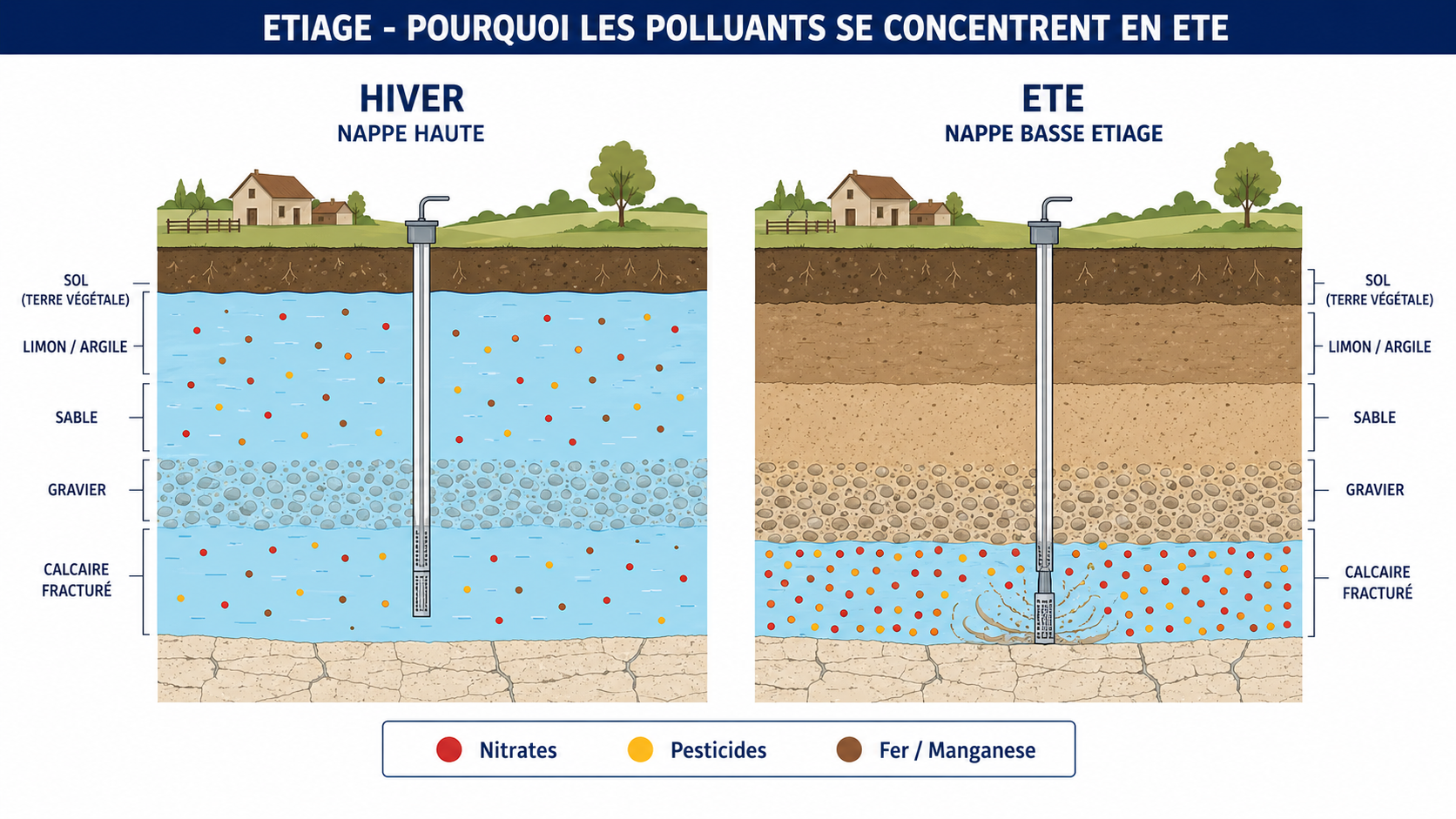
En période normale, les polluants présents dans une nappe phréatique sont dilués dans un grand volume d'eau. Lorsque le niveau de la nappe baisse – phénomène d'étiage – ce volume diminue, mais la charge en polluants reste globalement identique. Le résultat est mécanique : les concentrations augmentent. Un forage qui captait une nappe à 8 mètres peut, en été, pomper une eau nettement plus chargée si la nappe est descendue à 4 mètres.
Parallèlement, la baisse du niveau de la nappe rapproche la pompe du fond du puits, là où les sédiments, boues et matières organiques s'accumulent. Le pompage devient plus turbide, plus chargé en fer et manganèse, et potentiellement contaminé bactériologiquement. Les puits peu profonds peuvent s'assécher complètement lors des étiages sévères.
💡 Nappes réactives vs nappes inertielles : tout n'est pas égal face à la sécheresse
Le BRGM distingue deux grands types de nappes. Les nappes réactives (Bretagne, Normandie karstique, Massif central) réagissent rapidement aux sécheresses – leur niveau peut chuter en quelques semaines. Les nappes inertielles (Bassin parisien, Champagne, Beauce) réagissent lentement – leur niveau évolue sur des cycles pluriannuels. Cette distinction est capitale pour anticiper les risques selon votre région.
| Caractéristique | 🔴 Nappes réactives | 🟡 Nappes inertielles |
|---|---|---|
| Définition | Sables, graviers, calcaires karstiques, granites altérés | Craie, calcaires non karstiques, grès |
| Réaction sécheresse | Rapide (quelques semaines) | Lente (mois à années) |
| Recharge estivale | Possible après pluies importantes | Très rare – cycle pluriannuel |
| Régions | Bretagne, Massif central, Normandie karstique, Provence | Bassin parisien, Champagne, Beauce, Artois |
| Risque étiage 2025 | Élevé – vidange précoce dès fév-mars | Modéré – niveaux modérés à hauts |
| Impact puits/forages | Fort – assèchement possible | Faible à modéré – nappes profondes plus stables |
| Concentration polluants | Forte en étiage (moins de dilution) | Modérée – tampon plus important |
2. Contaminants that worsen in summer
Fer et manganèse : les signaux visuels d'un étiage
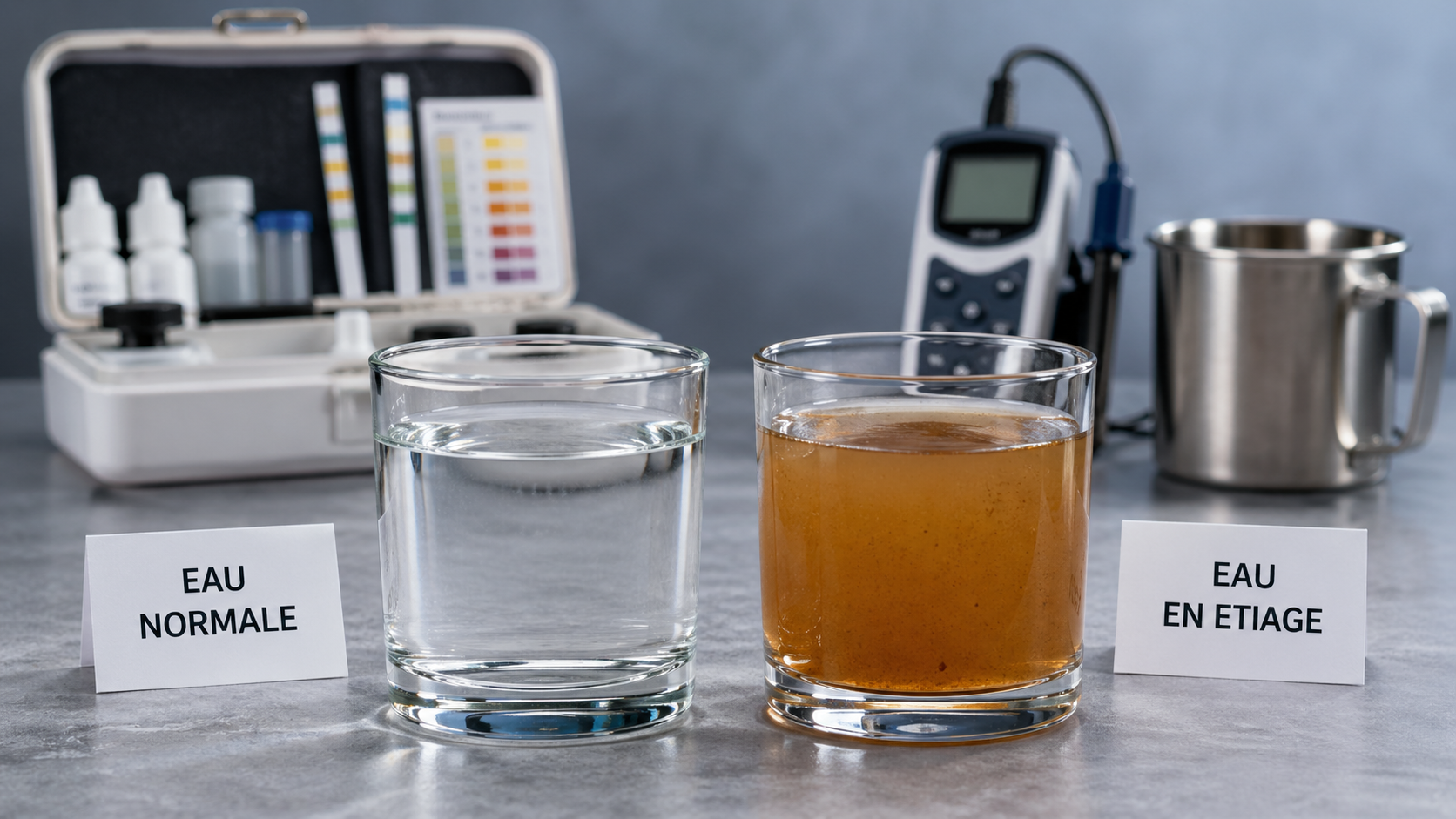
Le fer et le manganèse sont naturellement présents dans les eaux souterraines. En période d'étiage, la pompe capte une eau plus proche du fond du puits où ces éléments se concentrent. Résultat : eau rougeâtre ou noirâtre, goût métallique prononcé, dépôts dans les canalisations et les appareils électroménagers. Ces deux paramètres sont souvent les premiers indicateurs visuels d'une dégradation de la qualité en été.
Turbidité : l'eau devient trouble
Lorsque le niveau de la nappe baisse, les pompages soulèvent les sédiments accumulés au fond du forage. L'eau devient trouble, ce qui crée un effet d'ombre réduisant l'efficacité des systèmes UV et colmatant les filtres plus rapidement. Une turbidité élevée est à la fois un problème de qualité et un risque pour les équipements de traitement en aval.
Bactéries : moins de dilution = plus de risque
En période de sécheresse, les nappes peu profondes reçoivent moins d'apports d'eau fraîche qui diluait naturellement les agents pathogènes. La contamination bactérienne – notamment par E. coli provenant d'effluents agricoles ou de fosses septiques – devient plus probable. C'est l'une des raisons pour lesquelles la désinfection UV est indispensable en été pour toute installation alimentée par forage ou puits.
Nitrates et pesticides : l'effet de concentration
Nitrates et pesticides sont les polluants les plus détectés dans les eaux souterraines françaises. En période de sécheresse, ils se concentrent mécaniquement : une nappe dont le niveau baisse de 50 % peut voir les concentrations en nitrates doubler. Près de 24 % des masses d'eau souterraines du nord de la France dépassent 40 mg/L de nitrates en conditions normales – ce seuil peut être franchi plus fréquemment en été dans les zones vulnérables.
3. The 8 key parameters to test in summer
| Paramètre | Cible | Alerte | Impact en sécheresse |
|---|---|---|---|
| Fer (Fe) | < 0,2 mg/L | > 0,5 mg/L | Eau rougeâtre, goût métallique, colmatage filtres |
| Manganèse (Mn) | < 0,05 mg/L | > 0,1 mg/L | Eau noirâtre, dépôts noirs – concentrations doublent en été |
| Turbidité | < 1 NTU | > 4 NTU | Sédiments remis en suspension par pompage de nappes basses |
| Nitrates (NO₃⁻) | < 25 mg/L | > 50 mg/L | Concentration via évaporation – risque nourrissons |
| Bactéries (E. coli) | 0 UFC/100 mL | > 0 UFC/100 mL | Contamination plus fréquente : moins de dilution |
| pH | 6,5 – 8,5 | < 6,0 ou > 9,0 | pH acide favorise dissolution métaux |
| Conductivité (TDS) | < 1 000 µS/cm | > 2 000 µS/cm | Concentration des sels dissous – charge minérale globale |
| Pesticides | < 0,1 µg/L par substance | Dépassement seuil UE | Moins dilués en sécheresse – 24 % nappes Nord en alerte |
⚠️ Puits privés : aucun contrôle officiel en période d'étiage
Les puits et forages privés ne font l'objet d'aucune surveillance réglementaire systématique, contrairement au réseau public. En période d'étiage, les teneurs en fer, manganèse et bactéries peuvent dépasser les normes sans que l'utilisateur s'en aperçoive. Le seul moyen de détecter ces dégradations est un test terrain régulier, idéalement au début, au milieu et en fin d'été.
4. Risk areas in France and Belgium
France : les régions les plus vulnérables à l'étiage estival
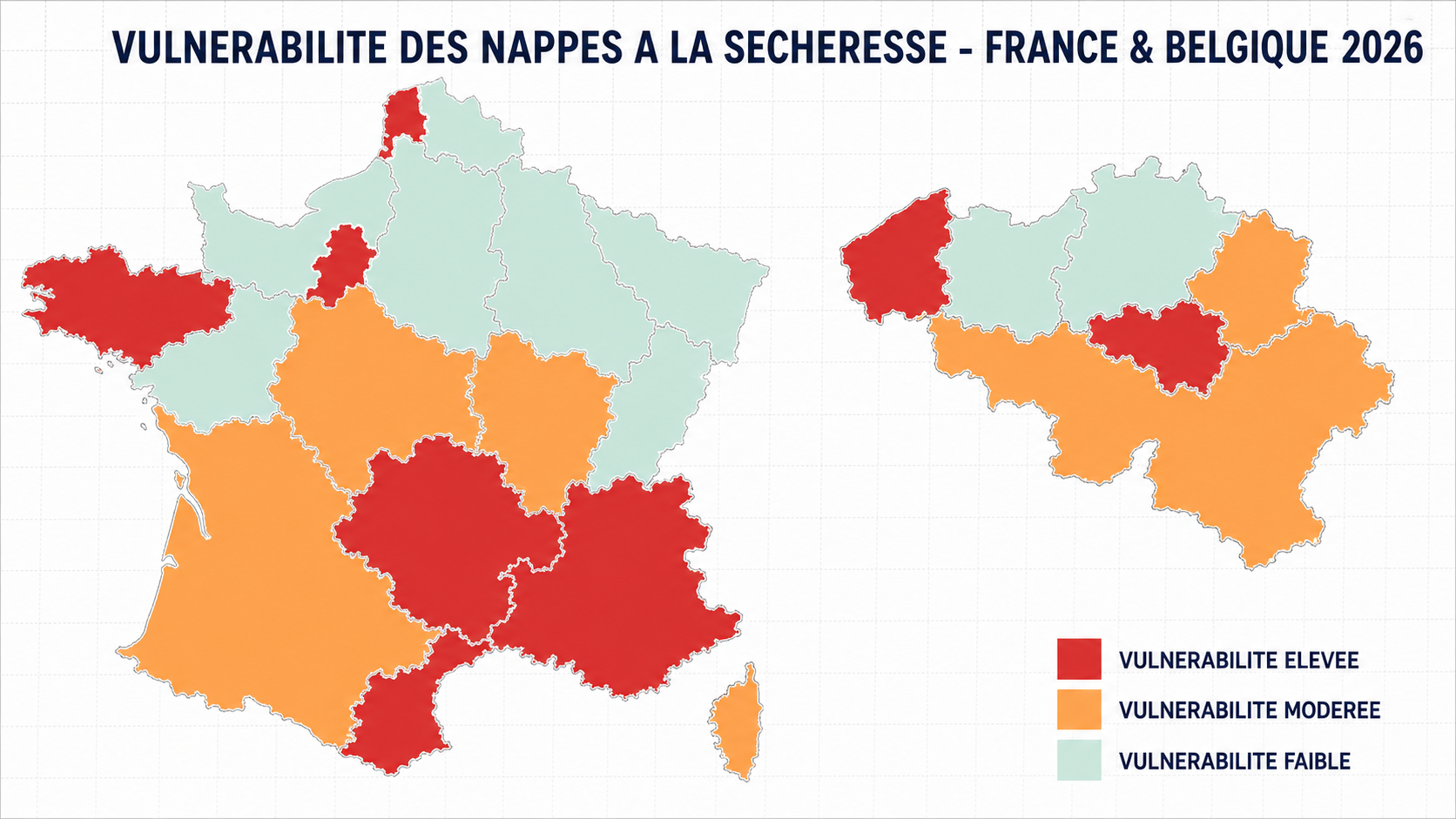
Le BRGM identifie plusieurs zones particulièrement sensibles à la baisse des nappes en été. En 2025, le début précoce de la vidange dès février-mars a aggravé la situation dans plusieurs régions qui auraient normalement bénéficié d'une meilleure recharge hivernale.
- Roussillon et Corbières : niveaux bas à très bas en mai 2025 – région structurellement vulnérable avec nappes réactives peu profondes.
- Bretagne : nappes de socle (granites) très réactives – assèchement rapide des puits peu profonds lors des étés secs.
- Normandie : géologie karstique calcaire dans la moitié est – perméabilité élevée = impact rapide de la sécheresse.
- Nord et Hauts-de-France : nappes réactives du Boulonnais dégradées en 2025 – zones agricoles à haute densité de puits privés.
- Massif central : socle cristallin peu perméable – nappes peu profondes très vulnérables à l'étiage estival.
- Provence-Alpes-Côte d'Azur : sécheresses récurrentes (2003, 2022) – pression accrue sur les nappes côtières et les forages touristiques.
Belgique : une vulnérabilité structurelle en Flandre
En Wallonie, 80 % de l'eau potable provient des eaux souterraines. Les nappes des sables du Crétacé (Hesbaye) et du Thanétien sont sensibles à l'étiage en zone agricole intensive. La Flandre, avec une densité agricole parmi les plus élevées d'Europe et une pression constante sur les eaux souterraines, reste particulièrement exposée à la concentration des polluants en été.
5. The DIMM treatment chain for borehole water in summer
| Contaminant / problème | Solution DIMM | Efficacité | Remarque clé |
|---|---|---|---|
| Fer et manganèse | Birm (catalytique) | ⭐⭐⭐⭐⭐ | Sans produit chimique, backwash périodique. Référence forages. |
| Fer et Mn (forte concentration) | Green Sand + permanganate | ⭐⭐⭐⭐ | Forages très chargés – aussi H₂S (œuf pourri). |
| Turbidité / sédiments | Sable filtrant + porte-filtre | ⭐⭐⭐⭐ | Premier étage indispensable – particules > 20 µm. |
| Bactéries / virus | UV DIMM | ⭐⭐⭐⭐⭐ | Désinfection sans chimie. Obligatoire après filtration. |
| Nitrates | Osmose inverse (OI) | ⭐⭐⭐⭐⭐ | 95–99 % d'abattement. Seule solution fiable. |
| Pesticides | Charbon actif + OI | ⭐⭐⭐⭐ | Charbon = composés organiques ; OI = résiduel. |
| Multi-paramètres | Tests eau DIMM | ⭐⭐⭐⭐⭐ | Diagnostic terrain rapide. Essentiel en étiage. |
| Protection en amont | Porte-filtres automatiques | ⭐⭐⭐⭐ | Préfiltration amont protégeant les équipements. |
Étape 1 – Diagnostic : tester avant de traiter
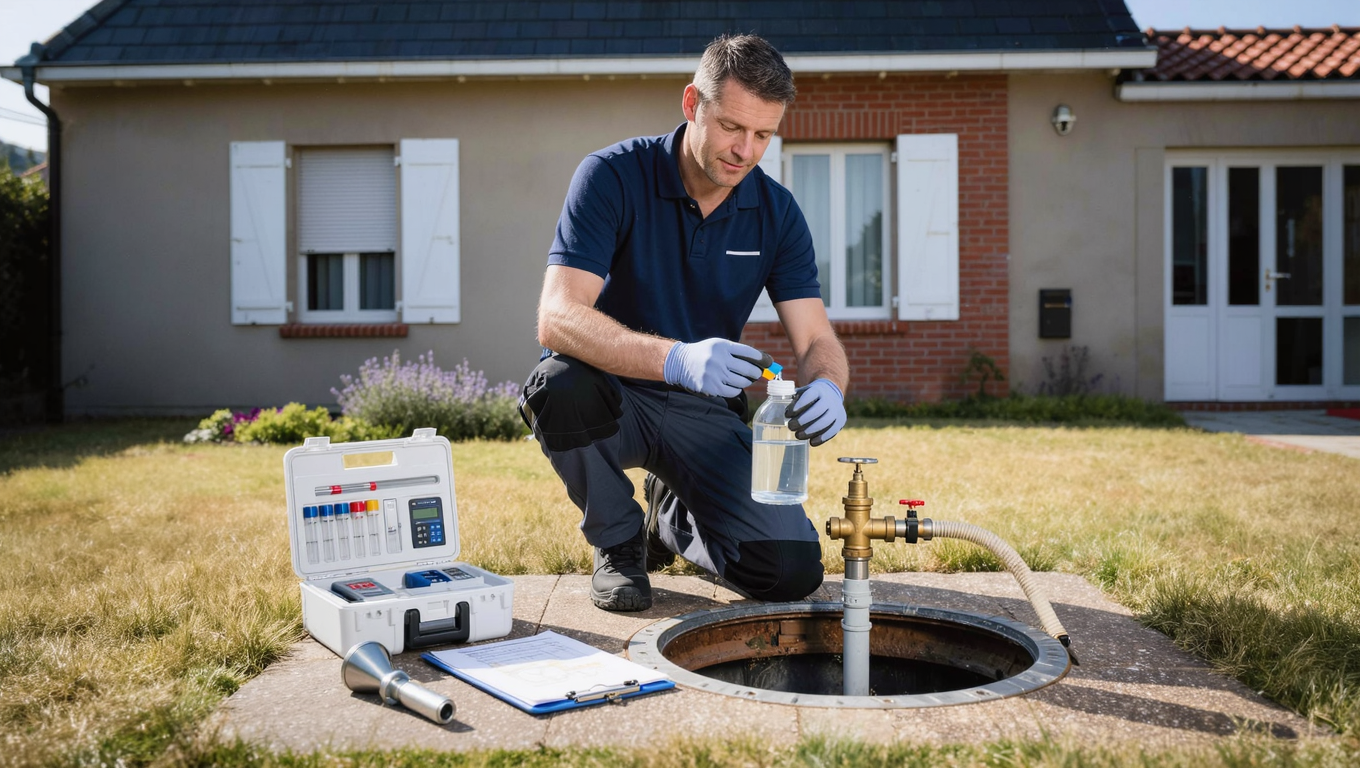
La première règle en période d'étiage est de ne jamais supposer que la qualité de l'eau est identique à l'hiver. Un test terrain rapide sur les 8 paramètres du tableau précédent est indispensable en début d'été. Il permet d'adapter la chaîne de traitement à la qualité réelle de l'eau au moment le plus critique de l'année.
🔗 Solutions DIMM – Tests et diagnostic
- Tests de l'eau DIMM – bandelettes et kits d'analyse rapide : fer, manganèse, turbidité, pH, nitrates, dureté, bactéries indicatrices. Résultat en quelques minutes sur le terrain. Indispensable en début et milieu d'été.
Étape 2 – Préfiltration : retenir les sédiments
En période d'étiage, la turbidité augmente. Un porte-filtre automatique en premier étage retient les sédiments remis en suspension par le pompage et protège les équipements en aval – notamment les médias filtrants et les lampes UV – d'une surcharge solide.
🔗 Solutions DIMM – Préfiltration
- Porte-filtres et filtres automatiques DIMM – retiennent particules, sédiments, matières en suspension. Premier étage obligatoire avant tout traitement.
- Sable filtrant DIMM – filtration mécanique en filtre à colonne (forte capacité, longue durée de vie).
Étape 3 – Déferrisation : Birm et Green Sand
La solution de référence contre le fer et le manganèse en eau de forage est le média Birm. Ce média catalytique oxyde le fer dissous (Fe²⁺) en fer précipité (Fe³⁺) retenu dans le filtre, sans aucun produit chimique – simplement grâce à l'oxygène dissous dans l'eau. Un simple lavage à contre-courant (backwash) suffit à régénérer le Birm. Pour les forages avec teneurs très élevées ou présence de sulfure d'hydrogène (odeur d'œuf pourri), le Green Sand + permanganate offre une solution plus puissante.
🔗 Solutions DIMM – Déferrisation
- Média Birm DIMM – catalytique, sans produit chimique. Référence pour forages en zone fer/manganèse élevé.
- Green Sand + permanganate DIMM – forages très chargés, élimination Fer + Mn + H₂S.
Étape 4 – Charbon actif : pesticides et composés organiques
En période de sécheresse, les pesticides et composés organiques – moins dilués – peuvent atteindre des concentrations préoccupantes dans les eaux de forage superficielles. Le charbon actif en média filtrant adsorbe efficacement ces composés, améliore le goût et l'odeur de l'eau, et complète la chaîne de traitement chimique.
🔗 Solutions DIMM – Charbon actif
- Charbon actif DIMM (granulé, poudre ou bloc) – adsorption pesticides, herbicides, COV, chlore et sous-produits.
Étape 5 – UV : désinfection sans chimie
La stérilisation UV est le dernier étage indispensable de toute chaîne de traitement sur eau de forage. Elle garantit une eau exempte de bactéries, virus et parasites, sans résidu chimique, même en période d'étiage. L'UV nécessite une eau préalablement filtrée (turbidité < 1 NTU, fer < 0,2 mg/L) pour être pleinement efficace – d'où l'importance des étapes précédentes.
🔗 Solutions DIMM – Stérilisation UV
- UV domestiques DIMM (puits/forages) – compacts, faciles à entretenir, lampe annuelle. Protection bactérienne immédiate.
- UV professionnels DIMM (forts débits) – pour collectivités, agro-industrie, hôtellerie en zone rurale.
Étape 6 – Osmose inverse : la barrière finale
Pour les zones où les nitrates et pesticides dépassent les normes en été, l'osmose inverse en point d'usage est la solution la plus complète. Elle garantit une eau de boisson conforme même en pic d'étiage, avec des taux d'abattement de 95 à 99 % pour nitrates, pesticides, métaux lourds et PFAS.
🔗 Solutions DIMM – Osmose inverse
- Osmoseurs sous évier DIMM – point d'usage. Élimination nitrates, pesticides, fer résiduel, métaux lourds, PFAS.
- A2O Pure (Aquaporin Inside®) – débit direct 2,1 L/min, sans réservoir, connecté IoT.
6. The complete chain: 3 typical profiles
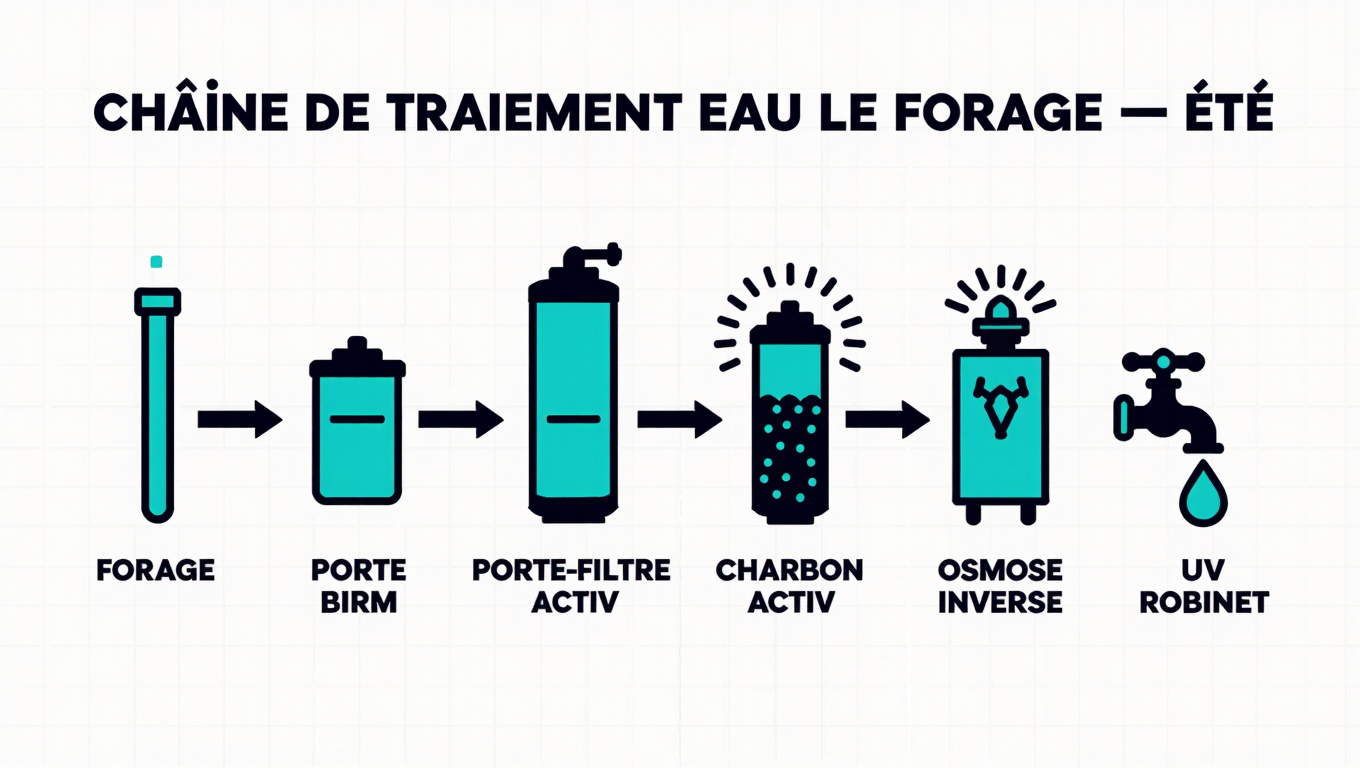
🌾 Profil A – Puits privé en zone agricole (fer + nitrates + bactéries)
- Diagnostic → Tests eau DIMM (fer, Mn, turbidité, nitrates, bactéries)
- Préfiltration → Porte-filtre automatique (sédiments, turbidité)
- Déferrisation → Média Birm (Fe < 0,2 mg/L, Mn < 0,05 mg/L)
- Adsorption → Charbon actif (pesticides, COV)
- Désinfection → UV DIMM
- Eau de boisson → Osmoseur sous évier DIMM (nitrates, PFAS)
🏨 Profil B – Hôtel / camping alimenté par forage en zone sèche
- Analyse laboratoire → Paramètres réglementaires avant ouverture de saison
- Filtration industrielle → Porte-filtres haute capacité (turbidité estivale)
- Déferrisation → Birm ou Green Sand selon teneur
- Désinfection → UV professionnel (gros débits)
- Eau de boisson dédiée → Osmoseurs en cuisine et en chambres si zone vulnérable
- Suivi mensuel → Tests terrain DIMM toute la saison
🏘️ Profil C – Collectivité rurale sur réseau public en zone d'étiage
- Suivi renforcé estival → Tests terrain mensuels en juillet-août
- Protection captages → Filtration avancée en amont si turbidité observée
- Eau de boisson sécurisée → Osmoseurs sous évier dans les points sensibles (crèches, écoles, EHPAD)
- Communication transparente → Information aux usagers en cas de dépassement seuil
7. Summer monitoring protocol
La surveillance de la qualité de l'eau en été doit être proactive, pas réactive. Attendre que l'eau rougisse ou que des problèmes de santé apparaissent est toujours trop tard. Voici le protocole recommandé par DIMM pour les installations sur forage.
- Juin (avant l'étiage) : test terrain complet des 8 paramètres clés. Ajuster la chaîne de traitement si nécessaire. Remplacer médias et lampes UV.
- Juillet (début étiage) : test turbidité et fer en priorité. Vérifier le colmatage des filtres. Augmenter la fréquence des backwashs.
- Août (pic étiage) : test complet si juillet montrait une dégradation. Analyse bactériologique si pluies orageuses récentes (remobilisation).
- Septembre (fin étiage) : bilan de la qualité estivale. Rapport client avec recommandations pour l'été suivant.
Conclusion: summer starts now for your groundwater
La sécheresse estivale est un phénomène prévisible, cyclique et de mieux en mieux documenté par le BRGM et les agences de l'eau. Ses effets sur la qualité des eaux souterraines sont réels et mesurables. Pour les professionnels du traitement de l'eau, l'anticipation est la clé : installer ou renforcer les systèmes de traitement avant le pic d'étiage est toujours moins coûteux que de réagir à une dégradation avancée ou à une contamination déclarée.
Chez DIMM, nous accompagnons depuis plus de 30 ans les professionnels dans la protection des installations sur forage et puits privé. Notre gamme couvre l'intégralité de la chaîne – du diagnostic aux osmoseurs industriels – avec un support technique réactif et des stocks disponibles immédiatement.