


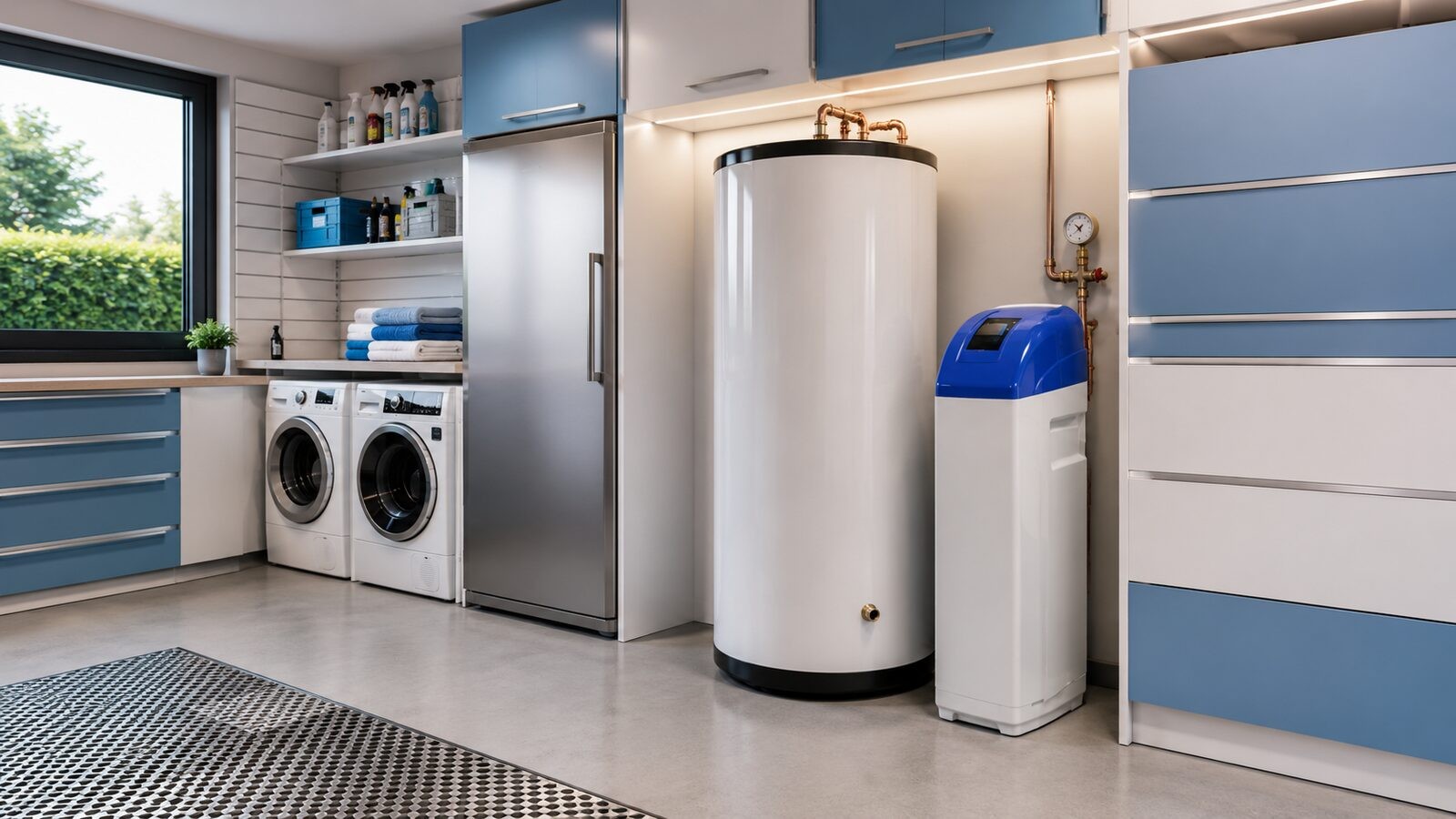
The resin water softener is the benchmark solution against limescale. But its principle — ion exchange — has a downside: once saturated with calcium and magnesium, the resin must be regenerated using a brine (water + salt). This regeneration generates a salty discharge, drained to the sewer.
This discharge is often ignored, yet it raises real environmental and regulatory questions, particularly with on-site (non-collective) sanitation. Good news: a well-designed, well-sized and well-set softener greatly reduces these discharges. Let us take stock, without dramatising or minimising.
1. Where does the brine come from?
In a softener, hard water passes through an ion-exchange resin that captures calcium and magnesium (responsible for limescale) in exchange for sodium ions. When the resin is saturated, it captures nothing more: it must be regenerated.
Regeneration consists of passing a concentrated brine (salt-saturated water) through the resin. The excess sodium "pushes out" the fixed calcium and magnesium, which are then flushed to the sewer with the rinse water. This effluent is what is called the brine discharge.
2. What does the discharge contain?
The regeneration water is salty and loaded. It mainly contains:
- Sodium chloride (NaCl): the excess salt not consumed by the exchange.
- Calcium and magnesium chlorides: the captured limescale, released in dissolved form.
- The rinse water: a volume of water accompanying each regeneration.
The sensitive point is the chlorides: they are poorly retained by the conventional processes of treatment plants and therefore end up, in part, in natural environments.
3. What are the impacts?
On collective sanitation (sewer → plant)
Diluted in the network, domestic discharges remain modest at the scale of one household. But cumulatively, they contribute to the salinity of wastewater — and the chlorides largely pass through the plants to reach the rivers.
On on-site sanitation (septic tank)
This is the most delicate case. A very concentrated brine arriving directly in a tank may, according to some views, disrupt the anaerobic digestion and bacterial balance. Views differ: some standards (EN 12566-3) conclude there is no notable negative effect, other work points to a risk. As a precaution, it is better to check the compatibility and local regulations before connecting a softener to an autonomous system.
On environments and soils
On a large scale, the input of sodium and chlorides contributes to the salinisation of surface waters and can affect soils and crops if the water is reused.
4. What the regulations say
In practice, a domestic softener discharges to the wastewater network (mains sewer), in compliance with the community's sanitation bylaw, which may set conditions or limits.
- Collective sanitation: connection to the sewer, in accordance with the local sanitation service's bylaw.
- On-site sanitation: discharges must meet the applicable requirements (regulated discharge parameters); connecting the brine to the tank requires caution and verification.
- Large installations: beyond certain thresholds, specific rules (discharge framework, "water law") may apply.
⚠️ The reflex: check locally
The concrete rules depend on the municipality and the type of sanitation. Before installation, consult the applicable sanitation bylaw and, for autonomous sanitation, ensure the compatibility of the discharge.
5. How to reduce brine discharges
The impact depends directly on the amount of salt and water consumed at each regeneration. Several levers, which can be combined, greatly reduce it.
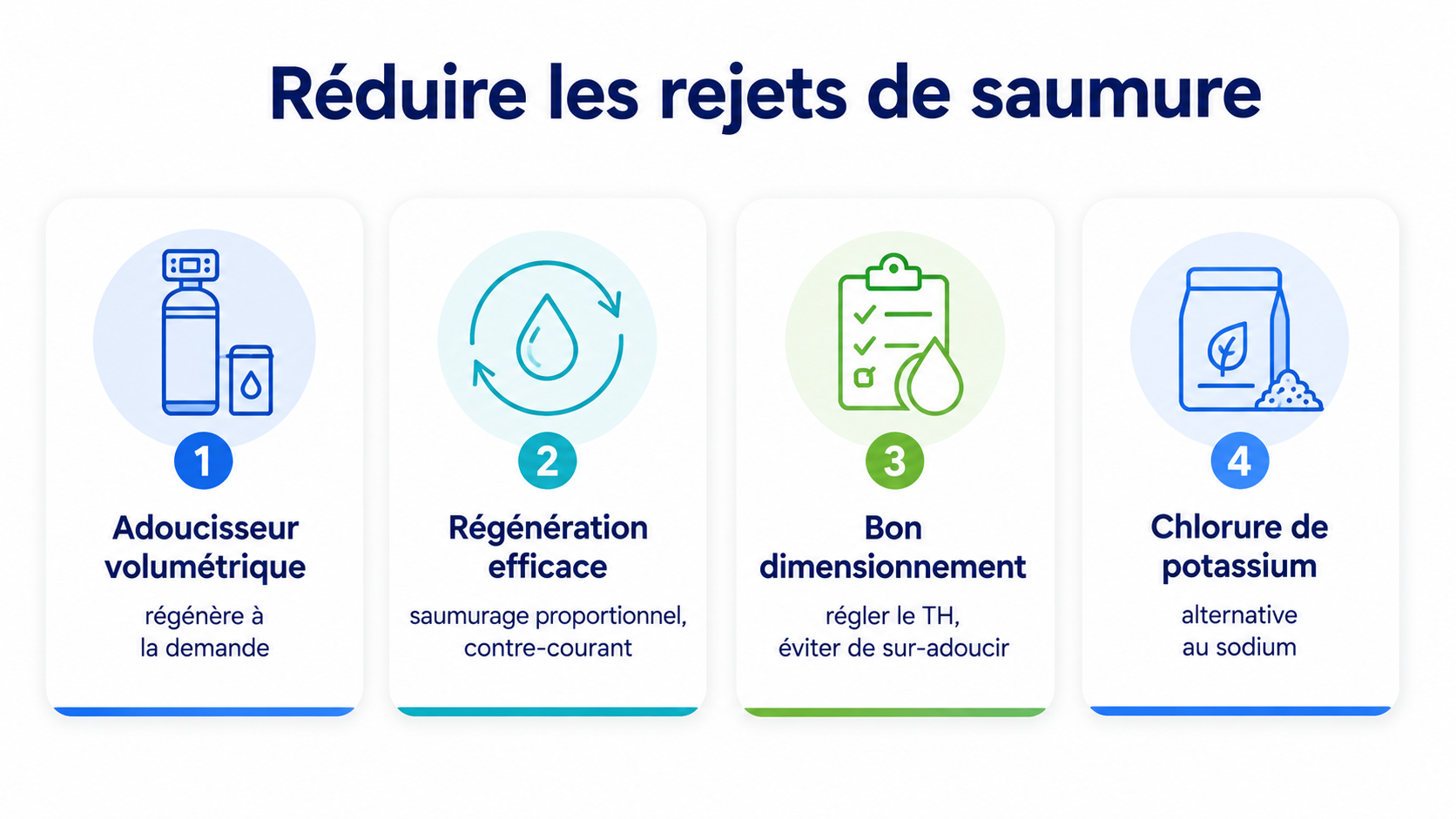
- Volumetric softener (on demand) rather than timed: it regenerates according to actual consumption, not on a fixed date — so less often, less salt and water.
- Efficient regeneration: proportional brining and counter-current systems consume less salt per regeneration.
- Correct sizing & hardness setting: a suitable unit and a non-zero outlet hardness (water not over-softened) space out regenerations.
- Potassium chloride (KCl): it replaces sodium with potassium (useful when sodium is a problem) — more expensive, but an option.
💡 When salt is truly a problem
Where salty discharge is banned or impossible (certain autonomous sanitation, local constraints), salt-free alternatives can be considered (anti-scale processes by nucleation/TAC), bearing in mind that they do not "soften" the water strictly speaking but limit scaling.
6. Proper connection
On the installation side, a few rules of good practice protect the environment and compliance:
- Drain to the wastewater network with an air gap (backflow prevention) at the discharge point.
- Avoid, unless approved, direct discharge into a septic tank; prefer a suitable outlet.
- Comply with the manufacturer's recommendations and the local sanitation bylaw.
🔗 DIMM solutions — Responsible softening
- Volumetric softeners with efficient regeneration (proportional brining, counter-current).
- Sizing & hardness setting to limit salt, water and discharges.
- Alternatives & advice depending on the type of sanitation and local constraints.
7. Who should be vigilant here?
Installers & resellers
Advice makes the difference: choosing a well-sized volumetric unit, setting the hardness, checking the sanitation and the local bylaw — all points that reduce impact and secure the installation.
Communities & large consumers
On large installations, optimising brining and, where applicable, recovery or reduction solutions for effluents (low-discharge technologies) make full sense.
Conclusion: soften better, discharge less
Brine discharge is the logical downside of softening by ion exchange. It is not a reason to abandon the technology, but a parameter to master: a volumetric, well-sized softener with efficient regeneration consumes far less salt and water, and therefore discharges less. Add to this compliance with local regulations, particularly in on-site sanitation. Softening better also means discharging less.
The DIMM teams support partner installers, distributors and resellers in choosing high-performance softeners and in the responsible sizing of installations, in France and Belgium.
Reference points
- Resin regeneration produces a salty effluent (NaCl, calcium and magnesium chlorides, rinse water).
- Chlorides are poorly retained by treatment plants and partly reach the environment.
- On-site sanitation: differing views (EN 12566-3 vs other work); caution and verification recommended.
- Regulations: comply with the local sanitation bylaw; specific rules for large installations.
- Reducing discharges: volumetric softener, proportional / counter-current brining, correct sizing and hardness setting, KCl, salt-free alternatives.