

Tap water is the most monitored food in France — yet its real quality at the point of use varies enormously by region. Limescale, nitrates, pesticides, PFAS, chlorine: every area has its challenges. For you, water-treatment professionals, knowing the water of each area is the basis for advising and equipping your customers correctly.
Why water quality is a daily issue
Poor water quality is not just about taste. Limescale scales up water heaters, pipes and appliances — up to +30% energy use on a scaled tank. Nitrates, pesticides and PFAS raise health questions. Chlorine affects taste and smell. For your customers, well-treated water protects installations, comfort and budget; for you, it is a strong selling point and high-value sales.
What is quality water?
- Hardness (TH, in °f) — calcium and magnesium content. Above 25-30 °f, water is hard and scaling.
- pH and calco-carbonic balance — water that is too soft becomes aggressive (corrosion).
- Nitrates & pesticides — of agricultural origin (nitrate limit: 50 mg/L).
- PFAS — "forever chemicals", newly regulated (EU Directive 2020/2184).
- Chlorine and by-products — necessary disinfection, but taste/odour to correct.
- Microbiology & metals — bacteria (incl. legionella in DHW), lead, iron, manganese.
Key point — The utility's figure is a network average. Real quality is measured at the point of use, especially with a private borehole or a mains/borehole mix.
Water, region by region
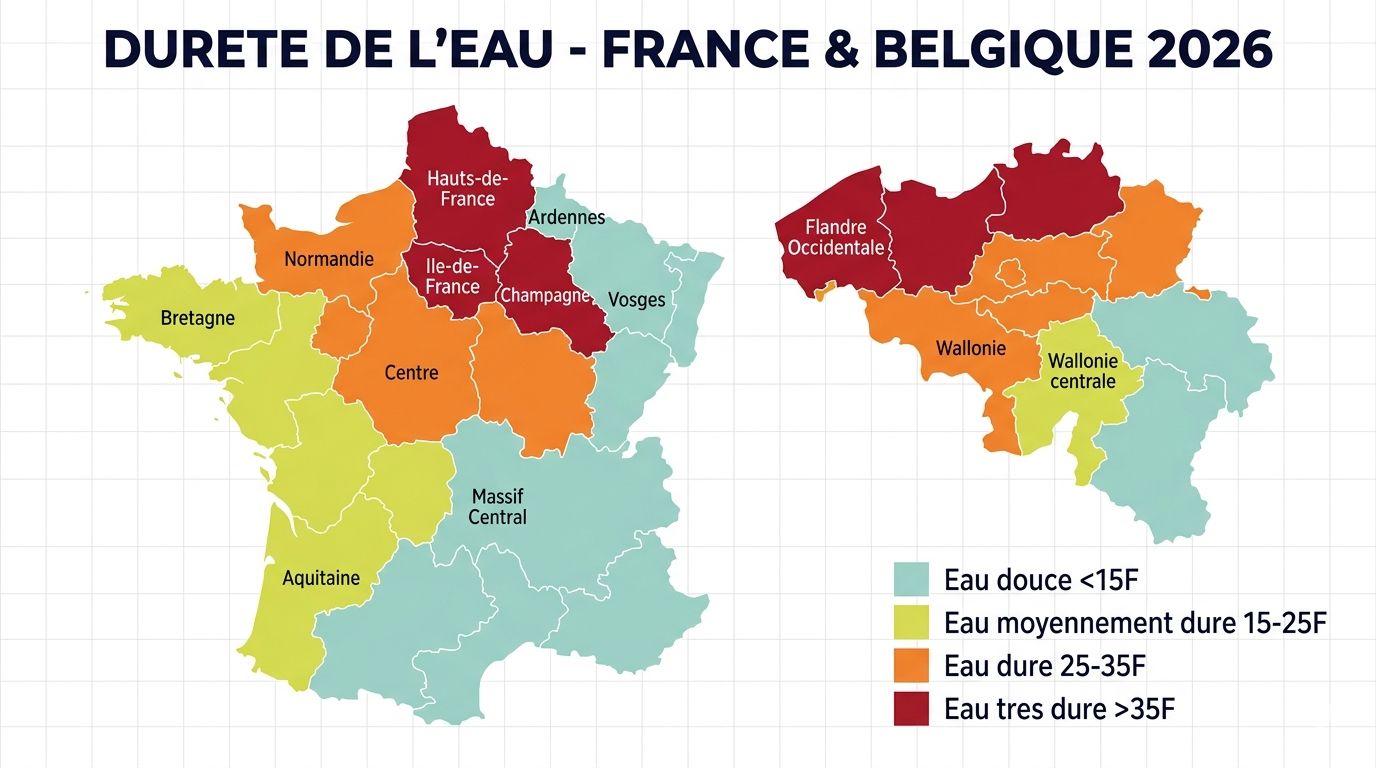
- Île-de-France & Paris basin — limestone bedrock: among the hardest water in France (often 30-40 °f). Softening almost unavoidable.
- Hauts-de-France & Grand Est (Alsace) — abundant aquifers but hard, locally high in nitrates.
- Burgundy–Franche-Comté & Jura — karstic limestone: hard water and possible turbidity after rain.
- Auvergne & Massif Central — volcanic/granitic bedrock: naturally soft, low-mineral water.
- Nouvelle-Aquitaine — limestone aquifers: often hard, watch nitrates/pesticides in farming areas.
- Occitanie & Pyrenees — soft mountain water at altitude, picking up limescale in the plains.
- PACA & Mediterranean — hard water and a resource under summer stress.
- Brittany & Pays de la Loire — granitic bedrock: rather soft, but historic nitrates/pesticides.
- Alps & Savoie — quality mountain water, soft to moderately hard.
The main water pollutants
- Limescale — not a health risk but a cost: scaling, overconsumption, breakdowns.
- Nitrates & pesticides — agricultural, a major issue in rural and catchment areas.
- PFAS — persistent per/polyfluorinated substances, now tested in drinking water.
- Chlorine & by-products — taste, odour and trihalomethanes to limit.
- Microplastics & heavy metals — lead (old pipes), iron, manganese (boreholes).
- Microbiology — bacteria and legionella in poorly managed hot-water systems.
Our recommendations for daily treatment
DIMM, a water-treatment wholesaler, thinks in multi-barrier terms and supplies you the equipment to build the right chain for each project — to offer to your customers.
- Sediment pre-filtration — first barrier against sand, rust and particles.
- Water softener — against limescale (target 5 °f residual). See the ORUS softener and the full range.
- Activated carbon — removes chlorine, tastes, odours and some pesticides. See the tap filter.
- Reverse osmosis — ultra-pure drinking water (nitrates, PFAS, metals). See the under-sink RO.
- UV sterilisation — chemical-free disinfection for boreholes and sensitive networks. See UV sterilisation.
- PFAS solutions — dedicated filtration. See our PFAS page.
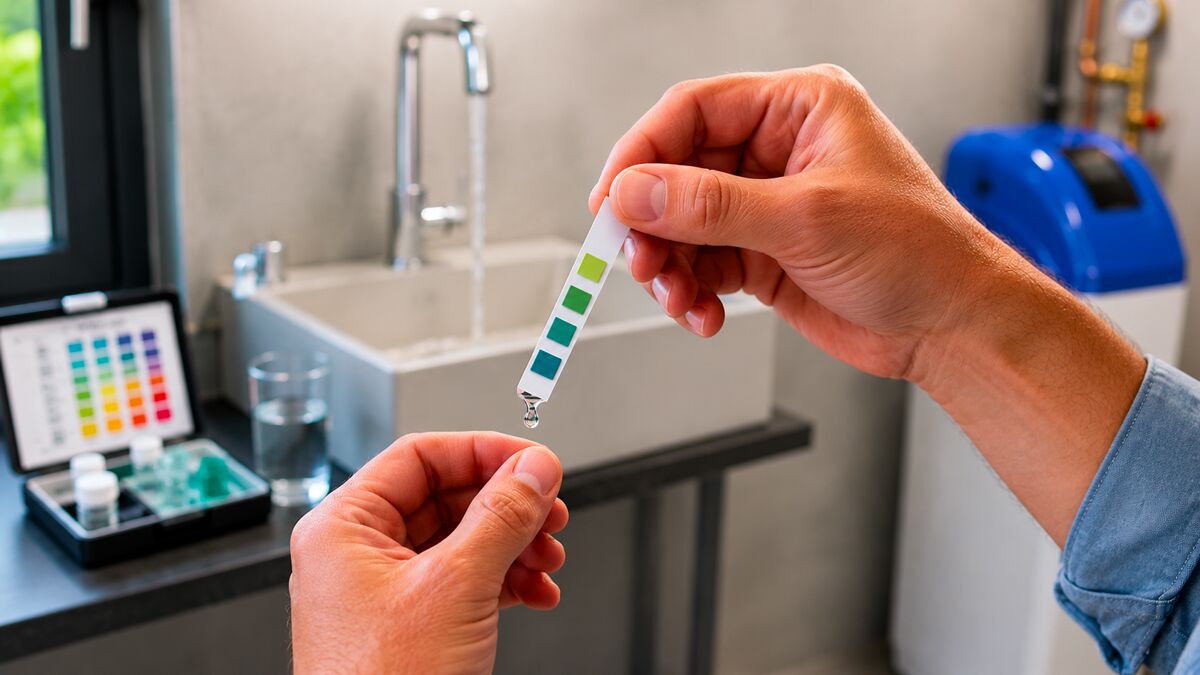
The right approach — 1) measure incoming water, 2) identify priority pollutants, 3) size the treatment chain, 4) maintain. Exactly the support DIMM provides.
Conclusion
There is no single "French water" but as many waters as there are territories. Knowing yours — hardness, pollutants, seasonal variations — lets you choose the right treatment, neither oversized nor insufficient. DIMM supports installers, distributors and resellers in France and Belgium with diagnosis, sizing and durable, certified treatment solutions.
Sources & references
- ANSES — Tap water quality (parameters and limits).
- Directive (EU) 2020/2184 on the quality of water for human consumption.
- WHO — Guidelines for drinking-water quality.
- Ministry of Health / ARS — Regional water quality reports.