

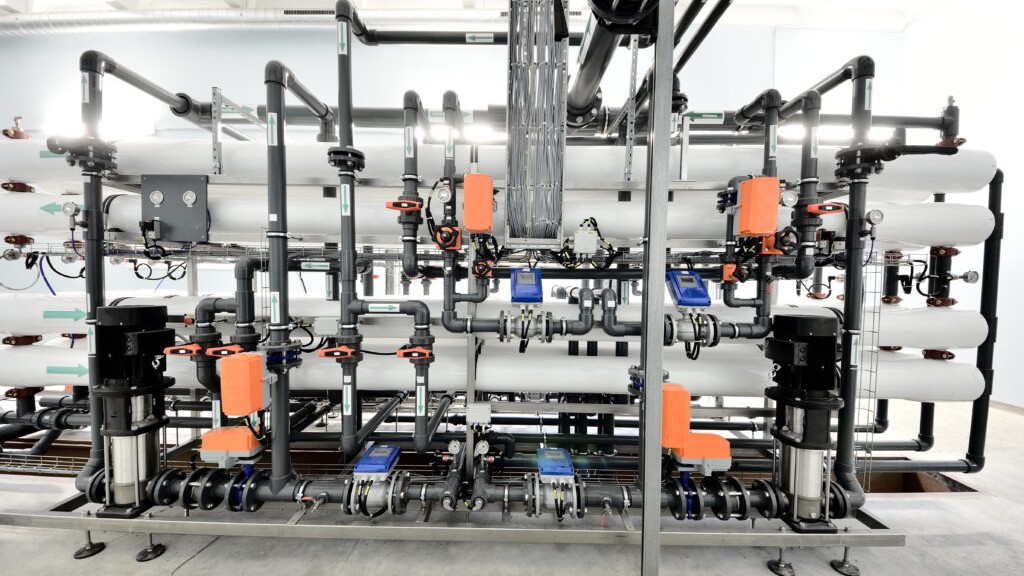
Reverse osmosis is the most advanced purification technology in water treatment. But it is also one of the most maintenance-demanding: its performance rests on a chain of filters and on a semi-permeable membrane whose condition determines everything. Neglect maintenance and water quality quietly degrades, consumption rises, and the membrane — the most expensive element — dies prematurely.
In a professional context (hospitality, laboratories, healthcare, industry, food processing), the stakes are twofold: guaranteeing consistent, compliant water, and controlling the running cost. The good news: a well-monitored RO unit is extremely reliable. It all comes down to planned servicing and a few regular checks.
1. Why maintenance is decisive
On an RO unit, each stage protects the next. If the prefilters are saturated, chlorine and particles reach the membrane and damage it. If the membrane fouls, quality drops and water consumption climbs. Maintenance is therefore not a formality: it is what protects the most expensive investment in the system.
Rigorous servicing brings three concrete benefits: stable water quality (essential in professional use), a maximised membrane lifespan, and a controlled running cost — replacing prefilters on time costs far less than replacing a membrane prematurely.
2. The maintenance schedule
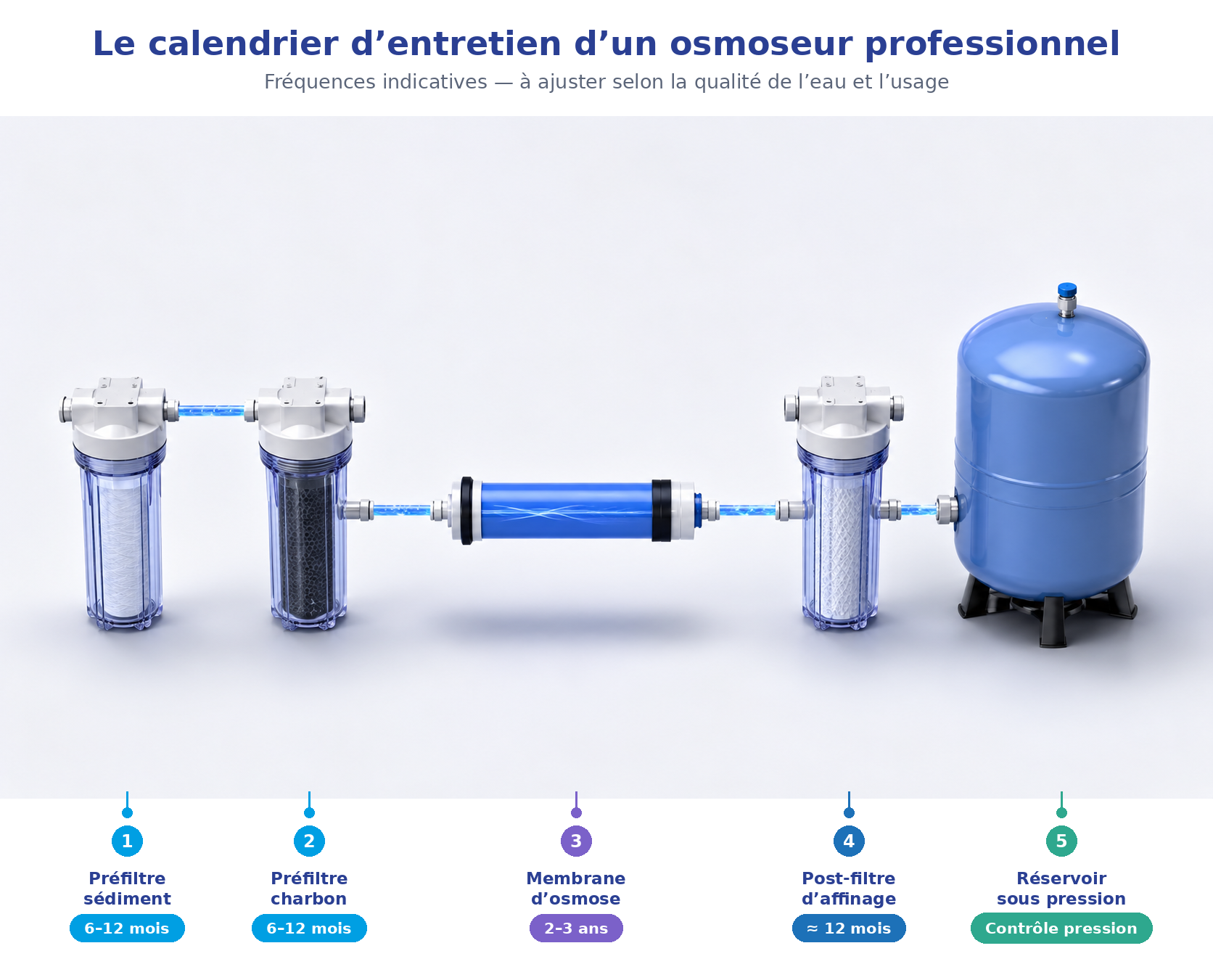
Here are the reference intervals. They are indicative: the quality of the feed water (hardness, chlorine, turbidity) and the intensity of use can shorten them significantly.
3. Prefilters: the first line of defence
Before reaching the membrane, the water passes through multi-stage prefiltration. A sediment filter retains sand, rust and particles; an activated-carbon filter removes chlorine — essential, because chlorine irreversibly destroys the polyamide membranes of reverse osmosis.
This is the most frequent and most decisive maintenance: clogged prefilters let through what they should stop and accelerate membrane wear. Replace them every 6 to 12 months, more often if the water is loaded. Each replacement is also the chance to inspect the seals and filter housings.
4. The membrane: the heart of the system
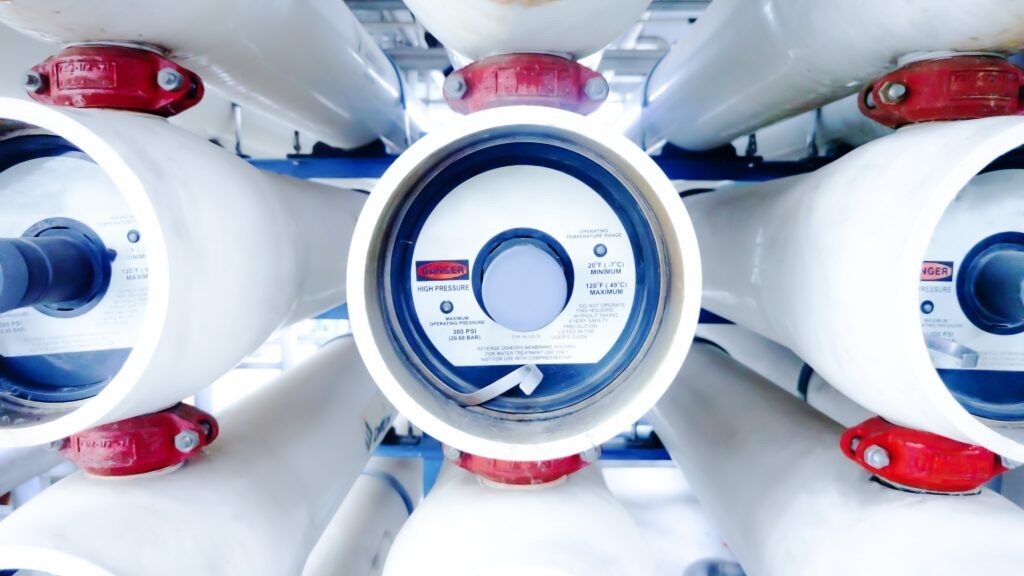
The reverse-osmosis membrane is the central — and most expensive — element. Well maintained, it typically lasts 2 to 3 years, sometimes more. Three enemies shorten its life: chlorine (hence the vital role of upstream carbon), scaling (limescale, on hard water) and biofouling.
The most reliable warning signal is a rising TDS (see §5): when the water produced becomes noticeably less pure, or the flow drops while the prefilters are new, the membrane is reaching end of life. In an industrial context, chemical cleaning (CIP) is also performed — acid solutions against scaling, alkaline against organic fouling — to extend its life.
5. The checks to follow
Maintenance is not limited to replacing consumables: it rests on regular measurements that detect drift before a breakdown.
- TDS / conductivity: the key indicator. RO water is generally between 10 and 100 ppm. A lasting rise signals a tired membrane. In industry, monitoring is daily.
- Feed pressure: sufficient pressure (often provided by a booster pump) is essential to the membrane's performance.
- Tank pressure (if present): a tank that empties slowly often betrays a lack of air pressure to top up.
- Rejection rate & flow: monitor the ratio of pure water to reject water, and the state of the flow restrictor.
💡 Keep a maintenance log
Recording replacement dates, TDS and pressure values turns maintenance into management: you anticipate replacements, objectify the membrane's end of life and prove compliance — invaluable in a professional, regulated environment.
6. Disinfection and prevention
A very pure water circuit is not immune to microbial growth in the pipes, tank and tap. A periodic disinfection (sanitation) — at least once a year, with a potable-water-compatible product — limits this risk, ideally during the annual filter replacement.
The best maintenance, however, is preventive and starts upstream:
- Softening the feed water if it is hard: it protects the membrane from scaling.
- Effective dechlorination (carbon): to preserve the membrane from chlorine.
- Antiscalant and good setting of the conversion rate in industrial installations, to limit scaling and fouling.
🔗 DIMM solutions — RO & consumables
- Professional & industrial RO units — from compact to high-capacity skids.
- Membranes, prefilters & post-filters — genuine consumables for every service interval.
- Pretreatment — softeners, carbon filtration and upstream disinfection solutions.
7. Who is this monitoring for?
Hospitality, laboratories & healthcare facilities
Where water must be of consistent, traceable quality, planned maintenance and TDS monitoring are not optional: they guarantee compliance and continuity of service.
Industry & food processing
On high capacities, monitoring becomes professional: daily control of conductivity and pressures, scheduled chemical cleaning and antiscalant management to protect costly membranes.
Conclusion: anticipate rather than endure
Maintaining a professional RO unit comes down to one idea: protect the membrane. Prefilters replaced on time, a monitored TDS, regular disinfection and suitable pretreatment are enough to guarantee pure, stable and economical water over time. Conversely, neglected maintenance always costs — first in water quality, then in the membrane. A schedule kept beats a breakdown endured.
The DIMM teams support partner installers, distributors and resellers in choosing RO units, consumables and pretreatment solutions, as well as in setting up maintenance plans, in France and Belgium.
Reference points
- Prefilters (sediment + carbon): replacement every 6 to 12 months depending on water quality.
- RO membrane: typical lifespan of 2 to 3 years; sensitive to chlorine, scaling and biofouling.
- RO water: TDS generally between 10 and 100 ppm; daily monitoring in industry.
- Circuit disinfection / sanitation at least once a year, potable-water-compatible product.
- Prevention: upstream softening and dechlorination, antiscalant and chemical cleaning (CIP) in industry.