



This technical guide, written by the DIMM NV technical department, is intended for installers and maintenance technicians working on residential water softeners. It covers all preventive and corrective maintenance operations, from the resin to the control valve.
Reference document · This guide summarises best practices accumulated by DIMM since 1991. For any installation-specific questions, contact the DIMM technical department.
Are you a homeowner? · This guide is primarily intended for water treatment professionals. If you are a homeowner, we strongly recommend that you call on a qualified installer for the maintenance of your water softener. A professional has the right tools, suitable products and the expertise needed to ensure your appliance operates correctly and lasts as long as possible.
1. How does a water softener work?
A water softener works on the principle of ion exchange: calcium (Ca²⁺) and magnesium (Mg²⁺) ions, responsible for limescale, are captured by a resin and replaced by sodium (Na⁺) ions from the regeneration salt.
The operating cycle comprises 5 phases:
- Service (softening) · hard water passes through the resin bed; calcium and magnesium are retained
- Backwash · reversed flow to clean the resin and remove impurities
- Regeneration (brining) · a saturated salt solution recharges the resin with sodium
- Slow rinse · removal of residual brine
- Fast rinse · final cleaning before returning to service
Key point · Softened water quality depends on the proper execution of each phase. Any malfunction in the regeneration cycle immediately results in limescale at the outlet (hardness leakage).
2. Ion-exchange resin maintenance
Lifespan and ageing
Residential water softener resin has a lifespan of 10 to 15 years under normal conditions. It gradually degrades due to oxidation (mains water chlorine) and fouling by iron or organic matter.
Signs of end-of-life resin:
- Recurring hardness leakage despite correct regeneration
- Constantly decreasing treated water volume between regenerations
- Fines (small broken grains) present in backwash water
Replacement threshold · A loss of exchange capacity (TEC) exceeding 20% requires partial or total resin replacement.
Recommended preventive treatments
- Resin cleaner · annual treatment with citric acid or a specific cleaner (Resup type) significantly extends exchange capacity. DIMM offers cleaners suitable for all softeners.
- Iron-rich water (Fe > 0.2 mg/L) · monthly 5% citric acid cleaning recommended to prevent resin poisoning
- Chlorinated water · in areas with high chlorine, prefer macroporous resin, more resistant to oxidation
WARNING · Never use sulphuric acid on softener resin: risk of irreversible calcium sulphate (CaSO₄) precipitation.
3. Regeneration: setting up your softener correctly
Regeneration modes
| Mode | Salt (g/L resin) | Hardness leakage | Typical use |
|---|---|---|---|
| Standard co-current | 80 – 120 | 0.5 – 2.0 °f | Classic softeners (Fleck, Autotrol) |
| Economy co-current | 50 – 80 | 2.0 – 5.0 °f | Reduced salt consumption, moderately hard water |
| Counter-current (upflow) | 60 – 100 | < 0.5 °f | Modern softeners (Floteck, Clack WS1) |
Parameters to check at each visit
- Inlet water hardness (°fH) · colorimetric test or strip
- Programmed capacity · must match resin volume and measured hardness
- Regeneration mode · volumetric (recommended) or timer-based
- Regeneration time · ideally between 02:00 and 04:00 to avoid use during the cycle
- Safety reserve · set to 20–30% of nominal capacity
Rinse water consumption
- Backwash · 2 to 3 resin volumes (BV) at 6–10 m/h, do not exceed 50% bed expansion
- Slow rinse · 2 BV at the same rate as brine
- Fast rinse · 3 to 6 BV at nominal service rate
- Typical total · 8 to 15 litres of water per litre of resin per cycle
4. Salt tank: maintenance and monitoring
Maintenance schedule
| Frequency | Action | OK criterion |
|---|---|---|
| Every 2 weeks | Visual check of salt level and absence of salt bridge | Salt ≥ 1/3 of tank |
| Monthly | Screen and float check | No deposit, free float |
| Annual | Complete drain, bottom cleaning, seal inspection | Clean bottom, no cracks |
Which salt to use?
- Salt pellets · NaCl ≥ 99.5%, EN 973 Type A standard. This is the standard for residential softeners.
- Compressed salt tablets · NaCl ≥ 99.8%, slower dissolution, ideal for small tanks
Prohibited salts · De-icing salt, unrefined sea salt and salts with anti-caking agents (ferrocyanide > 20 mg/kg) are forbidden: they irreversibly contaminate the resin and clog the valve.
Common problems
- Salt bridge · hard crust on the surface preventing salt dissolution. Diagnosis: push a broomstick · if resistance at top but cavity below, it's a bridge. Solution: break the crust, use better quality salt, don't overfill the tank.
- Mushing (salt sludge) · pasty deposit at tank bottom. Diagnosis: cloudy brine water. Solution: drain, clean, switch to purer salt.

5. Control valve: preventive maintenance
Common residential valve types
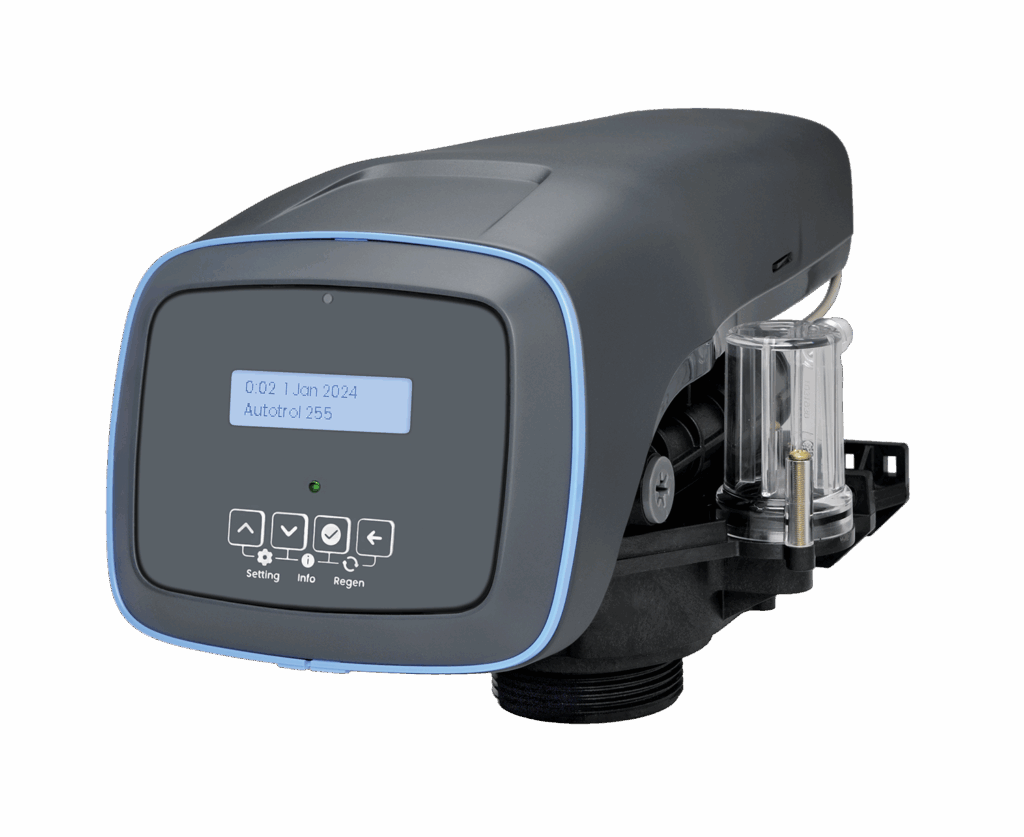
- Rotary cam valves · Fleck 5600 SXT, Fleck 5800 XTR, Autotrol 255/760, Floteck 85: rotating cam disc, standardised parts, high reliability
- Multi-piston valves · Clack WS1, BNT-1650: independent actuators per port, advanced programming, onboard diagnostics, counter-current capable
Annual maintenance kit
- O-rings · systematic replacement, EPDM or silicone compatibility
- Cycle disc / pistons · clean with 5% citric acid (never abrasive tools)
- Drive motor · check torque and connectors
- Bypass · test open/close, no seat leakage
- Venturi injector · disassemble and clean (ultrasonic or citric acid), check bore diameter
- Lubrication · food-grade silicone grease only
6. Softened water quality control
Parameters to monitor
| Parameter | Method | Frequency | Target value |
|---|---|---|---|
| Residual hardness (TH) | Strip or EDTA titrator | Monthly (owner) / Weekly (technician) | < 1 °fH |
| pH | pH meter or strip | Quarterly | 6.5 – 9.5 |
| Dissolved iron | Colorimetric kit | Annual (if borehole water) | < 0.1 mg/L |
Hardness leakage diagnosis
- Limescale at start of cycle · salt under-dosing, iron-fouled resin, channeling
- Limescale at end of cycle only · normal, resin exhaustion triggers regeneration
- Permanent limescale · bypass open, control valve stuck, or end-of-life resin
- Very low treated volume · internal valve leak, bypass partially open
7. Softener disinfection
Resin provides a favourable environment for bacterial growth (high surface area, permanent moisture). Disinfection is necessary:
- At commissioning or after resin replacement
- After any extended shutdown exceeding 72 hours (holidays, second home)
- In case of odour or abnormal bacteriological results
Simplified bleach protocol
- Prepare a solution at 50 mg/L active chlorine (approximately 4 mL of 2.6% bleach per litre of water)
- Pass 3 resin volumes of this solution in service mode
- Leave in contact for 30 minutes
- Rinse thoroughly until the water no longer smells of chlorine (minimum 10 resin volumes)
- Run a complete regeneration before returning to service
WARNING · Never exceed 50 mg/L active chlorine on gel resin (standard residential type). Beyond this, risk of irreversible resin oxidation.
8. Preventive maintenance plan · summary
| Frequency | Actions | Who? |
|---|---|---|
| Every 2 weeks | Check salt level · Check for salt bridge | Homeowner |
| Monthly | Test softened water hardness (TH strip) | Homeowner |
| Annual | Complete salt tank cleaning · Resin cleaner · Valve programme check · Bypass check | Homeowner or installer |
| Every 2 years | Valve seal replacement · Venturi cleaning · Motor check · Timed full cycle test | Installer / DIMM technician |
| 10 to 15 years | Resin replacement (based on residual capacity measurement) | Installer / DIMM technician |
9. Quick troubleshooting guide
| Symptom | Probable causes | What to do? |
|---|---|---|
| Permanently hard water | Bypass open, exhausted resin, stuck valve | Check bypass, force regeneration, inspect resin |
| Salty taste in water | Insufficient rinsing, blocked Venturi, valve stuck in brine position | Extend rinsing, clean Venturi, check valve sequence |
| Softener not drawing salt | Blocked Venturi, low brine level, salt bridge, failed check valve | Clean Venturi, check salt, break salt bridge |
| Excessive salt consumption | Over-regeneration, brine leak, incorrect settings | Check programme, inspect tank seals, recalculate dosing |
| Water pressure drop | Blocked resin, insufficient backwash, partially blocked screen | Extended backwash, resin cleaner, screen inspection |
| Softener not regenerating | Programming lost (power cut), motor failure, faulty meter | Reprogramme, check power supply, test meter |
10. DIMM maintenance products and parts
DIMM supplies all consumables and spare parts needed for residential water softener maintenance:
- Regeneration salt · high-purity pellets and tablets → view catalogue
- Resin cleaners and disinfectants → view catalogue
- Hardness test kits → view catalogue
- Seals, Venturi, valve spare parts → view catalogue
- Replacement resins and bottles → view catalogue
- Complete residential softeners → view range
For any technical enquiry or sizing request, contact the DIMM team.