


Clear, safe pool or spa water does not come from a single miracle product, but from a system. Three functions work together: filtration removes particles, disinfection eliminates micro-organisms, and water balance ensures it all works — and that the water stays pleasant and non-corrosive.
Neglect just one of these pillars and cloudy, green or irritating water is guaranteed. Let us look at each one's role, the available technologies, and the specifics of the spa, which is more demanding than the pool.
1. The three pillars of healthy water
Good water management is often summed up in a simple rule: balance, filter, disinfect. These three actions are interdependent.
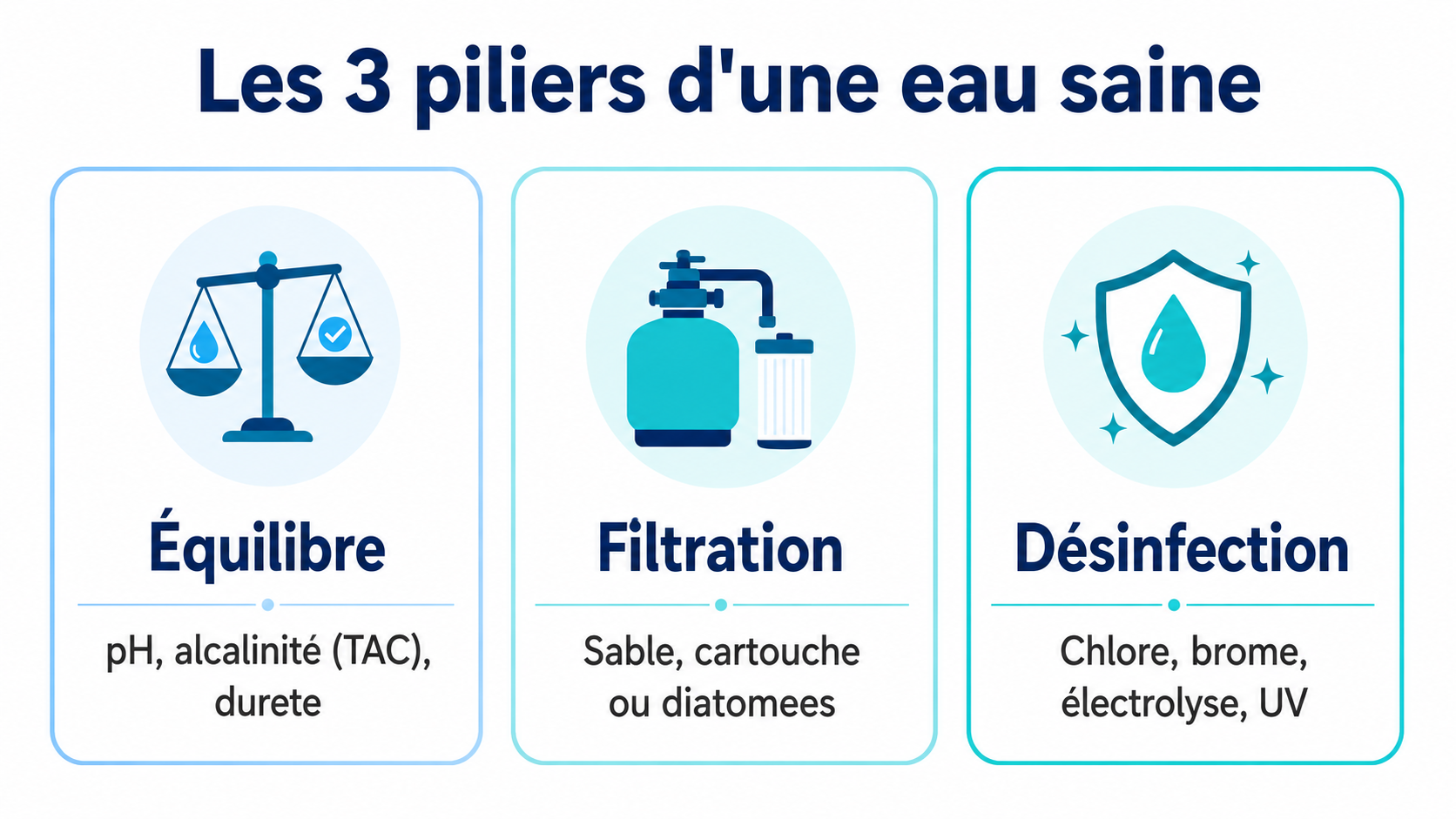
- Balance: pH, alkalinity (TA), hardness — it governs the effectiveness of disinfection and the bather's comfort.
- Filtration: it clarifies the water by retaining particles; without it, no disinfectant is enough.
- Disinfection: it destroys bacteria, viruses and algae, and maintains protection over time.
2. Filtration
Filtration is the pool's "kidney": the circulation pump passes the water through a filter that retains impurities. All the pool water must be filtered regularly (filtration time is adjusted to temperature and bather load).
Three main families of filters:
- Sand filter: the most common, robust and economical; fineness in the order of a few dozen microns, improvable with a specific media (filter glass). Maintained by backwashing.
- Cartridge filter: compact, finer than sand, no backwash (cartridge cleaning); ideal for small pools and spas.
- Diatomaceous earth filter: the finest filtration (a few microns), for very clear water; more technical maintenance.
3. Disinfection
Filtration clarifies but does not disinfect: you need an agent that destroys micro-organisms and leaves a residual protection in the water. The main options:
- Chlorine: the benchmark, effective and economical (tablets, liquid chlorine). Keep free chlorine at 1 to 3 mg/L.
- Salt electrolysis: a chlorinator produces chlorine from the salt dissolved in the water — less product handling, appreciated bathing comfort.
- Bromine: more stable at high temperature and less odorous than chlorine — hence its popularity for spas.
- Active oxygen: gentle and odourless, suited to small volumes; low residual, often used as a complement.
💡 UV and ozone: reinforcements, not replacements
UV and ozone treatments effectively destroy micro-organisms and help reduce the chlorine dose and chloramines (smell, stinging eyes). But they have no residual effect: a residual disinfectant (chlorine/bromine) remains essential in the water.
4. Water balance: the key to everything
This is the most underestimated pillar. Unbalanced water makes disinfection ineffective, irritates bathers and damages the pool and equipment. The parameters to monitor:
| Parameter | Indicative range | Role |
|---|---|---|
| pH | 7.2 – 7.4 | Comfort and disinfectant efficiency |
| Free chlorine | 1 – 3 mg/L | Active disinfection |
| TA (alkalinity) | 80 – 120 mg/L | Stabilises pH |
| Stabiliser (cyanuric acid, outdoor) | 20 – 50 mg/L | Protects chlorine from UV |
| TH (hardness) | ≈ 150 – 250 mg/L | Avoids aggressive or scaling water |
⚠️ Beware of over-stabilisation
The stabiliser protects chlorine from the sun, but in excess (above about 75 mg/L) it "locks" the action of chlorine: the water can turn despite a correct chlorine level. The solution then is a partial water renewal.
5. The special case of the spa
The spa concentrates every difficulty: hot water, small volume and heavy use relative to volume. Heat accelerates disinfectant consumption and favours microbial growth; the small volume makes the water more unstable.
Practical consequences: bromine is often preferred (stable when hot, low odour), the water is monitored more frequently, and regular water renewals are carried out. Well-set filtration and disinfection are even more critical here than in a pool.
6. Equip yourself well
- Filtration matched to volume (sand/glass, cartridge or diatomaceous earth) and a correctly sized pump.
- Disinfection of your choice (chlorine, salt electrolysis, bromine) depending on use, complemented if needed by UV/ozone to reduce chlorine.
- Regulation & measurement: testers or automatic pH and disinfectant regulators for stable water without thinking about it.
🔗 DIMM solutions — Pools & spas
- Filtration (media, cartridges) and circulation accessories.
- Disinfection & UV to reduce chlorine and secure the water.
- Measurement & regulation of pH and disinfectant, and advice tailored to the pool.
7. Who is this topic for?
Pool builders & installers
From advice to sizing, mastering the three pillars is the difference between water that "holds" all season and repeated call-outs.
Communities & establishments (spas, hotels)
Public pools and establishment spas impose stricter sanitary requirements: high-performance filtration, controlled disinfection, complementary treatments (UV) and rigorous monitoring.
Conclusion: three pillars, one balance
Beautiful pool or spa water is a matter of balance as much as products: filter to clarify, disinfect to sanitise, and balance so everything works. The right reflex is to measure regularly (pH, disinfectant) and adjust — bearing in mind that the spa, hotter and smaller, demands even more attention. Well set, the installation delivers crystal-clear, healthy and pleasant water throughout the season.
The DIMM teams support partner installers, distributors and resellers in choosing filtration, disinfection and regulation solutions for pools and spas, in France and Belgium.
Reference points
- Three pillars: water balance, filtration, disinfection.
- Indicative ranges: pH 7.2-7.4; free chlorine 1-3 mg/L; TA 80-120 mg/L; stabiliser 20-50 mg/L (outdoor).
- Filters: sand/glass (robust), cartridge (fine, compact), diatomaceous earth (the finest).
- Disinfection: chlorine, salt electrolysis, bromine (spas); UV/ozone as a complement (no residual).
- Spa: hot water + small volume + heavy use → increased monitoring and regular renewals.