

Almost half of the water used in a home serves purposes that do not require drinking water: toilet flushing, watering, floor washing, laundry. All uses that rainwater can cover, reducing the bill, easing the drinking-water resource and limiting run-off.
But rainwater is not "ready to use": it is soft, acidic and picks up contaminants on contact with roofs. Harvesting it therefore requires a suitable circuit, treatment proportionate to the use and compliance with a precise regulatory framework. Let us go through it.
1. Why harvest rainwater?
Three benefits add up. First, savings: covering non-potable uses with rainwater clearly cuts mains-water consumption. Then, resource preservation: drinking water is reserved for uses that really require it. Finally, stormwater management: storing rain limits run-off and eases the networks during heavy downpours.
Rainwater also has a technical advantage: it is naturally soft (no limescale), ideal for watering and appreciable for the washing machine · provided it is properly treated.
2. The harvesting circuit
A typical installation always follows the same logic, from the roof to the points of use.
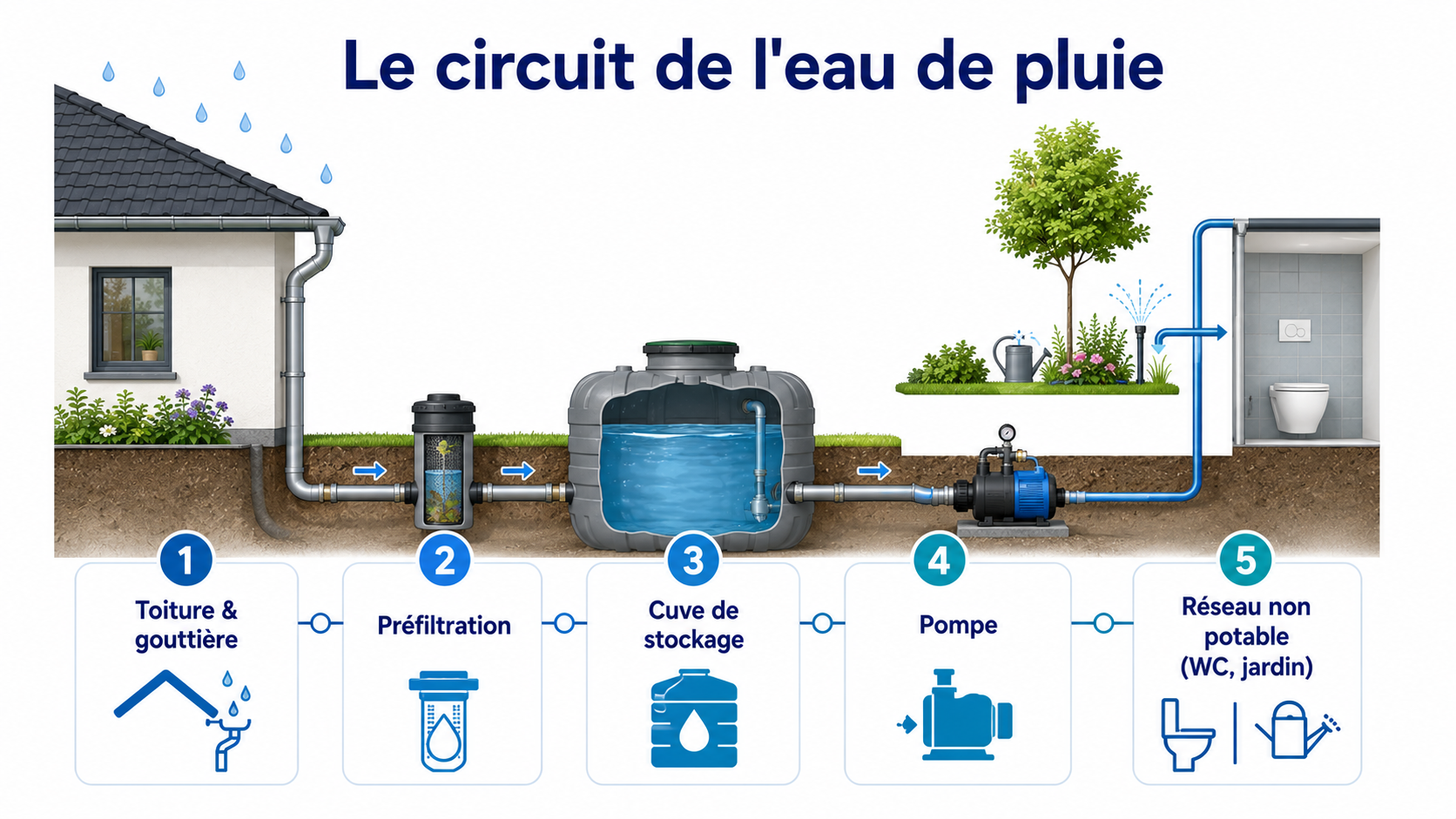
- Roof & gutters: the collection surface (inaccessible roofs, excluding asbestos-cement and lead).
- Prefiltration: leaf guards, mesh filters and a first-flush diversion device to divert the first run-off, the most loaded.
- Storage tank: buried or above-ground, with a calm inlet, an anti-odour siphon overflow and insect protection; a concrete tank has the advantage of raising the pH.
- Pump & distribution: to a separate network, distinct and marked, never connected to the drinking-water network.
3. What quality is rainwater?
At the source, rainwater is very lightly mineralised and acidic (pH often between 4.5 and 5.5), which makes it aggressive to certain materials (copper, galvanised steel). Running off the roof, it picks up dust, debris, bird droppings, micro-organisms and atmospheric pollutants.
Good news: storage in a concrete tank tends to remineralise the water and raise its pH (often towards 6.9–7.7). Still, for any contact use (laundry, cleaning), additional treatment is required.
4. Treat according to use
The principle: neither too much nor too little. Treatment is staged according to the demand of the use.
| Use | Recommended treatment |
|---|---|
| Watering, outdoors | Prefiltration only (leaf guard, mesh, first flush) |
| Toilets, floor washing | Prefiltration + fine filtration < 10 µm at the pump outlet |
| Washing machine | Fine filtration + UV disinfection (water in contact with laundry) |
| Tastes/odours or pollutants | Add activated carbon (UV does not treat the chemical) |
In practice: a sediment cartridge (spun PP or fibre, < 10 µm) protects the appliances and clarifies the water; a UV steriliser ensures microbiological safety without chemicals; activated carbon completes the setup if tastes/odours or micropollutants must be treated.
🚨 Rainwater is not potable
Rainwater must not be used for drinking, cooking, dishwashing or personal hygiene. Making it potable would require a heavy treatment chain and a strict sanitary framework; that is not the purpose of a domestic installation.
5. The regulatory framework (France)
The harvesting and use of rainwater are regulated. Since 1 September 2024, the decree and order of 12 July 2024 (on water unfit for human consumption) apply, replacing the order of 21 August 2008. The main principles:
- Outdoor uses: watering green spaces, washing exteriors and vehicles.
- Authorised indoor uses: toilet flushing, floor washing, and laundry (now clarified, subject to suitable treatment).
- Separate, marked network: distinct pipes, "non-potable water" signage, and backflow protection excluding any interconnection with the drinking-water network.
- Declaration to the town hall for indoor use connected to collective sanitation; additional steps for certain uses (washing machine).
⚠️ Dated information · to verify
Regulations evolve: these reference points are current as of June 2026 (framework of the order of 12 July 2024). Before any project, check the texts in force (Légifrance, ARS, town hall) and, in Belgium, the regional rules · the rainwater tank is often mandatory for new builds there.
6. Installation best practice
- No interconnection with the potable network: total disconnection, top-up filling by overflow with an air gap if necessary.
- Clear marking of pipes and "non-potable water" draw-off points.
- Regular maintenance: cleaning prefilters and gutters, replacing cartridges, checking the UV lamp, inspecting the tank.
- Suitable roofing materials: avoid asbestos-cement and lead for regulated uses.
🔗 DIMM solutions · Rainwater
- Prefilters & sediment filtration (< 10 µm) to clarify and protect appliances.
- UV sterilisers for the microbiological safety of indoor uses.
- Activated carbon & advice to treat tastes/odours and size the chain according to use.
7. Who is rainwater harvesting for?
Individuals & installers
Houses with a garden, construction or renovation projects: harvesting covers watering and toilets with simple treatment, and extends to laundry with fine filtration and UV.
Communities, tertiary & industry
Buildings with large roofs, green spaces, cleaning: the recoverable volumes are significant and the economic and environmental interest all the clearer, in compliance with the rules specific to the establishments concerned.
Conclusion: a precious resource, treated just right
Well designed, rainwater harvesting is a gesture that is both economical and ecological. The key comes down to two things: a clean circuit (prefiltration, suitable tank, separate network) and treatment proportionate to the use (fine filtration and UV indoors). All in compliance with regulations that changed in 2024 · and that should always be checked before starting.
The DIMM teams support partner installers, distributors and resellers in choosing prefilters, filters, UV sterilisers and rainwater treatment solutions, in France and Belgium.
Reference points (current June 2026, subject to change)
- A large share of domestic uses (toilet flushing, watering, washing…) does not require drinking water.
- Rainwater is naturally soft and acidic (pH ≈ 4.5–5.5); a concrete tank tends to raise the pH.
- Treatment by use: prefiltration (outdoor); filtration < 10 µm (toilets, floors); + UV (washing machine); + activated carbon for tastes/pollutants.
- France: decree and order of 12 July 2024 (in force on 1 September 2024), replacing the order of 21 August 2008; authorised uses (toilets, floors, laundry, outdoors), separate marked network, declaration to the town hall.
- Rainwater is not intended for human consumption (drinking, cooking, hygiene).
- Belgium: rainwater tank often mandatory in new builds (regional rules to check).