

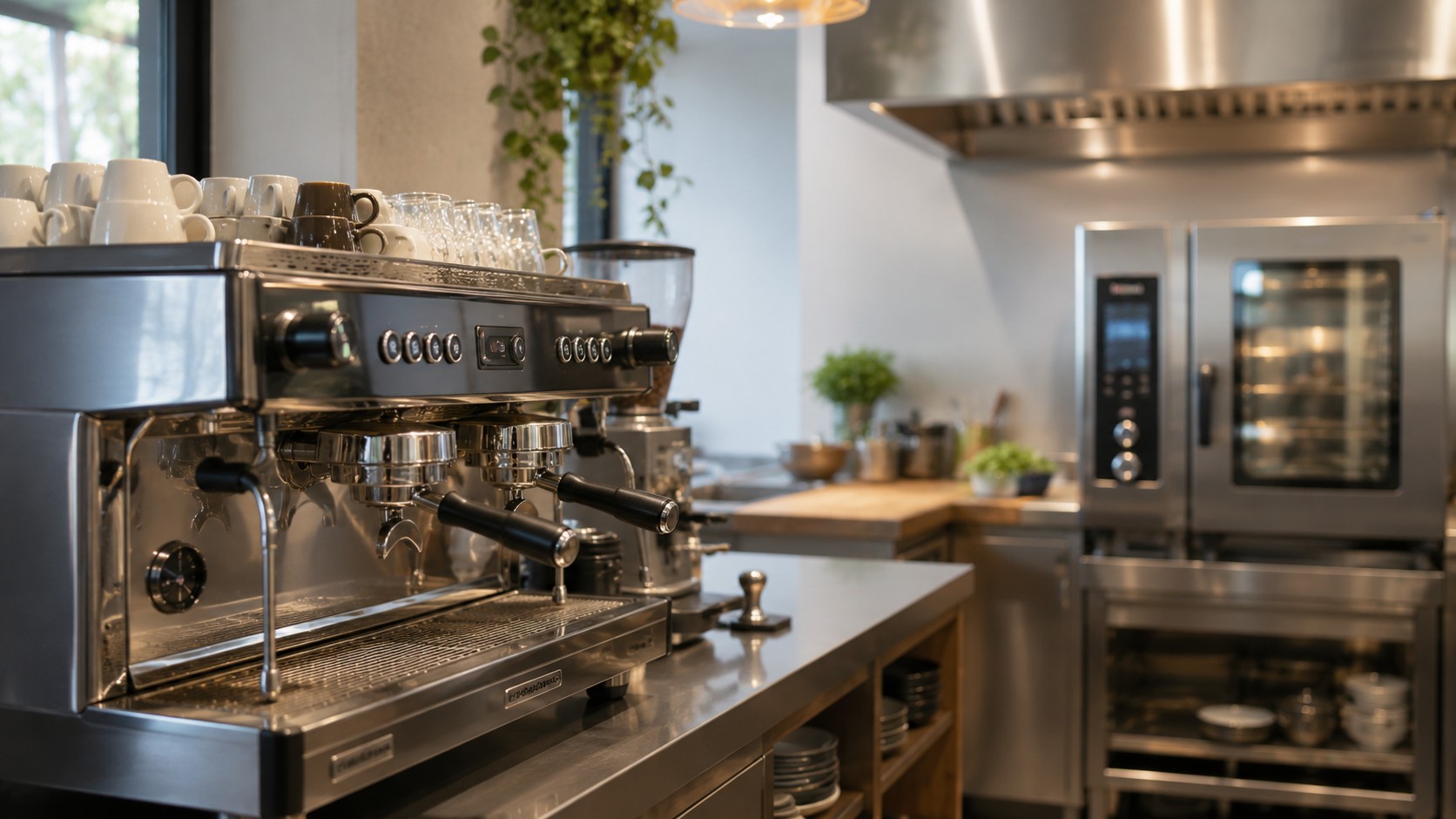
In a bakery or a restaurant, water feeds a chain of expensive, continuously used equipment: coffee machine, combi oven, dishwasher, ice machine, drink dispensers… Yet mains water, even when potable, is almost never ideal for these uses: too hard, sometimes too chlorinated, sometimes too rich in chlorides.
The result: scaling, breakdowns, excess energy use, altered flavours and premature failure. The good news: every problem has its solution, provided you treat the water precisely for each piece of equipment. Here's an overview.
1. Why water matters in a professional kitchen
Three reasons make water treatment essential in food service. First, product quality: a coffee, a tea, an ice cube, a stock… carry the taste of the water directly. Then equipment lifespan: scale and corrosion damage the most expensive appliances in the kitchen. Finally costs: excess energy, maintenance, breakdowns and downtime.
There is also the warranty dimension: many manufacturers make the warranty of their equipment (ovens, coffee machines) conditional on a precise water quality. Treating water also protects your investment.
2. The enemies of water in the kitchen
- Limescale (hardness): it scales ovens, coffee machines, dishwashers, ice makers and water heaters. A scale deposit not only insulates heating elements (excess consumption), it ends up blocking and breaking the appliances.
- Chlorine and chloramines: essential for the network, they alter the taste and smell of drinks and preparations · and also accelerate some corrosion.
- Chlorides: at high temperature (steam and combi ovens) they promote pitting corrosion of stainless steel. This is a critical, often underestimated point.
- Particles: sand, rust and fines clog and wear the solenoid valves and small passages of machines.
3. Equipment by equipment
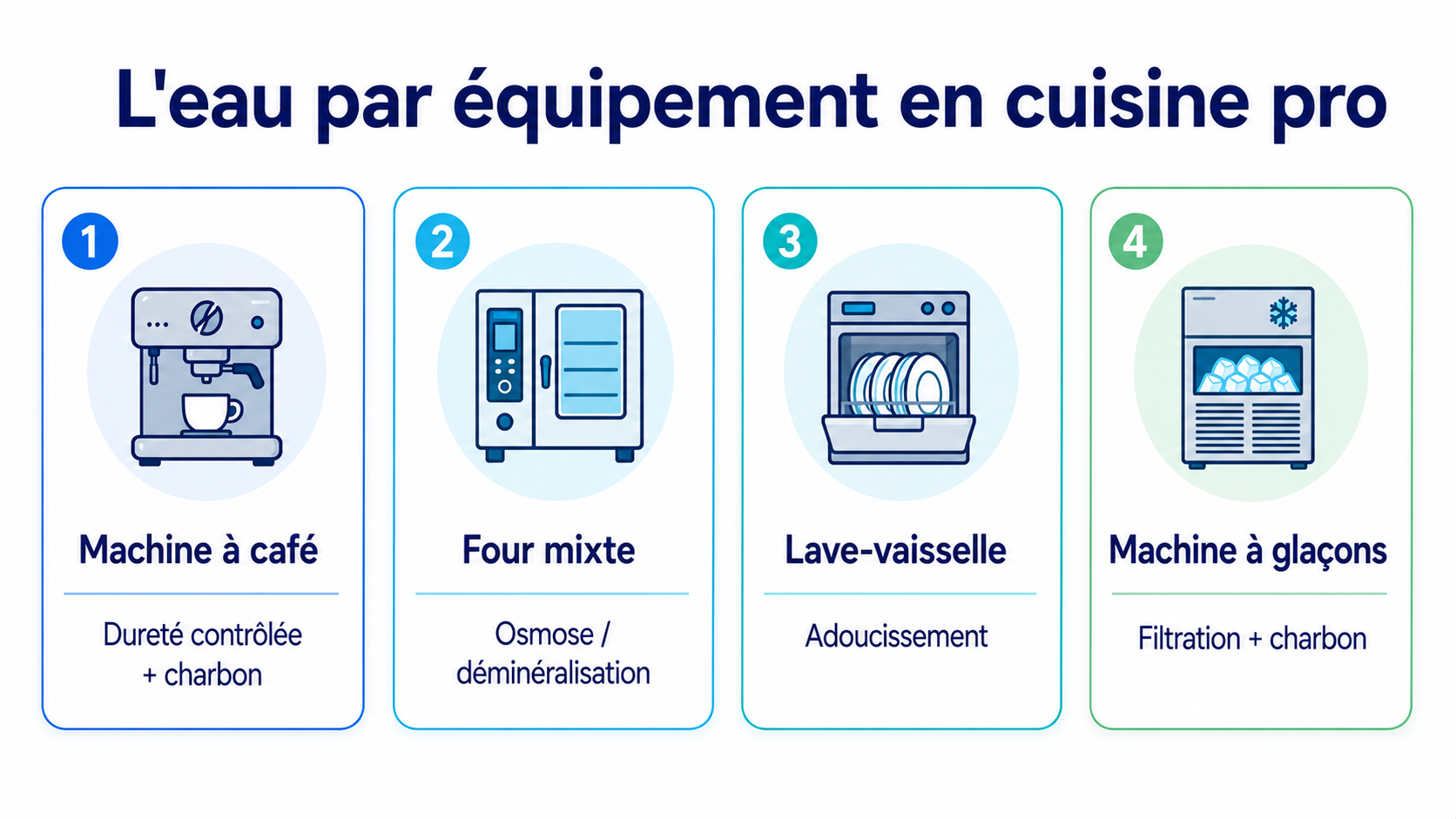
There is no universal treatment, but a need per appliance. The diagram below sums up the main requirements.
| Equipment | Main risk | Recommended treatment |
|---|---|---|
| Coffee / espresso machine | Scale + chlorine taste | Controlled hardness (decarbonation cartridge with bypass) + carbon |
| Combi / steam oven | Scale and chloride corrosion | Very low-mineral water: osmosis or demineralisation (per manufacturer spec) |
| Dishwasher | Scale, marks on dishes | Softening (soft water for spotless dishes) |
| Ice machine | Scale, taste, hygiene | Filtration + carbon (neutral clarity and taste) |
| Dispensers & drinks | Taste, microbiology | Carbon + fine filtration, UV if needed |
4. The treatment solutions
A few technical building blocks, combined as needed:
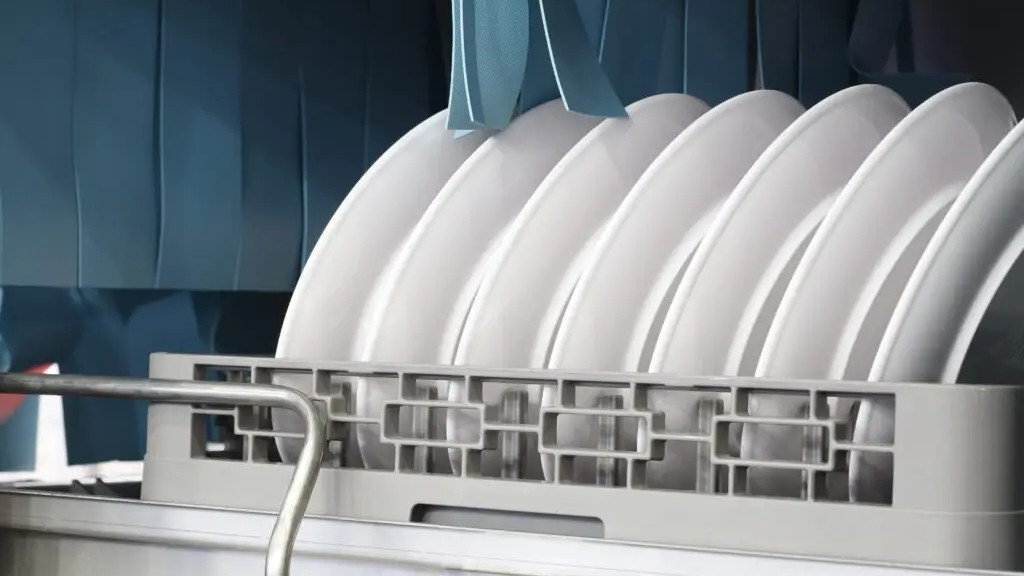
- Water softener: removes limescale by ion exchange. A well-sized central softener protects the whole kitchen (dishwasher, water heater, etc.) and simplifies maintenance.
- Decarbonation cartridges with adjustable bypass: for coffee machines, they reduce limescale while leaving a residual hardness useful for taste and extraction.
- Activated carbon: removes chlorine, tastes and odours · essential for coffee, tea, ice and drinks.
- Reverse osmosis: for combi ovens (and some high-end coffee machines), it sharply lowers hardness, TDS and chlorides.
- Sediment filtration & UV: to retain particles and secure microbiology where necessary.
5. The special case of coffee
Counter-intuitive but essential: for coffee, water must not be too soft. Fully demineralised water gives a flat coffee and can be aggressive. Aim for a controlled hardness · typically around 70 to 100 ppm total hardness · which protects the machine from scale while preserving extraction and aromas.
That is the whole point of bypass cartridges: they blend treated and raw water to precisely adjust residual hardness, and include carbon for chlorine.
6. The special case of the combi oven
The combi oven is the most demanding. It combines two risks: scaling of the steam generator and chloride corrosion, accelerated by heat. A simple softener is not always enough, because it does not remove chlorides.
The frequent answer is very low-mineral water obtained by reverse osmosis or demineralisation, sized according to the manufacturer's recommendations (each oven has its water-quality sheet: hardness, conductivity, chlorides, pH).
Always start from the manufacturer's sheet
Ovens and coffee machines specify a target water quality (hardness, conductivity/TDS, chlorides, pH). A local water test + these specs determine the right solution · and often condition the warranty.
DIMM solutions · food service & bakery
- Softeners (central or dedicated) for dishwashers and general protection.
- Coffee cartridges (decarbonation + carbon, adjustable bypass) and ice/drink filtration.
- RO units for combi ovens and demanding uses, + testing and sizing.
7. Who is this treatment for?
Bakeries & pastry shops
Ovens, coffee machines and washing-up: suitable treatment protects the equipment and stabilises quality, day after day.
Restaurants, hotels & institutions
Intensive kitchens, bars, breakfast rooms: the combination of softener + coffee filtration + oven osmosis secures operations and controls costs. Food-service installers and resellers find a real advisory lever here.
Conclusion: the right water, in the right place
In a bakery as in a restaurant, there is no single ideal water but several: soft for the dishwasher, controlled-hardness for coffee, very low-mineral for the combi oven, filtered and disinfected for ice and drinks. The right reflex: start from the water test and the manufacturer sheets, then size a treatment at the point of use. The payoff: better taste, longer-lasting equipment and controlled costs.
DIMM's teams support partner installers, distributors and resellers in choosing and sizing water-treatment solutions for food service and bakery, in France and Belgium.
Key points & references
- Limescale scales ovens, coffee machines, dishwashers and ice makers; scale increases energy use and causes breakdowns.
- Chlorine and chloramines alter taste; chlorides promote pitting corrosion of stainless steel, especially when hot (steam/combi ovens).
- Coffee: aim for controlled hardness (about 70-100 ppm), not fully demineralised water; bypass cartridge + carbon.
- Combi oven: very low-mineral water (osmosis / demineralisation) per the manufacturer's water-quality sheet.
- Dishwasher: softening; ice/drinks: filtration + carbon (± UV).