

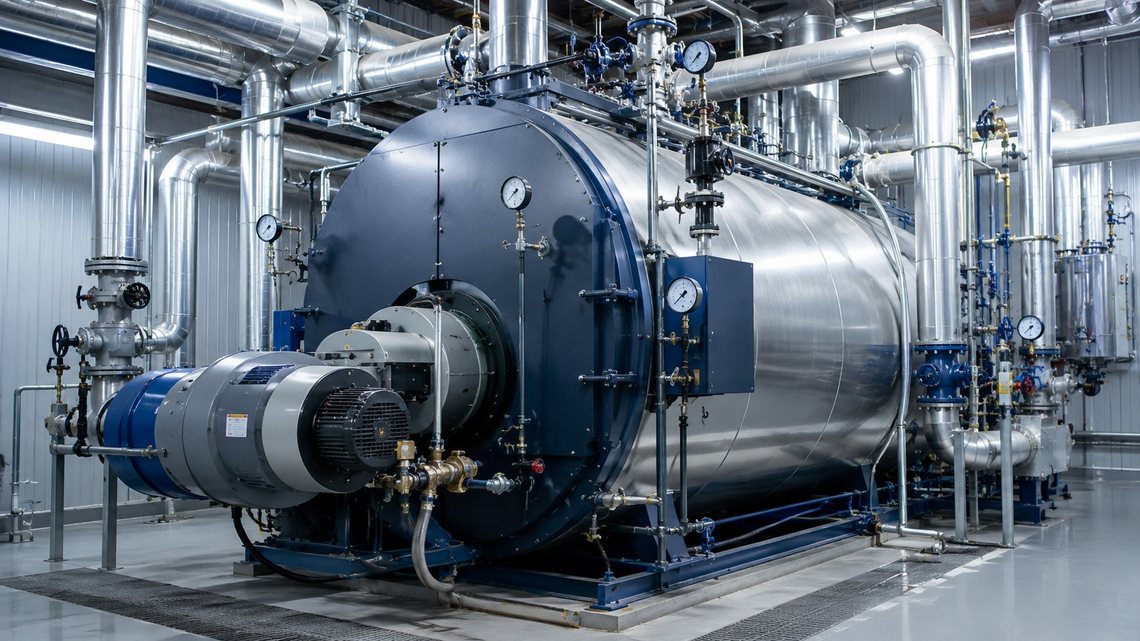
A boiler turns water into heat or pressurised steam: its heat-exchange surfaces work at high temperature, and the slightest impurity in the water has amplified consequences. Scale, corrosion and mineral carryover can cut efficiency, cause costly shutdowns and even lead to safety incidents.
That is why feedwater (make-up water + condensate) and boiler water are treated rigorously, within the framework of the manufacturer's specifications and the standards (e.g. EN 12953 for shell boilers). The same care applies to closed heating circuits. Here is how it works.
1. Why feedwater is critical
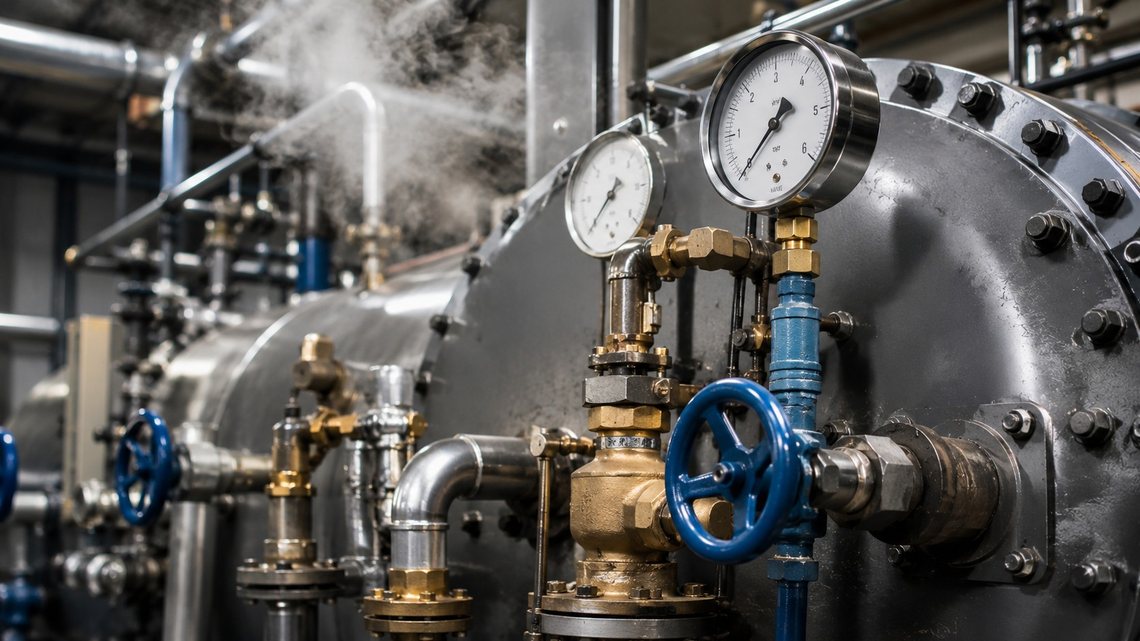
In a boiler, everything happens at the heat-exchange surfaces. Even a thin layer of scale acts as an insulator: more heat is needed (higher fuel consumption) and the metal overheats locally, which threatens the integrity of the tubes. On the corrosion side, dissolved gases attack the steel from the inside.
The stakes are threefold: energy efficiency, equipment lifespan and operational safety. Good water treatment is one of the best insurance policies a boiler room can have.
2. The three threats: scale, corrosion, carryover
Under the effect of temperature and concentration, boiler water concentrates three risks:
- Scale: dissolved salts (calcium, magnesium) precipitate on hot surfaces. Solution: remove hardness upstream (softening, demineralisation).
- Corrosion: dissolved oxygen and CO₂ attack the steel (pitting, attack on condensate lines). Solution: thermal deaeration + oxygen scavengers.
- Carryover (priming): at high salt concentration (TDS), salt-laden droplets leave with the steam and deposit salts on superheaters and equipment. Solution: blowdown.
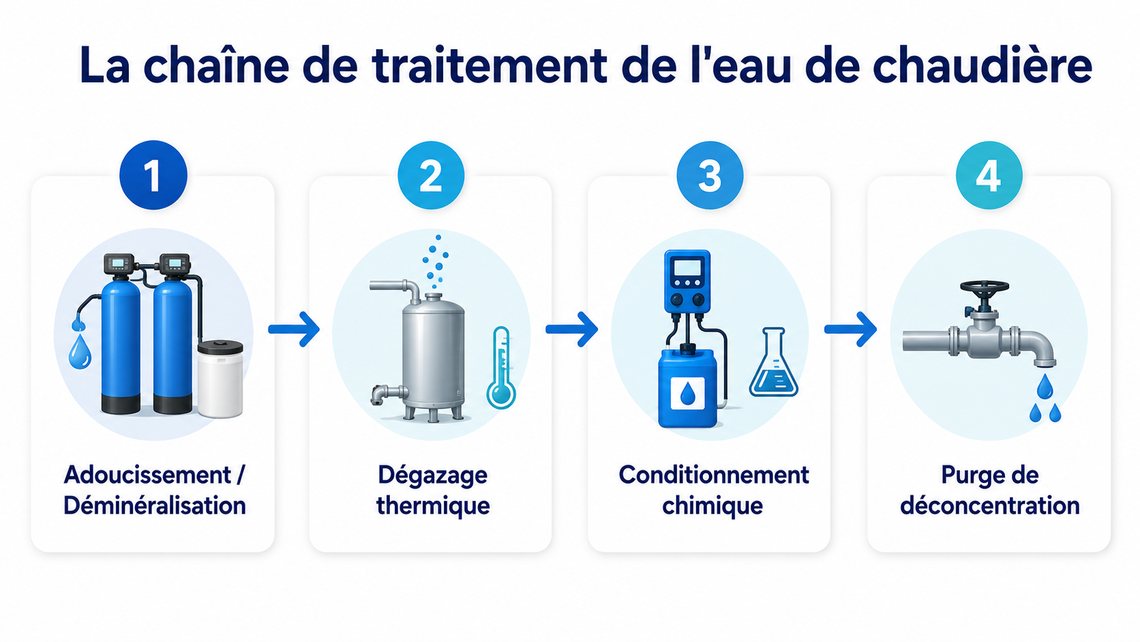
The response is organised as a coherent chain, from make-up water to blowdown:
3. Make-up water treatment
Make-up water compensates for losses (unrecovered steam, blowdown). It is treated according to the boiler's operating pressure:
- Softening (ion exchange): removes calcium and magnesium. The baseline, sufficient for many low and medium pressure boilers.
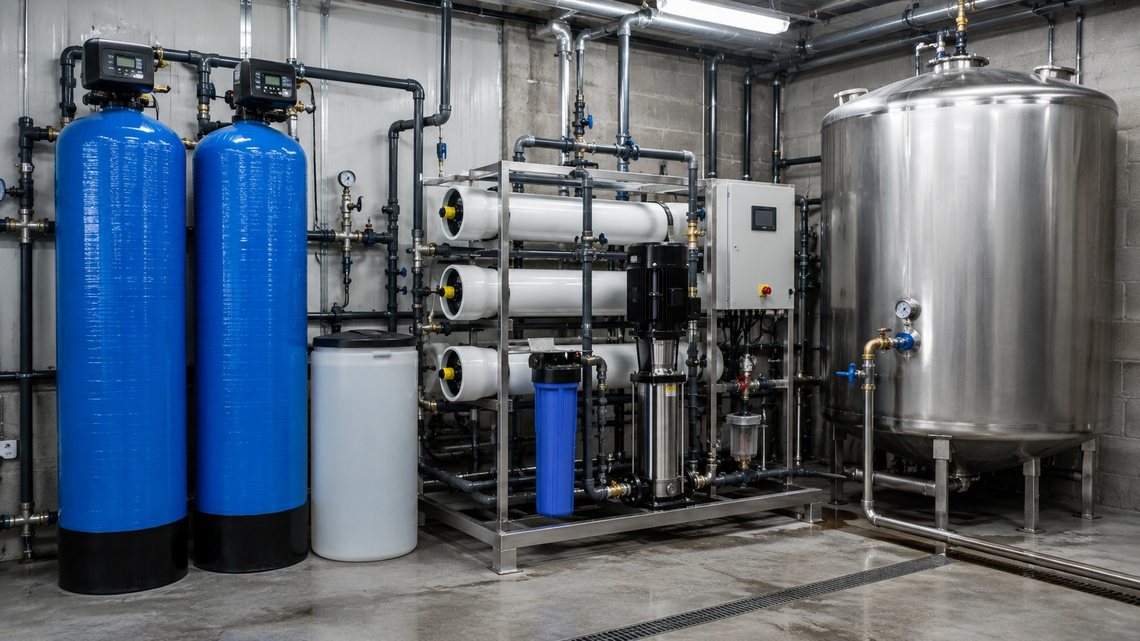
- Demineralisation / reverse osmosis: removes almost all dissolved salts (osmosis removes around 98% of salts), required as pressure and quality requirements rise.
- Thermal deaeration: a deaerating feed tank heats the water to drive out oxygen and CO₂ before it enters the boiler.
4. Chemical conditioning
Even when well treated, the water receives conditioning to secure the chemistry inside the boiler:
- Oxygen scavengers (reducing agents): eliminate traces of residual O₂ after deaeration.
- pH / alkalinity adjustment: maintains a protective, non-corrosive environment.
- Dispersants / antiscalants: keep any precipitates in suspension.
- Condensate treatment: amines (filming or neutralising) protect condensate return lines against CO₂ corrosion.
5. Blowdown
As steam escapes, salts concentrate in the boiler water. Beyond the limits set by the manufacturer (salt content / conductivity, alkalinity), part of the water must be drained to stay within range: this is blowdown, ideally controlled by conductivity so that only what is necessary is discharged.
Recovering heat from blowdown
Blowdown discharges hot pressurised water, and therefore energy. A heat recovery exchanger on the blowdown (and condensate return) significantly reduces the boiler room's energy bill.
6. Closed heating circuits
A closed heating circuit (hot water) is not renewed: the quality of the fill water is therefore decisive. Softened or demineralised water prevents scaling of generators and heat exchangers, while a corrosion inhibitor and a controlled pH protect the steel.
The typical enemy of closed circuits is magnetite sludge (black iron oxides), which clogs radiators, pumps and exchangers. Good practice: limit air ingress (high point, deaeration), filter (notably with a magnetic filter) and regularly check the quality of the circuit water.
DIMM solutions, boiler rooms & circuits
- Softening, osmosis & demineralisation for make-up water, depending on pressure.
- Deaeration, conditioning & condensate to control corrosion and chemistry.
- Fill water, inhibitors & filtration (magnetic) for closed circuits, plus analyses.
- Water softeners · Industrial reverse osmosis · Corrosion inhibitors · the full DIMM range
7. Standards & who this treatment is for
Industry, food processing, energy
Process steam, drying, sterilisation, process heating: water quality governs production and compliance. Treatment is sized according to operating pressure and the manufacturer's water quality sheet, in compliance with the applicable standards (EN 12953 and related).
Commercial buildings, public bodies & heat networks
Hospitals, large buildings, district heating networks: extensive circuits and costly equipment that need lasting protection through rigorous treatment and monitoring.
Conclusion: protect the water to protect the boiler room
Scale, corrosion, carryover: the boiler's three threats share the same origin, poorly prepared water. The answer is a coherent chain: treat the make-up water (softening, demineralisation), deaerate, condition the chemistry, blow down no more than necessary, and look after closed circuits. The result: efficiency, safety and equipment that lasts. The starting point remains the water analysis and the manufacturer's specification sheet.
DIMM's teams support installers, distributors and partner resellers in selecting and sizing water treatment solutions for industrial boilers and heating circuits, in France and Belgium.
Key facts & references
- Three threats: scale (salts precipitating when hot), corrosion (dissolved O₂/CO₂), carryover/priming (high TDS).
- Make-up water: softening (low/medium pressure); demineralisation / reverse osmosis (≈ 98% of salts) depending on operating pressure.
- Thermal deaeration to remove O₂ and CO₂; conditioning (O₂ scavengers, pH/alkalinity, dispersants, amines for condensate).
- Conductivity-controlled blowdown; heat recovery on blowdown and condensate.
- Closed circuits: treated fill water, corrosion inhibitor, magnetite control (magnetic filter).
- Sizing according to pressure and the manufacturer's water quality sheet; standards such as EN 12953.